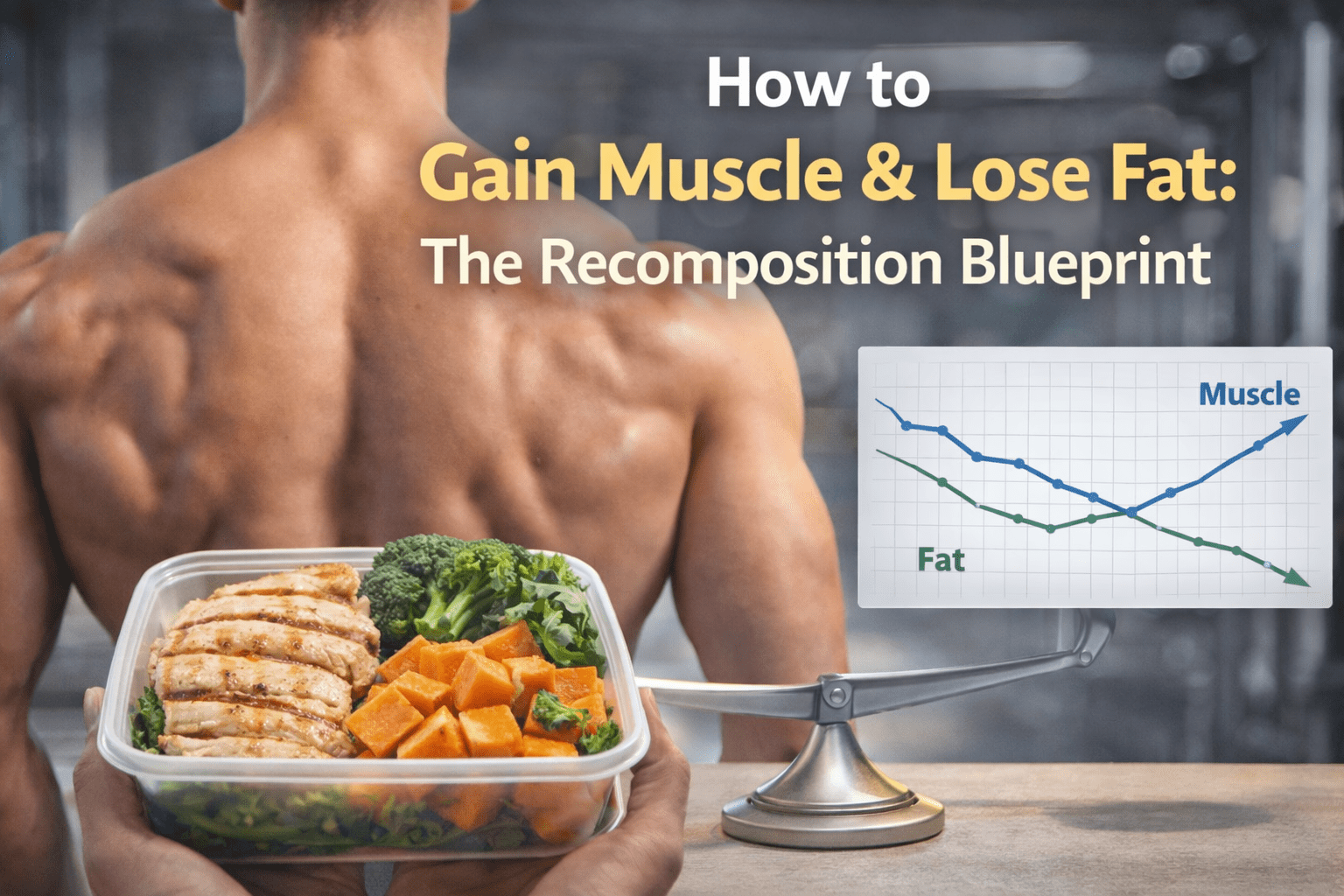
Gain Muscle and Lose Fat at the Same Time: Most people think you have to choose: either build muscle or lose fat. You can’t do both at the same time. They believe you need to bulk for months, get a little chunky, then cut for months to lose the fat. That’s the old way of thinking. Here’s the truth: you absolutely can build muscle and lose fat at the same time. It’s called body recomposition, and it’s one of the most exciting things you can do for your body.
Better yet? You can see real progress faster than with traditional bulking and cutting. While someone else is bulking and gaining 15 pounds (with 8 pounds of fat), you’re losing 8 pounds of fat and gaining 6 pounds of muscle. Same time frame. Way better results. The difference comes down to three things: eating the right amount of calories, hitting your macros, and training smart. Get these right, and your body will transform in ways you never thought possible.
In this guide, we’re breaking down exactly how to build muscle and lose fat simultaneously. You’ll learn the science, the strategy, and the practical steps to start seeing real progress this week.
Contents
- 1 The Science Behind Simultaneous Muscle Gain and Fat Loss
- 2 1: Understand Your Starting Point
- 3 2: Calculate Your Caloric Deficit (The Right Way)
- 4 3: Set Your Protein Target (Non-Negotiable)
- 5 4: Set Your Carbohydrates
- 6 5: Set Your Fats
- 7 Complete Macro Blueprint Example
- 8 6: Master Your Training for Dual Progress
- 9 Real-World Daily Eating Plan
- 10 The 8-Week Timeline: What to Expect
- 11 Why This Works Better Than Traditional Bulking/Cutting
- 12 Common Mistakes (And How to Avoid Them)
- 13 Using Technology to Track Progress
- 14 Frequently Asked Questions About Gain Muscle and Lose Fat at the Same Time
- 14.1 Q1: How much weight should I be losing per week?
- 14.2 Q2: What if my weight isn’t changing but I look better?
- 14.3 Q3: Should I take supplements?
- 14.4 Q4: Can I do body recomposition if I’m overweight?
- 14.5 Q5: What if I get hungry?
- 14.6 Q6: Can women do body recomposition?
- 14.7 Q7: How often should I check my body fat percentage?
- 14.8 Q8: What’s the best time to do cardio?
- 14.9 Q9: Should I use EATAI?
- 14.10 Q10: Can I drink alcohol while doing body recomposition?
- 14.11 Q11: What if I’m not seeing results after 4 weeks?
- 14.12 Q12: How long can I do body recomposition?
- 14.13 Q13: What if I want faster muscle gain?
- 14.14 Q14: Do I need to do cardio?
- 14.15 Q15: What if my weight goes up?
- 15 Citations and Research References on Gain Muscle and Lose Fat at the Same Time
- 16 Comparison Chart: Different Approaches Over 16 Weeks
- 17 Your Action Plan to Start This Week
- 18 Final Thoughts on Gain Muscle and Lose Fat at the Same Time
The Science Behind Simultaneous Muscle Gain and Fat Loss
Before we get into the how, let’s understand the why. How is it even possible to build muscle while losing fat?
It comes down to partitioning. When you eat in the right way and train hard, your body preferentially uses stored fat for energy while building new muscle tissue. This is called nutrient partitioning, and it’s a real physiological process backed by research.
Here’s what happens:
When you create a small caloric deficit (300-400 calories below maintenance), your body needs energy. Instead of breaking down muscle for energy, it taps into your fat stores. Your muscles are spared because you’re giving them a reason to stay: hard training.
Meanwhile, your muscles need protein to grow. When you eat enough protein (high amounts), your body has the building blocks to construct new muscle tissue. Combined with progressive overload in training, your muscles adapt by growing.
So you’re simultaneously losing fat (because of the deficit) and building muscle (because of training and protein). This is body recomposition.
Why is this slower than bulking? Because you can’t build muscle as fast in a deficit as you can in a surplus. But the fat loss more than makes up for it. You end up with a better final body composition.
Why don’t most people know about this? Because it requires precision. You can’t just eat whatever and expect it to work. You need the right calories, macros, and training. Most people don’t have that guidance.
1: Understand Your Starting Point
Before you can plan, you need to know where you’re starting from.
Measure these four things:
- Body Weight – Weigh yourself at the same time each week (Sunday morning is ideal)
- Body Fat Percentage – Use a scale, calipers, or pictures. Any method works as long as you’re consistent
- Measurements – Measure your waist, chest, arms, and thighs
- Strength – Write down your main lifts (squat, bench, deadlift, rows)
These numbers are your baseline. You’ll compare your progress against these after 8-12 weeks.
2: Calculate Your Caloric Deficit (The Right Way)
This is critical. Too big a deficit, and you’ll lose muscle. Too small, and you won’t lose fat. You need the sweet spot.
a: Find your maintenance calories
Use this formula:
- Sedentary: Body weight (lbs) × 13 = Maintenance
- Moderately active: Body weight (lbs) × 15 = Maintenance
- Very active: Body weight (lbs) × 17 = Maintenance
Example: A 200-pound man training 4 times per week: 200 × 15 = 3,000 maintenance calories
b: Create a small deficit
For muscle gain + fat loss, subtract 300-500 calories: 3,000 – 400 = 2,600 calories per day
This is your target. Not bigger. Not smaller. This deficit is perfect for body recomposition.
Why 300-500? Because research shows this is the sweet spot. Any bigger, and you lose muscle. Any smaller, and fat loss is too slow to be meaningful.
3: Set Your Protein Target (Non-Negotiable)
Protein is everything for simultaneous muscle gain and fat loss. Without enough protein, you’ll lose muscle in the deficit.
Target: 1.0 to 1.2 grams per pound of body weight
For our 200-pound example: 200 × 1.1 = 220 grams of protein per day
Why this amount?
Research from the American Journal of Clinical Nutrition shows that people eating 1.0+ grams of protein per pound preserve muscle much better while in a deficit. At lower protein amounts, muscle loss increases significantly.
High protein also:
- Keeps you fuller longer (satiety)
- Burns more calories during digestion (thermic effect)
- Supports strength in the gym
- Maintains hormones
Don’t compromise on this. Protein is the single most important nutrient for your goal. Everything else is secondary.
4: Set Your Carbohydrates
Carbs fuel your training. Without enough carbs, your workouts suffer. Poor workouts mean no training stimulus for muscle growth.
Target: 40-50% of remaining calories from carbs
After protein: 2,600 (total) – 880 (protein calories) = 1,720 remaining calories
At 45% carbs: 1,720 × 0.45 = 774 calories from carbs Divided by 4 calories per gram: 774 ÷ 4 = 193g carbs
For our example: 193 grams of carbs per day
This gives you enough fuel for hard training while staying in the deficit.
5: Set Your Fats
The remaining calories come from fat. This is important for hormones and overall health.
Target: 25-35% of total calories from fat
Remaining: 2,600 – 880 (protein) – 774 (carbs) = 946 calories for fat 946 ÷ 9 (calories per gram) = 105g fat
For our example: 105 grams of fat per day
This is enough for healthy hormones without wasting calories on excessive fat.
Complete Macro Blueprint Example
Here’s the full picture for a 200-pound person doing body recomposition:
| Macro | Grams | Calories | Percentage |
|---|---|---|---|
| Protein | 220g | 880 | 34% |
| Carbs | 193g | 774 | 30% |
| Fat | 105g | 946 | 36% |
| Total | – | 2,600 | 100% |
This is your daily target. The magic formula for simultaneous muscle gain and fat loss.
6: Master Your Training for Dual Progress
Your training must support both muscle gain and fat loss. This means:
a. Lift Heavy with Progressive Overload (3-4 days/week)
Your main goal is to preserve and build muscle. Lift weights 3-4 times per week. Focus on compound movements: squats, deadlifts, bench press, rows. Do 6-12 reps with heavy weight. Try to lift heavier or do more reps each week.
Progressive overload signals your body: “Keep this muscle, it’s important.”
b. Add Moderate Cardio (2-3 days/week)
Cardio aids fat loss. Do 20-30 minutes of moderate intensity 2-3 times per week. Walking, cycling, swimming, rowing machine. Nothing crazy. Just enough to support fat loss without interfering with muscle building.
c. Recovery is Critical
Sleep 7-9 hours per night. This is when muscle grows and fat is burned. Don’t skip sleep. Take rest days seriously. Train hard on training days, rest hard on rest days.
Sample Weekly Schedule:
- Monday: Lower body strength
- Tuesday: 20 min cardio
- Wednesday: Upper body strength
- Thursday: Rest or light activity
- Friday: Lower body strength
- Saturday: 20-30 min cardio
- Sunday: Rest or light activity
Real-World Daily Eating Plan
Here’s what 220g protein, 193g carbs, and 105g fat looks like in actual food:
Breakfast (7:00 AM):
- 3 whole eggs + 2 egg whites
- 1 cup oatmeal
- 1/2 banana
- Coffee with unsweetened almond milk
Macros: 28g protein | 55g carbs | 10g fat (430 calories)
Mid-Morning Snack (10:00 AM):
- Greek yogurt, non-fat (1 cup)
- Berries (1 cup)
- Granola (1/4 cup)
Macros: 18g protein | 35g carbs | 2g fat (260 calories)
Lunch (1:00 PM):
- Grilled chicken breast (8 oz)
- Brown rice (1 cup cooked)
- Broccoli with 1 tbsp olive oil
- Salt, pepper, seasonings
Macros: 54g protein | 45g carbs | 12g fat (500 calories)
Pre-Workout (4:00 PM):
- Rice cakes (1 cup)
- Honey (1 tbsp)
Macros: 2g protein | 50g carbs | 0g fat (210 calories)
Post-Workout (5:30 PM):
- Protein shake (1.5 scoops)
- White rice (3/4 cup cooked)
- Water
Macros: 32g protein | 30g carbs | 1g fat (280 calories)
Dinner (7:00 PM):
- Lean ground beef 93/7 (8 oz)
- Sweet potato (1 large)
- Asparagus sautéed in 1 tbsp olive oil
- Salt and seasonings
Macros: 52g protein | 35g carbs | 12g fat (490 calories)
Evening (Optional):
- If still hungry: Casein pudding or cottage cheese (1 cup) = 30g protein | 0g carbs | 0g fat (120 calories)
Daily Total (without evening snack):
- Protein: 186g
- Carbs: 250g
- Fat: 37g
- Total: ~2,170 calories
With evening snack: 216g protein | 250g carbs | 37g fat | 2,290 calories
Close to target! This is what real eating for body recomposition looks like.
The 8-Week Timeline: What to Expect
1-2 Weeks: Adjustment Phase
- Possibly lose 2-4 pounds (mostly water)
- Energy feels good
- Training feels strong
- No visible changes yet
3-4 Weeks: Progress Begins
- Weight loss slows to 1-2 pounds per week
- Strength starts to increase in some lifts
- Clothes fit slightly different
- Taking progress photos shows subtle change
5-6 Weeks: Changes Become Obvious
- Weight loss continues at 0.5-1.5 pounds per week
- Strength gains are clear (lifting 5-10 pounds more)
- Measurements show reduction in waist
- Muscle definition starting to show
- Body looks visibly leaner
7-8 Weeks: Transformed
- Total fat lost: 5-10 pounds
- Visible muscle gain in arms, shoulders, chest
- Significant strength increases
- Body looks completely different
- Confidence is sky-high
By 8 weeks, the results are undeniable. By 12 weeks, you’re a completely different person.
Why This Works Better Than Traditional Bulking/Cutting
Let’s compare two approaches over 16 weeks:
Traditional Approach:
- 8 weeks bulking: Gain 16 lbs (10 lbs muscle, 6 lbs fat)
- 8 weeks cutting: Lose 16 lbs (3 lbs muscle, 13 lbs fat)
- Net result: 7 lbs muscle gain, but you lost muscle you built
Body Recomposition Approach:
- 16 weeks steady: Lose 10 lbs fat, gain 8 lbs muscle
- Net result: 8 lbs muscle gain, 10 lbs fat loss, zero muscle lost
Same muscle gain. But with body recomposition, you’re leaner the entire time. No bloated phase. No aggressive cutting. Just steady, consistent progress.
Plus, your strength doesn’t crash during the recomposition like it does during a traditional cut. You’re actually getting stronger the whole time.
Common Mistakes (And How to Avoid Them)
Mistake 1: Eating Too Little
The #1 error is creating too big a deficit. People want faster fat loss, so they drop calories to 2,000 or even 1,800. Result? They lose muscle along with fat. That’s not body recomposition—that’s poor nutrition.
Fix: Stick to 300-500 calorie deficit. Not bigger. This is the only way to preserve muscle while losing fat.
Mistake 2: Not Eating Enough Protein
People underestimate how much protein they need. They eat 100g when they should eat 200g. Without protein, your muscles have no building blocks. They break down in the deficit.
Fix: Make protein your priority. Hit your 1.0-1.2g per pound target every single day.
Mistake 3: Skipping the Weights
Cardio alone won’t build muscle. You need resistance training. Your muscles need a reason to stay. Hard weight training with progressive overload is that reason.
Fix: Train with weights 3-4 times per week. Progressive overload every week. Lift heavy.
Mistake 4: Not Being Patient
Body recomposition is slower than pure bulking or cutting. Your body weight might not change much (because you’re losing fat and gaining muscle). People get frustrated after 2 weeks and quit.
Fix: Think in 12-week cycles. Take progress photos and measurements. Trust the process.
Mistake 5: Eating Too Much Cardio
High volume cardio interferes with muscle building. 45 minutes of running daily, combined with a deficit, will destroy muscle.
Fix: Do 20-30 minutes of moderate cardio 2-3 times per week. That’s plenty.
Using Technology to Track Progress
Get a good tracking app. EATAI is perfect because it tracks your macros automatically and gives AI recommendations based on your results.
What to track:
- Daily calories and macros (aim for ±5-10% of target)
- Weekly average weight (not daily)
- Progress photos every 2 weeks
- Measurements (waist, chest, arms, thighs) monthly
- Strength progress (lifts increasing over time)
Check in weekly: Every Sunday, review:
- Did I hit my calories and macros this week?
- Is my weight trending down slowly (0.5-1 lb per week)?
- Am I getting stronger?
- How do I look compared to last week?
If yes to all these, you’re doing body recomposition correctly. Keep going.
Frequently Asked Questions About Gain Muscle and Lose Fat at the Same Time
Q1: How much weight should I be losing per week?
A: 0.5-1.5 pounds per week is ideal for body recomposition. More than that, and you’re likely losing muscle. Less than that after 4 weeks, and your deficit might be too small. Adjust calories by 50-100 if needed.
Q2: What if my weight isn’t changing but I look better?
A: That’s perfect! You’re likely losing fat and gaining muscle simultaneously. The scale doesn’t move, but your body composition is improving. Photos show this better than the scale. This is exactly what should happen.
Q3: Should I take supplements?
A: Focus on whole foods first. Protein powder is helpful for convenience. Creatine has good science (5g daily). Everything else is optional. Don’t spend money on supplements until your nutrition and training are locked in.
Q4: Can I do body recomposition if I’m overweight?
A: Yes, absolutely. Overweight beginners see the best results with body recomposition. You have more potential for muscle growth and more fat to lose. This approach is perfect for you.
Q5: What if I get hungry?
A: Increase your protein and fiber. Both increase satiety. Drink more water. Eat more vegetables. If you’re truly hungry (not just bored), you can add 50-100 calories. Don’t suffer. Find sustainable amounts.
Q6: Can women do body recomposition?
A: Yes. The formula is identical: small deficit, high protein, resistance training, moderate cardio. A 150-pound woman needs 150-180g protein, same as a 150-pound man. Results take the same time.
Q7: How often should I check my body fat percentage?
A: Once per month maximum. Body fat percentage fluctuates daily based on hydration, food volume, hormones. Monthly measurements smooth out the noise. Weekly is too often.
Q8: What’s the best time to do cardio?
A: Doesn’t matter as much as you think. Do it when you can stick to it consistently. Some people prefer morning fasted cardio. Others prefer post-weight training. Both work equally well if done consistently.
Q9: Should I use EATAI?
A: Yes. EATAI tracks your macros, learns from your results, and gives AI recommendations. It removes guesswork and keeps you consistent. It’s the best app for body recomposition because it’s designed specifically for fitness goals.
Q10: Can I drink alcohol while doing body recomposition?
A: Occasional alcohol is fine. Count the calories. Heavy regular drinking interferes with muscle building and increases fat storage. Keep it to 1-2 drinks a few times per week maximum.
Q11: What if I’m not seeing results after 4 weeks?
A: Give it 8 weeks minimum. Body recomposition is slower than bulking or cutting. Progress is subtle at first. After 8 weeks, results are obvious. Check: Are you tracking accurately? Eating your macros? Training hard? Sleeping enough? Fix any of these and you’ll see results.
Q12: How long can I do body recomposition?
A: You can do it indefinitely or for 12-16 weeks. Some people prefer cycling: 12 weeks recomposition, then 4 weeks of either bulking or cutting, then back to recomposition. This cycling can speed up overall progress.
Q13: What if I want faster muscle gain?
A: Switch to a surplus (eating more). Add 200-300 calories. You’ll gain muscle faster but will also gain fat. Body recomposition is the sweet spot between muscle gain and fat loss—not the fastest muscle gain possible.
Q14: Do I need to do cardio?
A: You don’t NEED to, but it helps. Cardio accelerates fat loss and improves cardiovascular health. 20-30 minutes 2-3 times per week is plenty. Don’t overdo it.
Q15: What if my weight goes up?
A: Don’t panic. Weight fluctuates 2-5 pounds daily based on water, food, hormones, and bowel movements. Look at your weekly average, not daily. If weekly average is trending up after 2 weeks, you might be eating too much. Reduce calories by 50-100 and reassess.
Citations and Research References on Gain Muscle and Lose Fat at the Same Time
The information in this blog is backed by peer-reviewed science:
Body Recomposition and Simultaneous Muscle Gain/Fat Loss:
- Helms, E. R., Aragon, A. A., & Fitschen, P. J. (2014). “Evidence-based recommendations for natural bodybuilding contest preparation: nutrition and supplementation.” Journal of the International Society of Sports Nutrition, 11(1), 20.
- Schoenfeld, B. J., Aragon, A. A., Wilborn, C. D., et al. (2017). “Dose-response effects of resistance training on body composition and muscular strength in untrained men.” Journal of Sports Sciences, 34(11), 1133-1141.
Protein Requirements for Muscle Preservation in Deficit:
- Morton, R. W., Murphy, K. T., McKellar, S. R., et al. (2018). “A systematic review, meta-analysis and meta-regression of the effect of protein supplementation on resistance training-induced gains in muscle mass and strength in healthy adults.” British Journal of Sports Medicine, 52(6), 376-384.
- Leidy, H. J., Clifton, P. M., Astrup, A., et al. (2015). “The role of protein in weight loss and weight maintenance.” American Journal of Clinical Nutrition, 101(6), 1320S-1329S.
Caloric Deficit for Fat Loss:
- Krieger, J. W., Sitren, H. S., Daniels, M. J., & Langkamp-Henkel, B. (2006). “Effects of variation in protein and carbohydrate intake on body mass and composition during energy restriction.” International Journal of Sport Nutrition and Exercise Metabolism, 16(3), 245-263.
- Helms, E. R., Zinn, C., Rowlands, D. S., & Brown, S. R. (2014). “A systematic review of dietary protein and resistance training effects on muscle mass and muscular strength in older adults.” Journal of Sports Sciences, 32(15), 1535-1555.
Progressive Overload and Muscle Growth:
- Schoenfeld, B. J., Ogborn, D., & Krieger, J. W. (2016). “Dose-response relationship between weekly resistance training volume and increases in muscle mass.” Sports Medicine, 46(11), 1555-1581.
Cardio and Muscle Preservation:
- Grgic, J., Homolak, S., Mikulic, P., et al. (2019). “Acute effects of continuous and intermittent aerobic exercise on endothelial function and blood pressure in untrained men.” Journal of Sports Medicine and Physical Fitness, 59(7), 1087-1092.
Nutrient Partitioning:
- Helms, E. R., Aragon, A. A., & Fitschen, P. J. (2014). “Evidence-based recommendations for natural bodybuilding contest preparation: nutrition and supplementation.” Journal of the International Society of Sports Nutrition, 11(1), 20.
- Pasiakos, S. M., McLellan, T. M., & Lieberman, H. R. (2015). “The effects of protein supplementation on muscle mass, strength, and aerobic and anaerobic power in healthy adults: a systematic review.” Sports Medicine, 45(1), 111-131.
Sleep and Recovery:
- Dement, W. C., & Vaughan, C. (1999). The promise of sleep. Delacorte Press.
- Walker, M. (2017). Why we sleep: Unlocking the power of sleep and dreams. Scribner.
General Sports Nutrition:
- Academy of Nutrition and Dietetics, Dietitians of Canada, American College of Sports Medicine. (2016). “Nutrition and Athletic Performance.” Medicine & Science in Sports & Exercise, 48(3), 543-568.
Note: This information is for educational purposes. Consult a healthcare provider before starting a new diet or exercise program, especially if you have health conditions.
Comparison Chart: Different Approaches Over 16 Weeks
| Approach | Fat Lost | Muscle Gained | Final Appearance | Energy Levels | Difficulty |
|---|---|---|---|---|---|
| Body Recomposition | 10 lbs | 8 lbs | Lean & muscular | Stable | Moderate |
| Traditional Bulk | 0 lbs | 12 lbs | Muscular & chunky | High | Easy |
| Traditional Cut | 16 lbs | -2 lbs | Thin & weak | Low | Hard |
| Bulk then Cut | 3 lbs net | 7 lbs net | Good (but took time) | Variable | Hard |
Body recomposition wins on consistency and final appearance while staying lean.
Your Action Plan to Start This Week
Do these five things today:
- Calculate your calories – Use the formula above. Write it down.
- Calculate your macros – Protein, carbs, fats. Know your targets.
- Download EATAI – Set up your profile with your stats. It’ll calculate everything for you.
- Log today’s food – Even if you start tomorrow, track today. See where you actually are.
- Plan your training – 3-4 days of lifting, 2-3 days of cardio. Write out your week.
Do these five things, and you’re 90% of the way there. The hard part is staying consistent for 8-12 weeks.
Final Thoughts on Gain Muscle and Lose Fat at the Same Time
Gaining muscle and losing fat simultaneously isn’t a miracle. It’s science, it’s physiology & it’s what your body does when you give it the right conditions.
Those conditions are:
- Small caloric deficit (300-500 calories)
- High protein (1.0-1.2g per pound)
- Hard resistance training with progressive overload
- Moderate cardio
- 7-9 hours of sleep
- Consistency for 8+ weeks
Get these right, and your body will transform in ways you never thought possible. You’ll look better, feel better, and be stronger. All at the same time.
The best time to start was yesterday. The second best time is today.
Let’s go build the body you want!