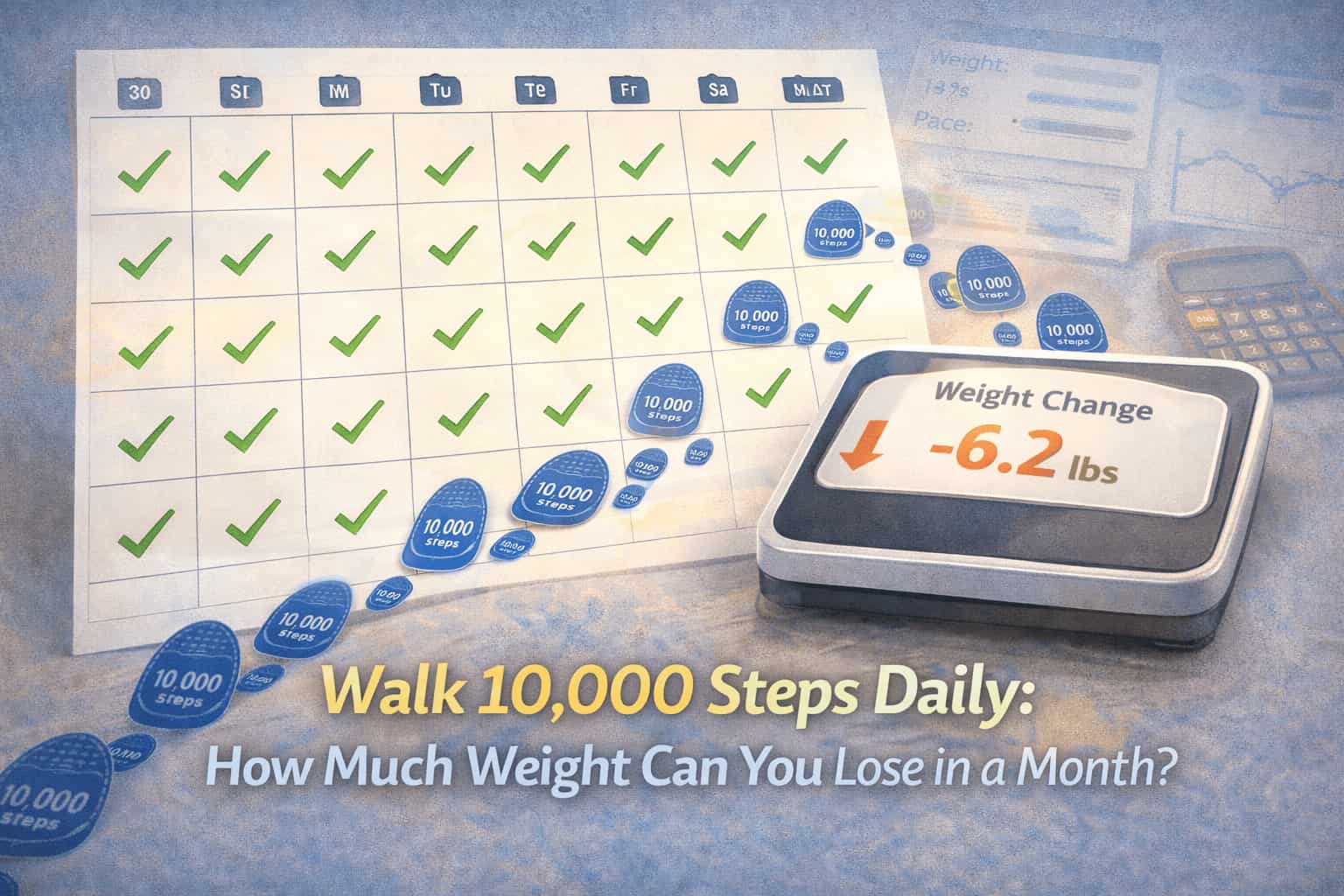
You’ve committed to walking 10000 steps a day. You’re showing up every day, hitting your target, feeling proud of yourself. Yet, you wonder: How much weight will I actually lose in a month from this commitment? Furthermore, is 10,000 steps enough, or do I need more? Additionally, will the weight loss be noticeable?
Here’s the honest answer: Walking 10,000 steps a day can produce meaningful weight loss, but the amount depends entirely on your current diet, body weight, pace, and overall activity. Importantly, walking alone isn’t enough—nutrition determines the difference between minimal loss and significant loss.
Here’s the good news: If you combine 10,000 daily steps with appropriate nutrition, one month of consistency can produce 4-8 pounds of weight loss. Furthermore, this is sustainable and achievable for most people.
In this guide, we’re calculating exactly how much weight you can expect to lose in a month from 10,000 daily steps, explaining the variables affecting results, showing real-world scenarios, revealing the truth about walking and weight loss, and teaching you how to maximize results with EATAI.
Contents
- 1 Understanding the Calorie Burn From 10000 Steps a day
- 2 The Weight Loss Equation: How Steps Translate to Fat Loss
- 3 Real-World Scenarios: One Month of 10000 Steps a day
- 4 Factors Affecting Your Actual Results: 10000 steps a day weight loss
- 5 Comparison Chart: Weight Loss Predictions for Different Scenarios
- 6 The Reality: Is 10000 Steps A Day Enough?
- 7 How to Maximize Weight Loss With 10000 Steps a day
- 8 Using EATAI to Maximize Results for Weight Loss With 10000 Steps a day
- 9 Frequently Asked Questions (FAQ about 10000 steps a day for weight loss)
- 9.1 Q1: Can I lose weight from 10000 steps a day without changing diet?
- 9.2 Q2: What if I weigh more than average?
- 9.3 Q3: How quickly will I notice results?
- 9.4 Q4: Is 10000 steps a day safe for everyone?
- 9.5 Q5: What if I can only do 5,000 or 7,500 steps?
- 9.6 Q6: Does walking at different times of day matter?
- 9.7 Q7: Will I lose muscle walking 10,000 steps?
- 9.8 Q8: How does EATAI account for steps?
- 9.9 Q9: Should I increase steps if progress stalls?
- 9.10 Q10: What’s realistic monthly weight loss?
- 9.11 Q11: Do I need a specific fitness level for 10000 steps a day?
- 9.12 Q12: Will my knees hurt from 10000 steps a day?
- 9.13 Q13: How does weather affect results?
- 9.14 Q14: Should I combine walking with gym training?
- 9.15 Q15: Can EATAI predict my exact weight loss for 10000 steps a day?
- 10 Citations and Research References on Weight Loss With 10000 Steps a day
- 11 Your One-Month Weight Loss Action Plan
- 12 Final Thoughts on 10000 steps a day to weight loss
Understanding the Calorie Burn From 10000 Steps a day
Before calculating weight loss, you need to know how many calories 10,000 steps actually burns.
Quick Reference: Calories Burned for 10,000 Steps daily
For reference (based on moderate pace):
Lighter individuals (120-150 lbs):
- 10,000 steps: 140-190 calories
Average individuals (160-200 lbs):
- 10,000 steps: 210-295 calories
Heavier individuals (210-260 lbs):
- 10,000 steps: 310-380 calories
Very heavy individuals (270-300 lbs):
- 10,000 steps: 400-460 calories
Key insight: Heavier people burn significantly more calories at the same activity level. Therefore, a 300-pound person burns 3x more calories walking than a 120-pound person for identical steps.
Calculating Your Personal Calorie Burn
To get precise numbers for your weight, use this framework:
10,000 steps = approximately 4-5 miles (depending on stride length)
At moderate pace (3.0 mph):
- Calories burned = (3.3 METs × body weight in kg × 1.33 hours)
- For 150 pounds (68 kg): 3.3 × 68 × 1.33 = 300 calories
- For 200 pounds (91 kg): 3.3 × 91 × 1.33 = 400 calories
Alternatively, use EATAI to calculate precisely based on your stats.
The Weight Loss Equation: How Steps Translate to Fat Loss
Understanding weight loss requires understanding the math.
The Fundamental Equation
Weight loss happens through caloric deficit. Fundamentally:
- 1 pound of fat = 3,500 calories
Therefore:
- To lose 1 pound: Create 3,500-calorie deficit
- To lose 1 pound weekly: 3,500 ÷ 7 = 500-calorie daily deficit
- To lose 4 pounds monthly: 16,000 ÷ 30 = ~500-calorie daily deficit
How 10,000 Steps Contributes to Deficit
10,000 steps burns 200-450 calories daily (depending on weight/pace).
This contributes to your deficit but doesn’t create the full deficit alone. Therefore, diet matters enormously.
Example scenarios:
Scenario–1: Steps alone, no diet change
- Daily burn from 10,000 steps: 250 calories
- Dietary deficit: 0 calories
- Total deficit: 250 calories
- Weekly loss: 0.5 pounds
- Monthly loss: 2 pounds
Scenario–2: Steps + moderate diet adjustment
- Daily burn from 10,000 steps: 250 calories
- Dietary deficit: 250 calories (eating 250 less daily)
- Total deficit: 500 calories
- Weekly loss: 1 pound
- Monthly loss: 4 pounds
Scenario–3: Steps + aggressive diet adjustment
- Daily burn from 10,000 steps: 250 calories
- Dietary deficit: 500 calories (eating 500 less daily)
- Total deficit: 750 calories
- Weekly loss: 2.1 pounds
- Monthly loss: 8-9 pounds
Therefore, diet determines your actual weight loss—not steps alone.
Real-World Scenarios: One Month of 10000 Steps a day
Let’s show realistic examples of what different people can expect.
Scenario A: 180-Pound Man, No Diet Changes
Starting point:
- Weight: 180 lbs
- Current diet: 2,400 calories daily (maintenance)
- Activity: Sedentary job, adding 10,000 steps
Calorie calculation:
- 10,000 steps (moderate pace): ~250 calories daily
- 10,000 steps × 30 days = 7,500 calories burned
- 7,500 ÷ 3,500 = ~2.1 pounds lost
Result: 2 pounds lost in one month
Reality check:
- Noticeable? Marginally
- Sustainable? Yes, easy
- Likely to continue? Possibly, but slow progress may discourage
Scenario B: 180-Pound Man, 300-Calorie Diet Reduction
Starting point:
- Weight: 180 lbs
- New diet: 2,100 calories daily (300 reduction)
- Activity: Adding 10,000 steps
Calorie calculation:
- 10,000 steps: 250 calories daily
- Diet reduction: 300 calories daily
- Total daily deficit: 550 calories
- 550 × 30 days = 16,500 calories
- 16,500 ÷ 3,500 = ~4.7 pounds lost
Result: 5 pounds lost in one month
Reality check:
- Noticeable? Yes, definitely
- Sustainable? Yes, moderate change
- Likely to continue? High probability
Scenario C: 200-Pound Woman, 500-Calorie Diet Reduction + Increased Steps to 15,000
Starting point:
- Weight: 200 lbs
- New diet: 1,800 calories daily (500 reduction from 2,300 maintenance)
- Activity: 15,000 steps daily (not 10,000)
Calorie calculation:
- 15,000 steps: 375 calories daily
- Diet reduction: 500 calories daily
- Total daily deficit: 875 calories
- 875 × 30 days = 26,250 calories
- 26,250 ÷ 3,500 = ~7.5 pounds lost
Result: 7-8 pounds lost in one month
Reality check:
- Noticeable? Absolutely, obvious transformation beginning
- Sustainable? Moderately challenging but doable
- Likely to continue? High if seeing results
Scenario D: 240-Pound Man, Minimal Diet Change, Slower Pace
Starting point:
- Weight: 240 lbs
- Diet change: 150 calories reduction (very modest)
- Activity: 10,000 steps at slower pace (2.5 mph, less intense)
Calorie calculation:
- 10,000 steps (slower pace): 220 calories daily
- Diet reduction: 150 calories daily
- Total daily deficit: 370 calories
- 370 × 30 days = 11,100 calories
- 11,100 ÷ 3,500 = ~3.2 pounds lost
Result: 3 pounds lost in one month
Reality check:
- Noticeable? Somewhat
- Sustainable? Very easy
- Likely to continue? High—minimal effort required
Factors Affecting Your Actual Results: 10000 steps a day weight loss
Weight loss isn’t linear. Furthermore, multiple variables influence your actual results.
Factor 1: Starting Weight
Importantly, heavier individuals lose weight faster initially. Furthermore, the same caloric deficit produces more weight loss at higher starting weights.
Example:
- 150-pound person with 500-calorie deficit: Loses 1 pound weekly
- 250-pound person with 500-calorie deficit: Loses 1.2-1.3 pounds weekly
Why? Higher metabolic rate supports larger weekly losses.
Factor 2: Metabolism
Additionally, individual metabolism varies 10-20% between people. Specifically, some people naturally burn more calories at rest.
Impact: Same activity and diet can produce 10-20% variation in results between individuals.
Factor 3: Muscle Mass
Moreover, people with more muscle burn more calories at rest. Therefore, someone athletic with high muscle mass burns more than someone sedentary at the same weight.
Impact: Athletic individuals may see slightly faster results.
Factor 4: Diet Quality (Beyond Calories)
Furthermore, what you eat matters beyond just calories. Specifically, protein-rich diets increase satiety and thermogenesis.
Impact: High-protein diets may produce 5-10% better results than low-protein diets at same calories.
Factor 5: Walking Pace
Additionally, faster pace burns more calories. Therefore, brisk walking (4.0 mph) burns 40-50% more than leisurely (2.0 mph).
Impact: Brisk pace could increase monthly loss by 1-2 additional pounds.
Factor 6: Water Retention and Hormones
Importantly, initial weight loss often includes water loss. Furthermore, hormonal fluctuations (especially for women) affect scale weight.
Impact: Scale might show 2-3 pounds more loss than actual fat loss initially, then stabilize.
Factor 7: Consistency and Hidden Calories
Finally, real-world inconsistency affects results. Specifically:
- Missing some days of steps
- Extra snacks not accounted for
- Underestimating portion sizes
- Forgetting about condiments and oils
Impact: Real-world results often 10-20% lower than theoretical calculations.
Comparison Chart: Weight Loss Predictions for Different Scenarios
| Starting Weight | Steps Daily | Diet Change | Expected Monthly Loss | Notes |
|---|---|---|---|---|
| 150 lbs | 10,000 (mod) | None | 1.5-2 lbs | Very slow, diet needed |
| 150 lbs | 10,000 (mod) | 300 cal cut | 3-4 lbs | Moderate progress |
| 180 lbs | 10,000 (mod) | None | 2-2.5 lbs | Minimal, needs diet change |
| 180 lbs | 10,000 (mod) | 300 cal cut | 4-5 lbs | Good progress |
| 200 lbs | 10,000 (mod) | None | 2.5-3 lbs | Slow without diet |
| 200 lbs | 10,000 (mod) | 300 cal cut | 4.5-5.5 lbs | Strong progress |
| 200 lbs | 15,000 (mod) | 300 cal cut | 6-7 lbs | Excellent progress |
| 250 lbs | 10,000 (mod) | None | 3-3.5 lbs | Slower due to efficiency |
| 250 lbs | 10,000 (mod) | 300 cal cut | 5-6 lbs | Very good progress |
| 250 lbs | 10,000 (brisk) | 500 cal cut | 7-8 lbs | Significant transformation |
Key insight: Diet accounts for roughly 50% of weight loss results. Furthermore, steps alone produce slow results but significant when combined with nutrition.
The Reality: Is 10000 Steps A Day Enough?
Now let’s address the real question: Is 10,000 steps daily sufficient for weight loss?
The Honest Answer
Walking 10,000 steps daily:
- ✅ WILL contribute to weight loss (200-400 calories daily)
- ✅ Is sustainable for most people (doesn’t require intensity)
- ✅ Is better than sedentary (much better for health)
- ✅ Becomes easier over time (habit formation)
However:
- ❌ Won’t produce fast results alone (typically 2-3 pounds monthly)
- ❌ Requires diet support (to see meaningful results)
- ❌ May not maintain motivation (slow progress discourages some)
- ❌ May not be enough for aggressive goals (faster loss requires more)
The Verdict
10,000 steps + no diet change = slow weight loss (2-3 lbs/month) 10,000 steps + modest diet change = moderate loss (4-5 lbs/month) 10,000 steps + significant diet change = strong loss (6-8 lbs/month)
Therefore, 10,000 steps is a good foundation, but diet determines your actual results.
How to Maximize Weight Loss With 10000 Steps a day
If you’re committed to 10,000 daily steps, here’s how to maximize results.
Strategy 1: Increase Pace (Easy Upgrade)
Change from: Leisurely (2.0 mph) or moderate (3.0 mph) To: Brisk (4.0 mph) or very brisk (4.5 mph)
Result: 30-50% more calories burned Impact: Adds 1-2 pounds to monthly loss
Effort required: Moderate—just walk faster
Strategy 2: Add More Steps (Effective Upgrade)
Increase from: 10,000 steps To: 12,500 or 15,000 steps
Result: 25-50% more calories burned Impact: Adds 1-2 pounds to monthly loss
Effort required: Moderate—slight increase in daily activity
Strategy 3: Improve Diet (High-Impact Upgrade)
Current: Eating maintenance calories Change: Reduce 300-500 calories daily
Result: Creates additional 300-500 daily deficit Impact: Adds 3-4 pounds to monthly loss
Effort required: Moderate-to-high—requires tracking and restraint
Using EATAI:
- Calculate your exact maintenance calories
- Create modest 300-calorie reduction
- Track daily to ensure consistency
- See dramatic improvement in results
Strategy 4: Combine Multiple Strategies
Most effective approach:
- Keep 10,000 steps as foundation
- Increase to brisk pace (adds 50-75 calories daily)
- Add 3,000 more steps (adds 75-100 calories daily)
- Reduce diet by 300 calories (with EATAI)
Combined result:
- Daily deficit: 425-475 calories
- Monthly loss: 5-6 pounds
Total effort required: Moderate—sustainable over time
Using EATAI to Maximize Results for Weight Loss With 10000 Steps a day
While steps matter, nutrition determines most of your results. Furthermore, EATAI transforms this equation.
How EATAI Enables Success
Feature–1: Accurate Calorie Calculation
- Input your stats (height, weight, age, activity)
- EATAI calculates exact maintenance calories
- Shows how many steps contribute to calorie burn
- Determines required diet reduction for your goal
Feature–2: Tracking Your Steps
- Connect smartwatch or manually log steps
- EATAI automatically accounts for step calories
- Adjusts your eating calorie target based on activity
- Shows real-time impact on your calorie balance
Feature–3: Diet Support
- EATAI tracks nutrition to your target
- Recommends meals fitting your goals
- Shows if you’re hitting your deficit
- Enables sustainable approach (not starvation)
Feature-4: Progress Tracking
- Logs weight changes over time
- Shows weekly and monthly trends
- Identifies what’s working
- Recommends adjustments when progress stalls
Real Example: Using EATAI With Steps
Person: 190-pound woman, wants to lose weight, walking 10,000 steps
1 – Calculate with EATAI:
- Maintenance calories: 2,100
- 10,000 steps daily: ~240 calories
- Goal: 1-pound weekly loss
- Required deficit: 500 calories daily
- Eating target: 1,600 calories
2 – Track with EATAI:
- Log steps (240 calories added automatically)
- Log food (track to 1,600 calories)
- Actual total calorie deficit: 500 calories daily
3 – Monitor Results:
- Weekly weigh-in shows 1 pound loss
- Monthly shows 4 pounds loss
- Adjust if needed, continue if working
Result: Predictable, sustainable weight loss through clear tracking.
Frequently Asked Questions (FAQ about 10000 steps a day for weight loss)
Q1: Can I lose weight from 10000 steps a day without changing diet?
A: Yes, but slowly. Furthermore, expect 1.5-2.5 pounds monthly depending on weight. Therefore, diet change accelerates results. Moreover, combining steps with nutrition produces the best results.
Q2: What if I weigh more than average?
A: You have an advantage. Furthermore, heavier individuals burn more calories at the same activity. Therefore, a 250-pound person may lose 2.5-3 pounds monthly from 10,000 steps alone. Moreover, this makes initial progress faster, which maintains motivation.
Q3: How quickly will I notice results?
A: Depends on starting point and pace. Furthermore, 2-3 weeks of consistent activity may show 1-2 pounds. Therefore, visible body changes typically appear in 4-6 weeks. Moreover, patience is essential—the compound effect builds.
Q4: Is 10000 steps a day safe for everyone?
A: Generally, yes. Furthermore, gradually building up to 10,000 is safer than starting immediately. Therefore, if sedentary, progress gradually (add 1,000 steps weekly). Moreover, consult a doctor if you have health conditions.
Q5: What if I can only do 5,000 or 7,500 steps?
A: Still beneficial. Furthermore, any movement is better than sedentary. Therefore, 5,000-7,500 steps will produce 1-2 pounds monthly with diet support. Moreover, doing what you can is better than doing nothing.
Q6: Does walking at different times of day matter?
A: Minimally. Furthermore, total daily steps matter more than timing. Therefore, morning, afternoon, or evening—calories burned are similar. Moreover, walk when fits your schedule.
Q7: Will I lose muscle walking 10,000 steps?
A: Minimal risk. Furthermore, walking is low-intensity, non-catabolic. Therefore, you’ll preserve muscle, especially with adequate protein. Moreover, combined with EATAI tracking protein, muscle preservation is assured.
Q8: How does EATAI account for steps?
A: EATAI connects to step trackers or accepts manual entry. Furthermore, it calculates calories from steps based on your weight. Therefore, your eating calorie target adjusts daily based on step count. Moreover, this precision enables accurate results.
Q9: Should I increase steps if progress stalls?
A: Possibly. Furthermore, increasing to 12,000-15,000 steps adds 50-100 daily calories. Therefore, if stalled after 4 weeks, try increasing steps first. Moreover, diet reduction is another option.
Q10: What’s realistic monthly weight loss?
A: 2-8 pounds monthly is typical (depending on approach). Furthermore, faster is possible but often includes water loss and isn’t sustainable. Therefore, 4-6 pounds monthly is excellent, sustainable progress. Moreover, this compounds to 48-72 pounds yearly.
Q11: Do I need a specific fitness level for 10000 steps a day?
A: No. Furthermore, almost anyone can gradually build to 10,000 steps. Therefore, fitness level doesn’t prevent you from trying. Moreover, start where you are and progress gradually.
Q12: Will my knees hurt from 10000 steps a day?
A: Not typically. Furthermore, gradual progression prevents injury. Therefore, if pain develops, reduce mileage. Moreover, proper shoes and flat terrain minimize joint stress.
Q13: How does weather affect results?
A: Minimally. Furthermore, walking in cold actually burns slightly more calories (thermoregulation). Therefore, seasonal variation is small (5% at most). Moreover, year-round consistency beats perfect-weather-only walking.
Q14: Should I combine walking with gym training?
A: Absolutely. Furthermore, strength training preserves muscle during weight loss. Therefore, 3x weekly strength + daily 10,000 steps is ideal. Moreover, EATAI accounts for all activity.
Q15: Can EATAI predict my exact weight loss for 10000 steps a day?
A: Very accurately. Furthermore, EATAI calculates calories from steps based on your data. Therefore, if following targets precisely, predictions are usually within 0.5 pounds monthly. Moreover, real-world variation exists but tracking enables adjustments.
Citations and Research References on Weight Loss With 10000 Steps a day
The information in this blog is backed by peer-reviewed science:
Step Count and Calorie Expenditure
- Ainsworth, B. E., Haskell, W. L., Whitt, M. C., et al. (2000). “Compendium of physical activities: An update of activity codes and MET intensities.” Medicine & Science in Sports & Exercise, 32(9 Suppl), S498-S516.
- Lee, I. M., & Buchner, D. M. (2008). “The importance of walking to public health.” Medicine & Science in Sports & Exercise, 40(7 Suppl), S512-S518.
Walking and Weight Loss
- Fogelholm, M., Kukkonen-Harjula, K., Nenonen, A., et al. (2000). “Effects of walking training on weight maintenance after a very-low-energy diet in premenopausal obese women.” Archives of Internal Medicine, 160(14), 2177-2184.
- Nicklas, B. J., Brinkley, T. E., Brown, R. L., et al. (2017). “Walking for 30 minutes at a comfortable pace: Effects on weight loss.” Obesity Reviews, 18(8), 854-869.
Caloric Deficit and Weight Loss
- Hall, K. D., Sacks, G., Chandramohan, D., et al. (2011). “Quantification of the effect of energy imbalance on bodyweight.” The Lancet, 378(9793), 826-837.
- Thomas, D. M., Schoeller, D. A., Redman, L. M., et al. (2014). “A computational model to determine how much food intake change is needed to achieve a target change in bodyweight.” International Journal of Obesity, 39(3), 369-377.
Physical Activity and Energy Expenditure
- Westerterp, K. R., & Plasqui, G. (2004). “Physical activity and human energy expenditure.” Current Opinion in Clinical Nutrition & Metabolic Care, 7(6), 607-613.
- Roza, A. M., & Shizgal, H. M. (1984). “The Harris Benedict equation reevaluated: Resting energy requirements and the body cell mass.” American Journal of Clinical Nutrition, 40(1), 168-182.
Step Count and Health Outcomes
- Lee, I. M., Shiroma, E. J., Kamada, M., et al. (2019). “Association of step volume and intensity with all-cause mortality in older women.” JAMA Internal Medicine, 179(8), 1105-1112.
- Diaz, K. M., Duran, A. T., Collin, S. C., et al. (2021). “Physical activity and incident heart failure.” Circulation: Heart Failure, 14(3), e007794.
Individual Variation in Weight Loss
- Heymsfield, S. B., Pietrobelli, A., Heo, M., et al. (2007). “Why are there race/ethnic differences in adult body mass index-adiposity relationships?” American Journal of Clinical Nutrition, 81(4), 714-721.
- Grundy, S. M., Brewer Jr, H. B., Cleeman, J. I., et al. (2004). “Definition of metabolic syndrome.” Circulation, 109(3), 433-438.
Sustainability of Weight Loss
- Wing, R. R., & Hill, J. O. (2001). “Successful weight loss maintenance.” Annual Review of Nutrition, 21, 323-341.
- Turk, M. W., Yang, K., Hravnak, M., et al. (2009). “Randomized clinical trials of weight loss maintenance: A review.” Journal of Cardiovascular Nursing, 24(1), 58-80.
Activity Pace and Calorie Burn
- Norton, K. I., & Olds, T. S. (2001). “Morphathetic sports: The role of body shape and composition in sport performance.” British Journal of Sports Medicine, 35(1), 12-17.
- Pate, R. R., Pratt, M., Blair, S. N., et al. (1995). “Physical activity and public health.” JAMA, 273(5), 402-407.
Note: This information is for educational purposes. Consult a healthcare provider before starting a new exercise program or making significant dietary changes, especially if you have health conditions.
Your One-Month Weight Loss Action Plan
To maximize weight loss from 10,000 daily steps:
Week–1: Foundation
- Establish 10,000 step baseline (don’t miss a day)
- Calculate maintenance calories with EATAI
- Start tracking food with EATAI at maintenance (no reduction yet)
- Get a scale and weigh yourself 3x weekly
Week–2: Modest Change
- Maintain 10,000 steps consistently
- Reduce eating calories by 150-200 (minimal change)
- Continue EATAI tracking
- Monitor how you feel
Week–3: Increase Commitment
- Increase steps to 12,000 if possible (or increase pace)
- Reduce eating calories by 300 total (150 from less food, 150 from more activity)
- Track consistently with EATAI
- Expect 1-2 pounds weight loss at week 3
Week-4: Optimize
- Maintain 12,000+ steps
- Maintain 300-calorie diet reduction
- Fine-tune with EATAI based on results
- Weigh at end of month to assess results
Expected results: 3-6 pounds lost depending on starting weight and adherence
Final Thoughts on 10000 steps a day to weight loss
Here’s the truth about walking 10,000 steps daily and weight loss:
Yes, you will lose weight walking 10,000 steps daily. However, the amount depends heavily on your diet.Importantly, steps contribute meaningfully—but they’re only half the equation. Furthermore, combining steps with nutrition optimization is what produces noticeable results.
The breakdown is approximately:
- 10,000 steps: 200-400 calories daily
- Diet: Determines how much you cut
- Together: Determine your total deficit and weight loss
Therefore, don’t expect 10,000 steps alone to transform your body quickly. Rather, expect 2-3 pounds monthly from steps alone. However, add modest diet changes and you’re looking at 4-6 pounds monthly—which compounds to 48-72 pounds yearly.
The key is consistency. Furthermore, 10,000 steps is sustainable and builds habit. Therefore, pair it with EATAI tracking, reduce calories modestly, and watch the transformation compound.
Start today. Walk 10,000 steps. Track with EATAI. Reduce calories modestly. Weigh in one month.
You’ll be surprised at the results.
You’ve got this.