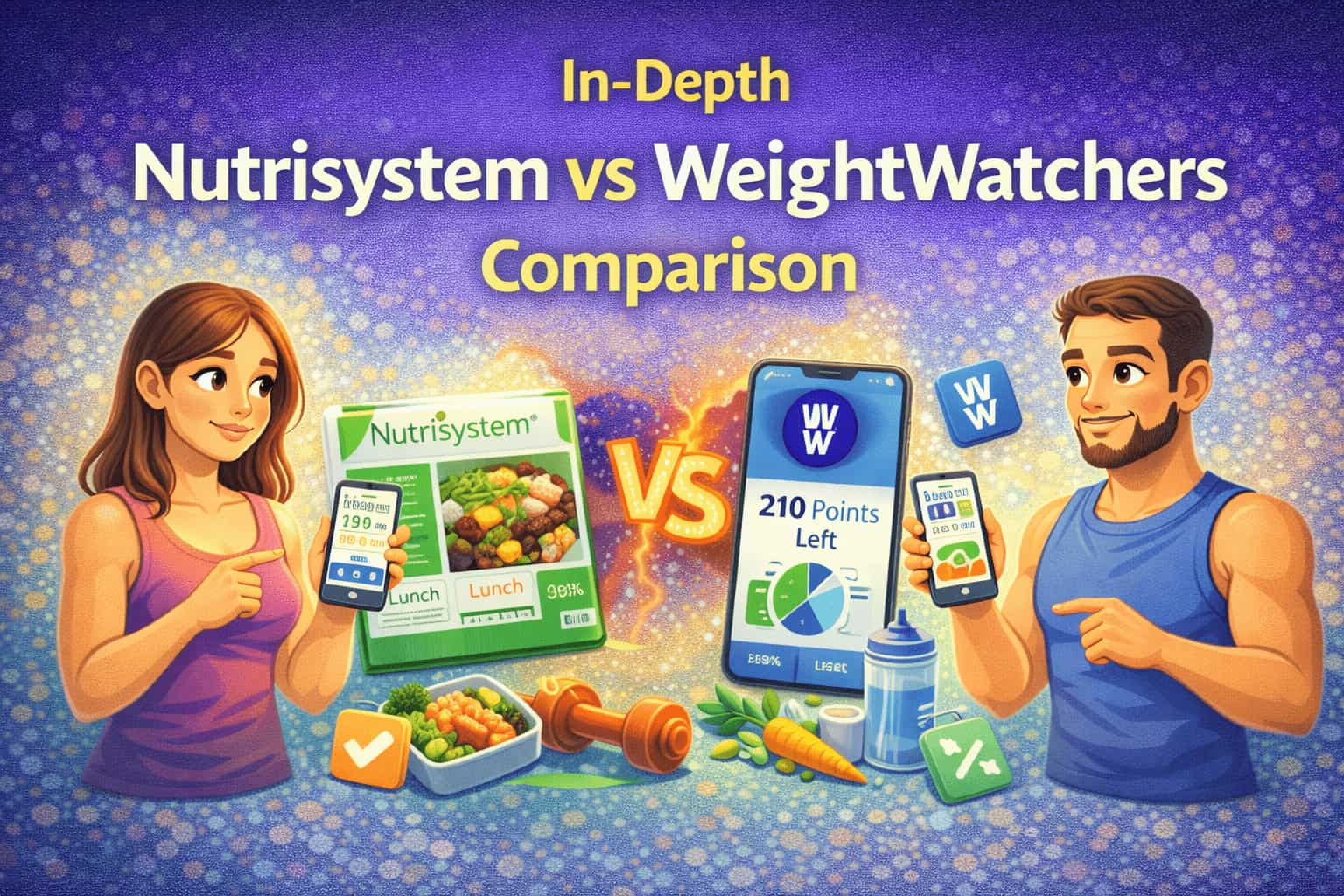
Are you trying to decide between Nutrisystem and WeightWatchers for your weight loss journey? Do you want to know which program delivers better results for your lifestyle and budget? Both Nutrisystem and WeightWatchers rank among America’s most popular weight loss programs, but they take fundamentally different approaches. This comprehensive comparison analyzes every aspect of both programs and introduces EATAI as a modern, free alternative that eliminates the limitations of both paid plans.
Contents
- 1 Quick Comparison Overview on Nutrisystem vs WeightWatchers
- 2 Complete Head-to-Head Comparison on Nutrisystem vs WeightWatchers
- 3 The Modern Free Alternative: EATAI
- 4 Who Should Choose Each Program?
- 5 Frequently Asked Questions About In-Depth Nutrisystem vs WeightWatchers Comparison
- 6 Which is better for weight loss: Nutrisystem or WeightWatchers?
- 7 How much does Nutrisystem vs WeightWatchers cost per month?
- 8 Can you eat your own food on Nutrisystem?
- 9 Is Nutrisystem or WeightWatchers better for long-term weight maintenance?
- 10 Do you have to cook with WeightWatchers?
- 11 Which program has better food: Nutrisystem or WeightWatchers?
- 12 Can you lose weight faster on Nutrisystem or WeightWatchers?
- 13 Is there a free alternative to Nutrisystem and WeightWatchers?
- 14 Conclusion on In-Depth Nutrisystem vs WeightWatchers Comparison
- 15 References on In-Depth Nutrisystem vs WeightWatchers Comparison
Quick Comparison Overview on Nutrisystem vs WeightWatchers
| Feature | Nutrisystem | WeightWatchers | EATAI |
|---|---|---|---|
| Approach | Pre-packaged meals delivered | Points-based DIY tracking | AI photo tracking |
| Monthly Cost | $300-495 | $23-54 | FREE |
| Food Included | Yes – most meals | No – buy your own | N/A – track any food |
| Meal Prep Required | Minimal – heat & eat | Yes – cook all meals | N/A |
| Flexibility | ★★☆☆☆ Limited variety | ★★★★★ Eat anything | ★★★★★ Track anything |
| Learning Curve | ★★★★★ Very easy | ★★★☆☆ Moderate | ★★★★★ Instant |
| Long-Term Sustainability | ★★☆☆☆ | ★★★★☆ | ★★★★★ |
| Community Support | Online forums | Meetings + workshops | Check app |
| Expert Ratings | 3.3/5 (U.S. News) | 3.8/5 (U.S. News) | N/A |
| Average Weight Loss | 7 lbs first week, then 1-2 lbs/week | 1-2 lbs/week (3.5x more than DIY) | Depends on deficit |
| Best For | Busy people who hate cooking | DIY dieters wanting flexibility | Everyone |
Complete Head-to-Head Comparison on Nutrisystem vs WeightWatchers
Program Philosophy and Approach
Nutrisystem: The Meal Delivery Solution
Nutrisystem started in 1972 as a brick-and-mortar operation and has since become one of the leading providers of prepared meals for weight loss. The core concept is simple: eliminate the guesswork by delivering portion-controlled, pre-packaged meals directly to your door.
You receive 28 days of food shipments including breakfast, lunch, dinner, snacks, and desserts. Nutrisystem provides approximately 60% of your daily calorie intake through their meals, while you supplement with fresh fruits, vegetables, lean proteins, and low-fat dairy from your grocery store (the remaining 40%).
The program emphasizes high-protein foods with low glycemic indexes to control hunger and stabilize blood sugar. This approach proves particularly beneficial for people with type 2 diabetes – Nutrisystem D (their diabetes-specific plan) has clinical studies showing participants lost 16 times more weight than those following typical hospital-directed diets.
WeightWatchers: The Flexible Points System
WeightWatchers, currently the largest commercial weight-loss program in the world, takes a completely different approach. Instead of providing food, WeightWatchers teaches you to make smarter choices using their PersonalPoints system.
Every food receives a points value based on protein, carbohydrates, fat, fiber, calorie content, and how difficult it is for your body to process. You get a daily points budget customized to your gender, height, weight, and weight loss goals. The beauty of this system: no foods are off-limits.
Over 350+ foods count as ZeroPoint foods – including fruits, vegetables, eggs, and chicken breast – that don’t count toward your points budget. The app includes 11,000+ recipes, weight and activity trackers, and optional coach-led workshops available online or in-person.
California-based sports and media dietitian Sarah Alsing explains: “WeightWatchers uses a points system for foods to simplify eating healthy rather than needing to count calories, protein, fat and carbs each day. Nutrient-dense foods have fewer points to encourage you to eat them more often.”
Winner: Depends on preference – Nutrisystem for convenience, WeightWatchers for flexibility
EATAI Alternative: Skip both approaches – AI photo recognition tracks nutrition automatically without points systems or meal deliveries. Visit https://geteatai.app for free unlimited tracking.
Cost Comparison: What You Really Pay
Nutrisystem: $300-495 Per Month
Nutrisystem plans range from $300 to $495 monthly depending on which plan you choose:
- Basic Plan: ~$300/month
- Core Plan: ~$350/month
- Uniquely Yours: ~$400/month
- Uniquely Yours Ultimate: ~$495/month
This sounds expensive until you realize it includes most of your food. When you consider the average monthly grocery bill for one person runs $350-470, and Nutrisystem replaces about 60-70% of those groceries, the real cost becomes clearer.
Total monthly food cost on Nutrisystem: $300-495 (meals) + $100-150 (supplements) = $400-645
WeightWatchers: $23-54 Per Month (Plus All Your Food)
WeightWatchers appears much cheaper at $23-54 monthly:
- Digital Only: ~$23/month
- Digital + Workshops: ~$54/month
- Clinic access (weight-loss medications): Additional cost
However, this pricing is misleading because you must buy ALL your own food. Your typical grocery bill of $350-470 monthly remains unchanged.
Total monthly food cost on WeightWatchers: $23-54 (program) + $350-470 (groceries) = $373-524
The Real Cost Comparison: When you factor in grocery costs, both programs cost roughly $15+ per day total. Nutrisystem isn’t necessarily more expensive – you’re paying for convenience and portion-controlled meals instead of buying groceries.
Winner: Similar total costs when groceries are included
EATAI Alternative: $0/month forever – no subscription, no meal costs, just track what you already eat. Save $276-648 annually compared to WeightWatchers.
Food Quality and Variety
Show Image
Nutrisystem: 130+ Pre-Packaged Options
Nutrisystem offers over 130 menu choices including:
- Breakfast items (pancakes, muffins, granola)
- Lunch and dinner entrées (pasta, pizza, tacos, comfort foods)
- Snacks (chips, pretzels, cookies)
- Desserts (brownies, cakes)
The company prides itself on using quality ingredients and avoiding artificial flavors or sweeteners. Meals are nutritionally balanced, low in sodium, and portion-controlled. Most items are shelf-stable (don’t require refrigeration), though some frozen options exist.
Pros:
- No cooking or meal prep required
- Portion control handled automatically
- Convenient for busy lifestyles
- Diabetes-friendly options (Nutrisystem D)
Cons:
- Limited variety – eating the same meals repeatedly
- Some users find the food bland
- Highly processed pre-packaged meals
- Not restaurant-quality taste
WeightWatchers: Unlimited Options
WeightWatchers allows you to eat literally anything – from home-cooked meals to restaurant dining to convenience foods. You choose what to eat based on your points budget. The 11,000+ recipes in the app provide inspiration, but you’re not limited to them.
Pros:
- Complete food freedom and flexibility
- Eat fresh, home-cooked meals
- Dine at restaurants without restrictions
- Learn to make healthy choices long-term
Cons:
- Requires cooking skills and time
- Meal planning burden on you
- Learning curve for points system
- Can make poor choices within points budget
Winner: WeightWatchers for variety and quality
Convenience and Time Investment
Nutrisystem: Maximum Convenience
Nutrisystem wins decisively on convenience. Your meals arrive pre-packaged – just heat and eat. No meal planning, no grocery shopping (except for fresh supplements), no cooking, and no portion measuring required.
This convenience appeals especially to:
- Busy professionals with limited time
- People who hate cooking (50% of Americans)
- Those struggling with portion control
- Anyone wanting minimal daily decisions
Average time investment: 5-10 minutes daily for heating meals
WeightWatchers: DIY Time Investment
WeightWatchers requires significant time for meal planning, grocery shopping, cooking all meals, and tracking points for everything you eat. The flexibility comes with responsibility.
Many users find the planning, shopping, and cooking burden overwhelming. Registered dietitian Meghan Novoshielski notes: “It’s still a lot of work learning the Points system, figuring out what you can eat within your budget, and handling the planning, shopping and cooking for all your meals.”
Average time investment: 1-2 hours daily for planning, shopping, cooking, and tracking
Winner: Nutrisystem by a landslide
EATAI Alternative: 2-3 seconds per meal with photo recognition – no planning, no cooking, no points calculating required.
Weight Loss Results and Effectiveness
Nutrisystem Results:
- Claims up to 7 pounds in first week
- Then 1-2 pounds weekly ongoing
- Study showed 3.8% more weight loss than other programs after 3 months
- Up to 13 pounds and 7 inches lost in first month
WeightWatchers Results:
- Average 1-2 pounds weekly
- Claims members lose 3.5x more weight than DIY dieting
- Strong long-term success with community support
- Research-backed effectiveness
Research shows both programs work when followed consistently. U.S. News expert panel rated WeightWatchers 3.8/5 overall versus Nutrisystem’s 3.3/5, giving WeightWatchers the edge in expert opinion.
However, the critical factor is adherence. Research from the CDC shows nearly half of American adults attempt weight loss, but only 5% maintain their weight loss long-term. The program you can stick with produces better results than the “best” program you abandon.
Winner: Similar results (1-2 lbs/week), WeightWatchers rated higher by experts
Long-Term Sustainability
This is where the programs differ dramatically and where most dieters struggle.
Nutrisystem’s Transition Challenge:
Nutrisystem’s biggest weakness is teaching you to eat independently. As dietitian Sarah Alsing warns: “Nutrisystem meals might help you lose weight while you are on the program, but you could gain the weight back once you stop if you don’t learn how to eat healthy outside of the program.”
When you stop Nutrisystem, you face:
- Returning to old eating habits
- Not knowing proper portion sizes
- Lacking meal planning skills
- Dependency on pre-packaged foods
Nutrisystem offers counselor support for transitioning off pre-packaged meals, but many users report difficulty maintaining weight loss after stopping.
WeightWatchers’ Lifestyle Integration:
WeightWatchers explicitly focuses on sustainable lifestyle changes rather than temporary dieting. The program teaches you to make healthy choices in any situation – at home, restaurants, parties, or vacations.
You learn skills that last beyond the program:
- Identifying nutritious foods
- Understanding portion control
- Making informed choices
- Building healthy habits
The flexibility means you can stay on WeightWatchers indefinitely without feeling restricted.
Winner: WeightWatchers for long-term sustainability
EATAI Alternative: Learn nutrition awareness through AI feedback while eating your normal foods – builds lasting habits without dependency on any program.
Support and Community
Nutrisystem Support:
- Free access to registered dietitians
- Weight loss counselors (phone/online)
- Online discussion boards and forums
- NuMi app for tracking and tips
- 13-week Mindset Makeover behavioral guide
Support is available but not personalized – you don’t get an assigned coach. Different counselors may help you each time you reach out.
WeightWatchers Support:
- 24/7 in-app chat support
- Coach-led workshops (online or in-person) with some plans
- Group meetings for accountability
- Active community of millions
- Optional personal coaching
- Dietitian access (can be added)
WeightWatchers emphasizes community heavily. The group support and accountability help many members stay consistent. However, workshop and meeting access requires higher-tier plans.
Winner: WeightWatchers for comprehensive support options
The Modern Free Alternative: EATAI

Both Nutrisystem and WeightWatchers have significant limitations that EATAI solves:
Problems with Nutrisystem:
- Expensive ($300-495/month)
- Processed pre-packaged food
- Limited variety and taste
- Poor long-term transition
- Dependency on meal delivery
Problems with WeightWatchers:
- Monthly subscription ($23-54)
- Time-consuming points tracking
- Requires cooking skills
- Learning curve
- Must buy all food separately
How EATAI Outperforms Both:
Completely Free Forever No $300/month meal costs, no $23-54/month subscriptions – EATAI provides unlimited AI tracking free.
Instant Photo Recognition No points calculating or meal prep – photograph your food for instant nutrition data in 2-3 seconds.
Eat Real Food No processed meals or dietary restrictions – eat home-cooked, restaurant, or any foods you enjoy.
Builds Lasting Habits See nutrition data for YOUR actual foods – learn portion awareness and make informed choices long-term.
Saves Massive Time 2-3 seconds per meal versus WeightWatchers’ points calculation or Nutrisystem’s meal dependency.
Works Anywhere Track at restaurants, parties, home, or traveling – no meal deliveries or points budgets required.
Visit https://geteatai.app to stop paying for meal programs and subscriptions – get professional-grade AI tracking completely free.
Who Should Choose Each Program?
Choose Nutrisystem If:
✓ You hate cooking and meal planning ✓ You need maximum convenience ✓ You struggle with portion control ✓ You have type 2 diabetes (Nutrisystem D) ✓ You can afford $300-495/month ✓ You want to lose weight quickly short-term ✓ You don’t mind eating processed meals
Choose WeightWatchers If:
✓ You enjoy cooking and meal planning ✓ You want food flexibility ✓ You’re motivated by community support ✓ You prefer fresh, whole foods ✓ You can dedicate time to tracking ✓ You want a sustainable long-term program ✓ You’re willing to learn a new system
Choose EATAI If:
✓ You want free unlimited tracking ✓ You value your time (save 164 hours/year) ✓ You prefer eating real food ✓ You want simplicity (2-3 second photo logging) ✓ You’re tired of restrictive diets ✓ You want to build sustainable habits ✓ You refuse to pay $276-5,940/year for weight loss programs
Frequently Asked Questions About In-Depth Nutrisystem vs WeightWatchers Comparison
Which is better for weight loss: Nutrisystem or WeightWatchers?
Both programs produce similar weight loss results (1-2 pounds weekly) when followed consistently. U.S. News expert panel rated WeightWatchers higher (3.8/5 vs 3.3/5) overall. Nutrisystem claims faster initial loss (7 lbs first week), while WeightWatchers emphasizes sustainable long-term results. The best program is whichever you’ll actually stick with – Nutrisystem if you hate cooking, WeightWatchers if you want flexibility. EATAI offers free AI tracking without the limitations of either paid program.
How much does Nutrisystem vs WeightWatchers cost per month?
Nutrisystem costs $300-495/month but includes most food. WeightWatchers costs $23-54/month but you buy all your own groceries ($350-470). Total monthly food costs are similar at $400-645 (Nutrisystem) versus $373-524 (WeightWatchers). Both programs cost roughly $15/day total when you include all food expenses. EATAI costs $0 forever – save $276-648 annually compared to WeightWatchers subscriptions alone.
Can you eat your own food on Nutrisystem?
Yes, but only about 40% of your diet. Nutrisystem provides 60% of daily calories through pre-packaged meals while you supplement with fresh fruits, vegetables, lean proteins, and low-fat dairy from grocery stores. This “Flex Meal” system gives limited flexibility. After the first week, you can customize meal choices from their 130+ options. WeightWatchers and EATAI allow 100% food freedom – eat anything you want.
Is Nutrisystem or WeightWatchers better for long-term weight maintenance?
WeightWatchers is significantly better for long-term maintenance. The program teaches sustainable eating habits you can maintain indefinitely without dependency. Nutrisystem users often struggle transitioning off pre-packaged meals and may regain weight when returning to regular cooking. Research shows only 5% of dieters maintain weight loss long-term – success requires building lasting habits, which WeightWatchers emphasizes and Nutrisystem doesn’t.
Do you have to cook with WeightWatchers?
Yes, WeightWatchers requires buying and cooking your own food. This “do-it-yourself” approach gives complete flexibility but demands time for meal planning, grocery shopping, and cooking. About 50% of Americans hate cooking, making this a dealbreaker for many. Nutrisystem requires minimal cooking (just heating). EATAI works with any food – home-cooked, restaurant, takeout, or frozen meals.
Which program has better food: Nutrisystem or WeightWatchers?
WeightWatchers wins for food quality because you eat fresh, home-cooked meals. Nutrisystem provides processed, shelf-stable pre-packaged meals that some users find bland despite 130+ options. WeightWatchers allows restaurant dining, home cooking, and fresh ingredients versus Nutrisystem’s microwave meals. However, Nutrisystem’s convenience appeals to people who prioritize ease over gourmet taste.
Can you lose weight faster on Nutrisystem or WeightWatchers?
Nutrisystem claims faster initial results (up to 7 pounds first week, 13 pounds first month) versus WeightWatchers’ steady 1-2 pounds weekly. However, both programs average 1-2 pounds weekly after the initial period. Rapid first-week loss on Nutrisystem is largely water weight. Experts recommend 1-2 pounds weekly for sustainable, healthy weight loss. Both programs achieve this rate when followed consistently.
Is there a free alternative to Nutrisystem and WeightWatchers?
Yes, EATAI provides completely free AI-powered calorie tracking. Unlike Nutrisystem ($300-495/month) or WeightWatchers ($23-54/month), EATAI costs $0 forever. The app uses AI photo recognition to instantly calculate nutrition – just photograph your meals for 2-3 second logging versus WeightWatchers’ time-consuming points tracking or Nutrisystem’s meal dependency. Visit https://geteatai.app for unlimited free tracking without subscriptions or meal costs.
Conclusion on In-Depth Nutrisystem vs WeightWatchers Comparison
Nutrisystem and WeightWatchers represent two fundamentally different weight loss philosophies. Nutrisystem provides maximum convenience through pre-packaged meal delivery at $300-495/month but creates dependency and struggles with long-term sustainability. WeightWatchers offers flexibility and teaches lasting habits through points-based tracking at $23-54/month (plus all grocery costs) but requires significant time investment.
Expert ratings favor WeightWatchers (3.8/5 vs 3.3/5), and the flexible approach better supports long-term weight maintenance. However, Nutrisystem works well for busy people who hate cooking and can afford the monthly cost. Both programs deliver 1-2 pounds weekly weight loss when followed consistently.
The best program is whichever you’ll actually stick with for months. Research shows only 5% of dieters maintain weight loss long-term – consistency matters more than which program you choose.
However, both programs have a superior free alternative: EATAI eliminates Nutrisystem’s expense and processed foods while removing WeightWatchers’ time-consuming tracking. AI photo recognition provides instant nutrition data in 2-3 seconds – no meal deliveries, no points calculating, no subscription costs.
Visit https://geteatai.app to stop paying $276-5,940 annually for weight loss programs. Get professional-grade AI nutrition tracking completely free while eating the foods you actually enjoy.
Whether you choose Nutrisystem, WeightWatchers, or EATAI, commit to consistent tracking for at least 3 months. Weight loss requires dedication regardless of which tools you use. Pick the approach that fits your lifestyle and stick with it long enough to see results.
References on In-Depth Nutrisystem vs WeightWatchers Comparison
- U.S. News & World Report. (2025). Nutrisystem vs. WeightWatchers: What’s the Difference? Retrieved from https://health.usnews.com/wellness/compare-diets/articles/nutrisystem-vs-ww-weight-watchers
- Cal AI. (n.d.). In-Depth Nutrisystem vs WeightWatchers Comparison. Retrieved from https://www.calai.app/blog/nutrisystem-vs-weightwatchers
- Weight Loss Tales. (2024). Weight Watchers vs. NutriSystem. Retrieved from https://www.weightlosstales.com/blog/weight-watchers-vs-nutrisystem
- V Nutrition and Wellness. (2024). Nutrisystem Vs. Weight Watchers (WW) – Unbiased Comparison Guide. Retrieved from https://www.vnutritionandwellness.com/nutrisystem-vs-weight-watchers/
- Pretty Sweet. (2024). WeightWatchers vs. Nutrisystem: Better Diet for You? Retrieved from https://prettysweet.com/weight-watchers-vs-nutrisystem/
- Frugal Rules. (2024). WeightWatchers (WW) vs. Nutrisystem | How the Diet Plans Compare. Retrieved from https://www.frugalrules.com/nutrisystem-vs-weight-watchers/
- Product Report Card. (n.d.). Side-by-Side Comparison of Weight Loss Programs. Retrieved from https://www.productreportcard.com/Best-Weight-Loss-Program-Reviews/Compare/12443-12445
- Centers for Disease Control and Prevention. (n.d.). Adult Obesity Facts. Statistics on weight loss attempts and long-term maintenance rates.