Are you finishing a diet and worried about gaining all the weight back? Do you wonder how long reverse dieting takes before you can eat normally again? Reverse dieting typically takes 4-12 weeks to reach maintenance calories, but the timeline varies based on your dieting history and goals. This complete guide explains exactly how long reverse dieting takes, what to expect each week, and how tracking with EATAI simplifies the process.
Contents
- 1 What Is Reverse Dieting?
- 2 The Timeline: How Long Does Reverse Dieting Actually Take?
- 3 Week-by-Week: What to Expect
- 4 What Does “Working” Actually Mean?
- 5 The Science: What Research Actually Shows
- 6 How to Track Your Reverse Diet Effectively
- 7 Common Reverse Dieting Mistakes
- 8 Alternative Approach: Dynamic Maintenance
- 9 Who Should Reverse Diet?
- 10 Frequently Asked Questions About How Long Does Reverse Dieting Take to Work Well
- 11 How long does reverse dieting take to work?
- 12 Can you lose weight while reverse dieting?
- 13 How many calories should I add per week during reverse dieting?
- 14 What happens if I increase calories too fast during reverse dieting?
- 15 Is reverse dieting scientifically proven to work?
- 16 How do I know when my reverse diet is done?
- 17 Can I reverse diet without tracking calories?
- 18 Should I reverse diet or just eat at maintenance immediately?
- 19 Conclusion on How Long Does Reverse Dieting Take to Work Well?
- 20 References on How Long Does Reverse Dieting Take to Work Well
What Is Reverse Dieting?
Reverse dieting involves slowly increasing your calorie intake after a period of calorie restriction. Instead of immediately returning to normal eating, you gradually add 50-150 calories per week until you reach maintenance level without rapid weight regain.
The concept emerged from the bodybuilding community as athletes sought ways to recover from contest prep without gaining excessive body fat. Research shows that calorie-restricted diets lower your metabolism and resting metabolic rate as your body slows down to preserve energy.
The theory behind reverse dieting is that slow calorie increases give your metabolism time to adapt. As you gradually increase intake, your metabolic rate slowly recovers while minimizing fat regain. However, recent research reveals a more complex picture than the popular narrative suggests.
The Timeline: How Long Does Reverse Dieting Actually Take?
Show Image
Standard Timeline: 4-12 Weeks
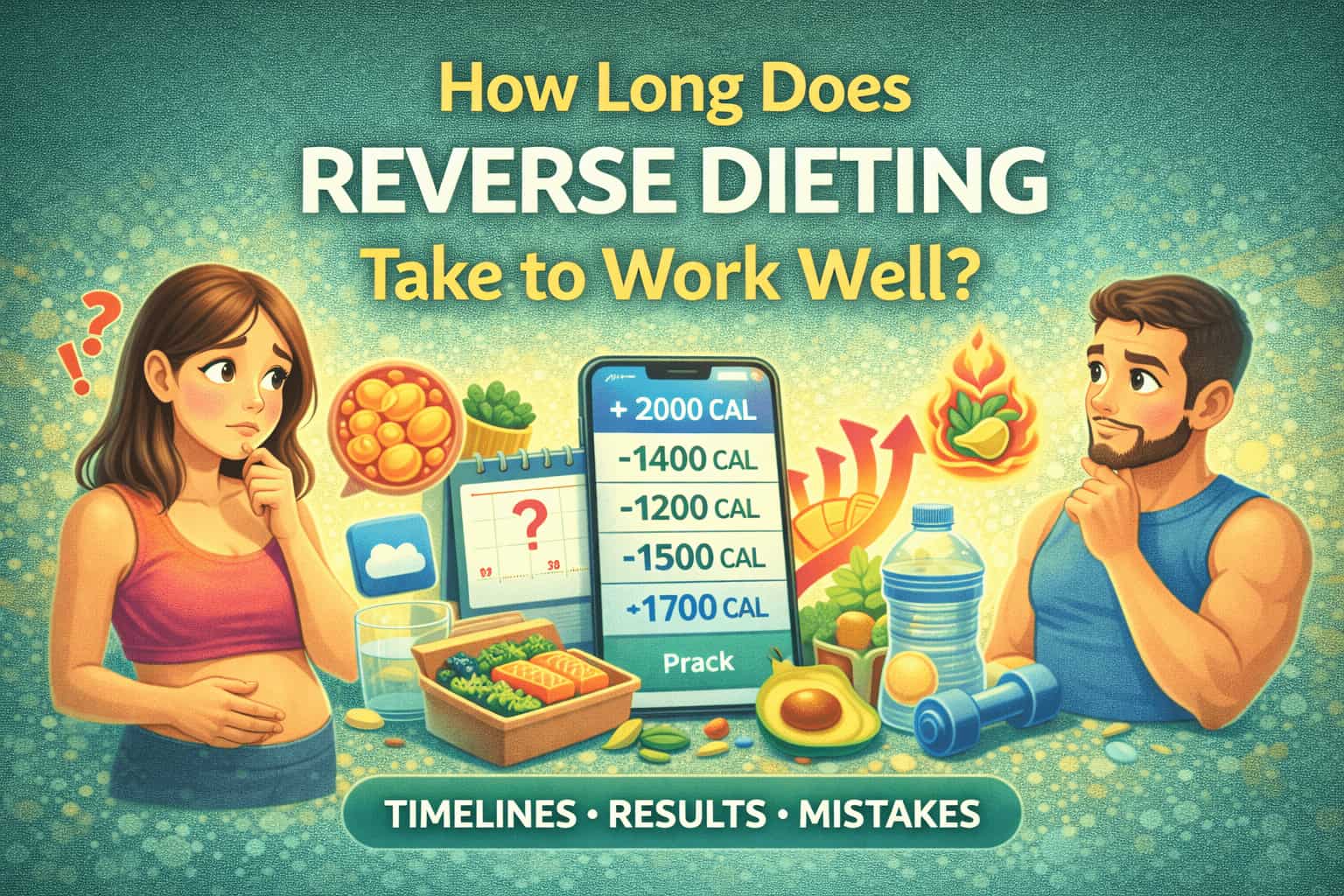
Most people reverse diet for 4-12 weeks on average. The exact duration depends on several factors including how long you dieted, how aggressive your deficit was, and your goal maintenance calorie level.
Week-by-Week Breakdown:
Weeks 1-2: Add 50-100 calories weekly, monitor weight closely Weeks 3-4: Continue gradual increases, metabolic markers start improving Weeks 5-8: Approach maintenance calories, energy levels normalize Weeks 9-12: Fine-tune to find true maintenance, stabilize weight
Research from the University of South Florida studied reverse dieting protocols with weekly calorie increases of 8.5% for males and 11.7% for females over 15 weeks. This structured approach prevented rapid weight regain while allowing gradual calorie restoration.
Extended Timeline: Several Months
Some people need longer reverse dieting periods, particularly those with extensive dieting history. If you’ve been restricting calories for many months or years, your metabolism requires more time to recover fully.
Data suggests that the time needed to recover from dieting is roughly proportional to how long you spent dieting. Someone who dieted for 3 months might reverse diet for 6-12 weeks, while someone with a year-long deficit might need 4-6 months of gradual increases.
Factors Affecting Duration
Starting Calorie Level: Lower starting calories require longer timelines to reach maintenance
Metabolic Adaptation Severity: Greater metabolic slowdown needs more recovery time
Body Fat Percentage: Leaner individuals often require longer, more cautious approaches
Training Status: Athletes and active individuals may recover faster than sedentary dieters
Previous Dieting History: Chronic dieters need extended periods for full metabolic restoration
Week-by-Week: What to Expect
Week 1: Initial Calorie Increase
Add your first 50-100 calories to your current intake. Your weight might increase slightly from glycogen and water restoration, not fat gain. This is normal and temporary.
You may notice slightly improved energy and mood. Track your weight daily but look at weekly averages. Day-to-day fluctuations are meaningless at this stage.
Weeks 2-3: Metabolic Adjustments Begin
Continue adding 50-100 calories weekly. Some people notice improved digestion as their body adjusts to more food. Sleep quality may improve slightly.
Your metabolism begins responding to increased energy availability. Non-exercise activity thermogenesis (NEAT) – fidgeting, spontaneous movement, and daily activities – starts increasing as your body conserves less energy.
Week 4-6: Noticeable Improvements
Energy levels improve more dramatically. You may feel warmer as your body temperature regulation normalizes. Strength and performance in workouts typically increase.
Hormonal markers begin recovering. Women may notice menstrual cycle regularity improving. Both men and women often report better mood and reduced food obsession.
Weeks 7-9: Approaching Maintenance
You’re now eating close to estimated maintenance calories. Weight should stabilize or increase very slowly. If weight increases rapidly, you’ve overshot maintenance.
Hunger levels normalize. The extreme hunger common at the end of diets should diminish. You feel more satisfied after meals and less preoccupied with food.
Weeks 10-12: Fine-Tuning and Stabilization
Adjust calorie intake in smaller increments (25-50 calories) to find your exact maintenance level. Your weight should remain stable week-to-week at true maintenance.
Metabolic rate has recovered substantially. Energy expenditure approaches pre-diet levels, though complete recovery may take longer for some individuals.
What Does “Working” Actually Mean?
The goals of reverse dieting include avoiding rapid weight regain, restoring metabolic rate, normalizing hormone levels, and improving quality of life and relationship with food.
However, recent research from the University of South Florida challenges popular claims. The study found no significant differences in weight regain between groups following gradual reverse dieting, immediate return to maintenance, or ad libitum eating.
All groups regained some weight during the post-diet phase, but none surpassed their initial 5% weight loss. Mean relative weight regain was 3.68% in the reverse diet group, 2.73% in the immediate return to maintenance group, and only 1.30% in the ad libitum control group.
These findings suggest that gradual calorie increases through reverse dieting may not be more effective at minimizing weight regain than less structured approaches. The psychological benefits and structured transition may matter more than metabolic advantages.
The Science: What Research Actually Shows
Limited Evidence Base
Scientific support for reverse dieting remains surprisingly limited. While anecdotal reports of successful reverse dieting have led to increased popularity, research is needed to evaluate its efficacy according to the International Journal of Sports Nutrition.
Very small studies have looked at athletes but found mixed results. One frequently cited study showed reverse dieting helped prevent weight regain in trained athletes – but this study included only two athletes without a control group. These results are far from conclusive.
Metabolic Adaptation Reality
Research confirms that calorie-restricted diets lower metabolism. Studies from The Biggest Loser show persistent metabolic adaptation even 6 years after competition. However, the magnitude is often overstated.
Recent data suggests metabolic adaptation accounts for about 120 calories daily with considerable individual variance. This is meaningful but not the dramatic slowdown often claimed by reverse dieting proponents.
Weight Regain Patterns
Research shows that when people first begin regaining weight, they preferentially regain fat mass until reaching their typical balance of fat and fat-free mass. Substantial hunger persists until individuals regain all the fat-free mass lost during dieting.
This challenges the reverse dieting premise. The body has powerful biological drives to restore lost tissue regardless of how slowly you add calories back.
How to Track Your Reverse Diet Effectively
Traditional Tracking Challenges
Successful reverse dieting requires meticulous calorie tracking. You need to know your exact intake to add precise weekly increases. Traditional manual tracking takes 15-30 minutes daily – searching databases, measuring portions, and calculating totals.
This tedious process causes many people to abandon tracking, undermining their reverse diet. Inconsistent tracking makes it impossible to determine if weight changes result from true metabolic adaptation or simply inaccurate logging.
How EATAI Simplifies Reverse Dieting
Show Image
EATAI revolutionizes reverse diet tracking through AI-powered photo recognition. Instead of manual database searching, simply photograph your meals for instant calorie calculations.
Key Benefits for Reverse Dieting:
Precise Calorie Tracking: Accurate intake data essential for gradual increases Effortless Daily Logging: 2-3 seconds per meal vs 15-30 minutes manually
Consistent Data: Eliminates guesswork that undermines reverse diet success Progress Monitoring: Track calorie increases and weight trends together Macro Breakdown: Monitor protein, carbs, and fats as you increase intake 100% Free: No premium costs for unlimited tracking
The app saves hours weekly compared to traditional tracking while maintaining the accuracy reverse dieting requires. When you need to add exactly 75 calories this week and 75 more next week, precise tracking becomes critical. EATAI provides this precision effortlessly.
Visit https://geteatai.app to start tracking your reverse diet with unlimited AI-powered nutrition tracking – completely free.
Common Reverse Dieting Mistakes
Increasing Calories Too Quickly
Adding 200-300 calories weekly defeats the purpose of gradual adaptation. Research suggests eating 20% above maintenance doesn’t significantly increase fat gain, but 40-60% above maintenance does.
If you maintain weight on 2,000 calories, you can add up to 400 extra calories daily without significant scale changes. But 800 additional calories will likely cause fat regain. Stick to conservative 50-150 calorie weekly increases.
Not Tracking Accurately
Guessing your intake makes reverse dieting impossible. You cannot make precise weekly adjustments without knowing your exact current calories. Use AI tools like EATAI or weigh and measure everything meticulously.
Expecting Linear Progress
Weight will fluctuate daily from water, sodium, digestion, and hormones. Looking at day-to-day changes causes unnecessary panic. Track weekly averages instead of daily measurements.
Stopping Too Soon
Some people reach estimated maintenance and immediately stop tracking. True maintenance requires several weeks of weight stability to confirm. Continue monitoring to ensure you’ve found your actual maintenance level.
Neglecting Training
Maintaining or increasing activity during reverse dieting helps offset calorie increases and supports metabolic recovery. Don’t reduce training volume as you add calories.
Alternative Approach: Dynamic Maintenance
Recent evidence suggests “dynamic maintenance” may work better than strict reverse dieting for many people. This flexible approach involves eating at estimated maintenance immediately after dieting, then adjusting based on results.
Benefits include faster metabolic and hormonal recovery, less tedious tracking requirements, simpler psychological transition, and similar outcomes to reverse dieting according to research.
The University of South Florida study found no significant advantage to gradual calorie increases versus immediate return to maintenance. Both approaches produced similar weight regain and metabolic outcomes.
Who Should Reverse Diet?
Ideal Candidates
Reverse dieting works best for competitive physique athletes recovering from contest prep, individuals with extreme metabolic adaptation from prolonged severe restriction, people who prefer structured, methodical approaches, and those with anxiety about rapid weight regain.
Who Might Skip It
Consider alternatives if you finished a moderate diet without extreme restriction, value flexibility over rigid structure, want faster metabolic recovery, or have a healthy relationship with food and trust your hunger signals.
Recent research suggests that for most people completing reasonable diets, immediately returning to maintenance calories works as well as gradual reverse dieting while allowing faster recovery.
Frequently Asked Questions About How Long Does Reverse Dieting Take to Work Well
How long does reverse dieting take to work?
Reverse dieting typically takes 4-12 weeks to reach maintenance calories, with most people averaging 6-10 weeks. However, duration varies based on your starting calorie level, how long you dieted, and your metabolic adaptation severity. Some people with extensive dieting history need several months. You know it’s working when you eat more calories without rapid weight gain, energy levels improve, and food obsession decreases.
Can you lose weight while reverse dieting?
Generally no – reverse dieting aims to increase calories to maintenance, not continue weight loss. However, some people lose small amounts if their metabolism recovers faster than they add calories. This is not the goal. If you want continued weight loss, stay in a deficit rather than reverse dieting. Reverse dieting is specifically for transitioning from weight loss to maintenance.
How many calories should I add per week during reverse dieting?
Add 50-150 calories per week during reverse dieting. Most experts recommend 50-100 calories weekly as a safe starting point. You can adjust based on results – if weight increases rapidly, slow down to 25-50 calories. If weight remains stable, you can increase by 100-150 calories. Consistency matters more than the exact amount. Choose a weekly increase and stick with it.
What happens if I increase calories too fast during reverse dieting?
Increasing calories too quickly can cause rapid fat regain, defeating the purpose of reverse dieting. Research shows eating 40-60% above maintenance leads to significant fat gain, while 20% above maintenance has minimal impact. If you add calories too fast, your intake may exceed your recovering metabolic rate, causing weight gain. Slow down increases and allow your body more adaptation time.
Is reverse dieting scientifically proven to work?
No, reverse dieting lacks strong scientific support despite popularity. Recent research from the University of South Florida found no significant difference in weight regain between reverse dieting and immediately returning to maintenance calories. While anecdotal reports suggest benefits, controlled studies show similar outcomes across different post-diet strategies. Reverse dieting may offer psychological benefits and structured transition, but metabolic advantages remain unproven.
How do I know when my reverse diet is done?
Your reverse diet is complete when you reach your estimated maintenance calories and weight remains stable for 2-4 weeks. At true maintenance, you should not lose or gain weight week-to-week. Energy levels should feel normal, hunger should be manageable, and you should be able to eat without obsessive food thoughts. Typically you’ve added 200-500 total calories from your dieting intake.
Can I reverse diet without tracking calories?
Reverse dieting without tracking calories is extremely difficult and not recommended. The process requires precise calorie management – knowing your exact intake and making specific weekly adjustments. Without tracking, you cannot determine if weight changes result from appropriate calorie increases or random variations. Use AI-powered apps like EATAI (https://geteatai.app) to make tracking effortless through photo recognition if manual logging feels burdensome.
Should I reverse diet or just eat at maintenance immediately?
Recent research suggests both approaches produce similar results for most people. The University of South Florida study found no significant advantage to gradual reverse dieting versus immediate return to maintenance calories. If you prefer structure and gradual change, reverse diet. If you want faster recovery and flexibility, immediately eat at maintenance. Both can work – choose based on your psychology and preferences.
Conclusion on How Long Does Reverse Dieting Take to Work Well?
Reverse dieting typically takes 4-12 weeks to transition from dieting to maintenance calories, though some people need longer depending on their circumstances. The process involves gradually adding 50-150 calories weekly while monitoring weight and metabolic markers.
However, recent research challenges popular reverse dieting claims. Studies show no significant advantage to gradual calorie increases versus immediately returning to maintenance. Both approaches produce similar weight regain and metabolic outcomes. The University of South Florida found that all post-diet strategies led to some weight regain, with ad libitum eating actually showing the least regain.
This doesn’t mean reverse dieting is useless – it offers psychological benefits, structured transition, and may help people comfortable with gradual change. But it’s not metabolically superior to simpler approaches as often claimed.
Whether you choose reverse dieting, immediate maintenance, or flexible eating, accurate tracking is essential. EATAI makes this effortless through AI-powered photo recognition that calculates calories instantly. Visit https://geteatai.app to start tracking your post-diet nutrition without tedious manual logging.
The most important factors for maintaining weight loss include continued self-monitoring, eating whole foods, regular physical activity, and sustainable lifestyle changes. Focus on building lasting habits rather than following rigid protocols. Choose the post-diet approach that fits your psychology and stick with it consistently.
Start your reverse diet or maintenance phase today. Use technology to simplify tracking so you can focus on actually recovering from dieting rather than drowning in spreadsheets. Your metabolism will recover – give it time and fuel it appropriately.
References on How Long Does Reverse Dieting Take to Work Well
- Rodriguez Da Silva, V., et al. (2025). The effects of reverse dieting on mitigating weight regain after a caloric deficit: a preliminary analysis. Journal of the International Society of Sports Nutrition, 22(Suppl 2). https://pmc.ncbi.nlm.nih.gov/articles/PMC12381988/
- Trexler, E. T., Smith-Ryan, A. E., & Norton, L. E. (2014). Metabolic adaptation to weight loss: implications for the athlete. Journal of the International Society of Sports Nutrition, 11(1), 7. https://pmc.ncbi.nlm.nih.gov/articles/PMC3943438/
- Cleveland Clinic. (2024). Reverse Dieting: Does It Work? Retrieved from https://health.clevelandclinic.org/reverse-dieting
- GoodRx. (2024). Reverse Dieting: What You Should Know. Retrieved from https://www.goodrx.com/well-being/diet-nutrition/reverse-dieting
- MacroFactor. (2025). Reverse Dieting: Hype Versus Evidence. Retrieved from https://macrofactorapp.com/reverse-dieting/
- My Juniper. (2025). Reverse Dieting: How to Support a Healthy Metabolism. Retrieved from https://www.myjuniper.com/blog/reverse-dieting
- Fittr. (n.d.). What is Reverse Dieting and How to Do It. Retrieved from https://www.fittr.com/article/what-is-and-when-to-implement-a-reverse-dieting-200/
- Hevy Coach. (2024). Reverse Diet: Meaning, Examples, and Benefits. Retrieved from https://hevycoach.com/glossary/reverse-diet/