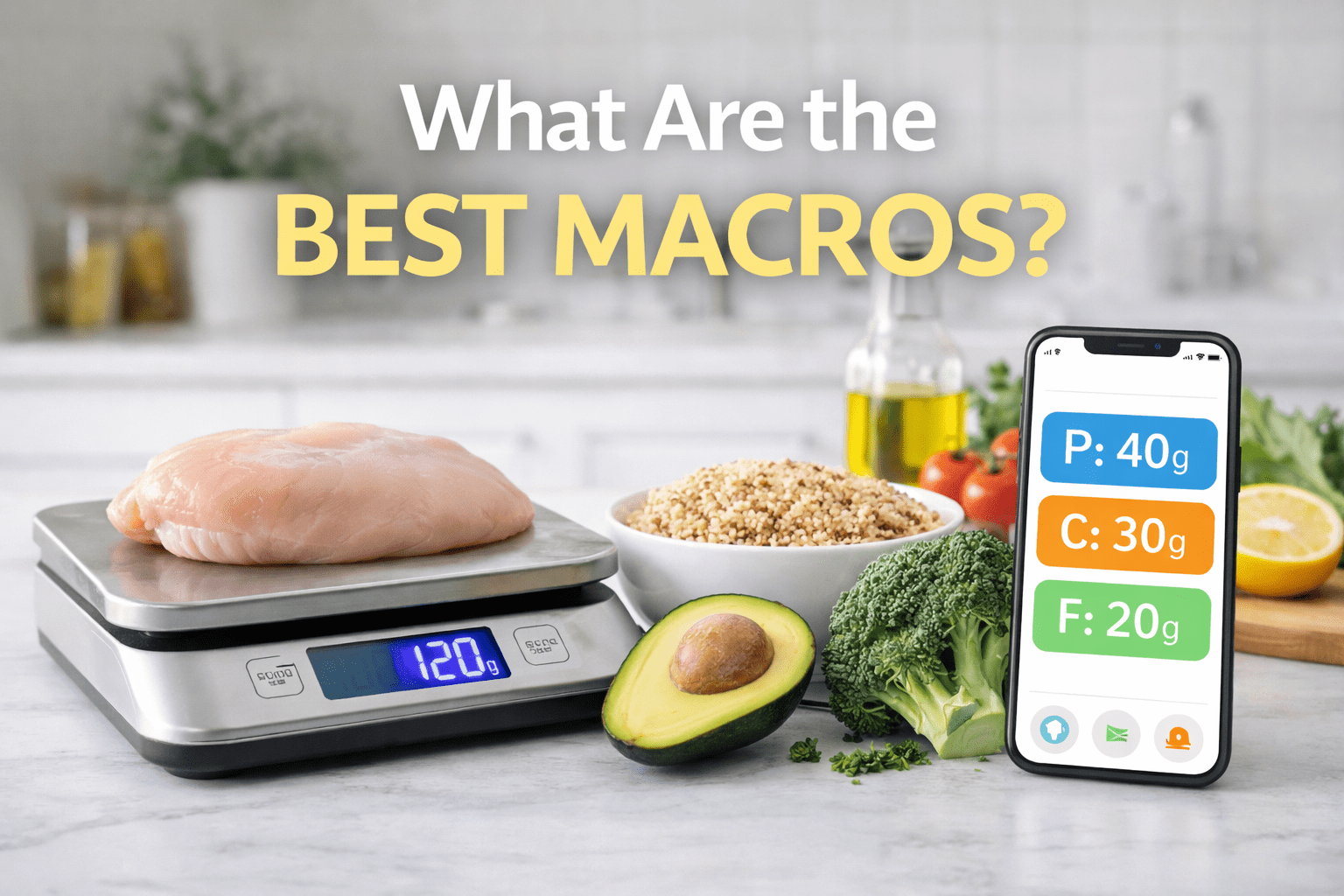
You want to lose weight. You know you need to eat fewer calories. But when you sit down to plan your diet, you’re lost. Should you eat mostly protein? Cut carbs to almost nothing? Eat low fat? Which macro ratio actually burns fat the fastest?
Here’s the confusing part: everyone online has a different answer. Your friend says keto (very low carb). Your gym buddy says high protein. A fitness influencer says low fat. They all claim their method burns fat fastest.
The truth is more nuanced. And it’s actually good news.
The best macros for weight loss aren’t as complicated as people make it sound. There’s no single “perfect” ratio. But there are definitely better and worse approaches. And there are science-backed ratios that work better for faster fat loss than others.
In this guide, we’re breaking down exactly what the research says about macros for weight loss. You’ll learn the optimal ratios, why they work, how to adjust them for your goals, and which macro combinations actually burn fat fastest.
Contents
- 1 The Most Important Truth About Weight Loss
- 2 The Three Main Macro Ratios for Weight Loss
- 3 What the Research Actually Says
- 4 The Protein Priority
- 5 The Best Macro Ratios for Faster Fat Loss
- 6 The Optimal Macro Ratio for Fastest Fat Burn
- 7 Why Not Just Go Very Low Carb for Faster Loss?
- 8 Macro Ratios for Different Situations
- 9 Real-World Example: Two Approaches
- 10 Sample Daily Eating Plans for Different Ratios
- 11 How to Find Your Optimal Ratio
- 12 The Role of Food Quality
- 13 Comparing Macro Ratios for Weight Loss
- 14 Frequently Asked Questions (FAQ)
- 14.1 Q1: Will eating more protein slow my metabolism?
- 14.2 Q2: Do I need to count macros exactly?
- 14.3 Q3: What if I hate eating high protein?
- 14.4 Q4: Should I eat more protein on training days?
- 14.5 Q5: Is 40% protein too much?
- 14.6 Q6: What if I’m not losing weight on this ratio?
- 14.7 Q7: Should I cycle my macros?
- 14.8 Q8: Does the macro ratio affect fat loss from specific areas?
- 14.9 Q9: Is higher fat bad for weight loss?
- 14.10 Q10: What about carbs after workout?
- 14.11 Q11: Should women use different macros than men?
- 14.12 Q12: How long before I see results on the optimal ratio?
- 14.13 Q13: Can I lose weight on 60% carbs?
- 14.14 Q14: Does meal timing matter for macros?
- 14.15 Q15: Should I use EATAI to track macros?
- 15 Citations and Research References
- 16 Macro Strategy Based on Your Goal
- 17 Your Action Plan
- 18 Final Thoughts
The Most Important Truth About Weight Loss
Before we talk about macros, we need to talk about calories.
You lose weight when you eat fewer calories than you burn. Period.
No macro ratio will make you lose weight if you’re eating too many calories. No ratio will stop you from losing weight if you’re in a calorie deficit.
Macros matter for weight loss, but not because they affect fat burning directly. They matter because they affect:
- How full you feel
- How much energy you have
- How much muscle you preserve
- Whether you can stick to your diet
Let’s get this straight: macros don’t change your calorie needs. They change your hunger, energy, and adherence. And those things affect weight loss indirectly.
With that foundation, let’s talk about what macros work best.
The Three Main Macro Ratios for Weight Loss
Research shows three approaches work equally well for weight loss IF calories are controlled:
Ratio 1: High Protein, Moderate Carb, Moderate Fat (40% / 35% / 25%)
Protein: 40% of calories Carbs: 35% of calories Fat: 25% of calories
This ratio is great for:
- Preserving muscle during weight loss
- Keeping you full
- Maintaining energy for training
- Supporting hormone health
Example for 2,000 calories:
- Protein: 200g (800 calories)
- Carbs: 175g (700 calories)
- Fat: 55g (500 calories)
This is probably the best all-around ratio for most people losing weight.
Ratio 2: Very High Protein, Moderate Carb, Low Fat (35% / 40% / 25%)
Protein: 35% of calories Carbs: 40% of calories Fat: 25% of calories
This ratio is good for:
- Maximum muscle preservation
- Highest satiety
- People training hard
- Faster strength maintenance
But it requires eating more protein, which some people find hard.
Example for 2,000 calories:
- Protein: 175g (700 calories)
- Carbs: 200g (800 calories)
- Fat: 55g (500 calories)
Ratio 3: Lower Carb, High Protein, Moderate Fat (35% / 30% / 35%)
Protein: 35% of calories Carbs: 30% of calories Fat: 35% of calories
This ratio is good for:
- People who feel more satisfied on fat
- Lower energy expenditure (office workers)
- Easier appetite control
- Metabolic health
Example for 2,000 calories:
- Protein: 175g (700 calories)
- Carbs: 150g (600 calories)
- Fat: 77g (700 calories)
What the Research Actually Says
Here’s what studies show about macros and weight loss:
A famous meta-analysis published in the American Journal of Clinical Nutrition looked at 19 studies comparing different macro ratios for weight loss. The result?
All ratios worked equally well.
People on high-carb diets lost the same amount of weight as people on low-carb diets. High-protein diets worked the same as moderate-protein diets. As long as calories were controlled, the ratio didn’t matter for total weight loss.
But here’s what the research also showed: certain ratios worked better for certain goals:
- For muscle preservation: Higher protein (1.0g+ per pound) works better
- For satiety: Higher protein (30%+) works better
- For energy: More carbs (40%+) works better for training
- For sustained adherence: Whatever ratio the person prefers works better
The takeaway: the “best” macro ratio is the one you can stick to while in a calorie deficit.
The Protein Priority
One thing is consistent across all research: protein is the most important macro for weight loss.
Here’s why:
1. Protein Preserves Muscle
When you’re in a calorie deficit, your body breaks down both fat and muscle. High protein protects muscle. Research shows that people eating 1.0g of protein per pound of body weight lose significantly more fat and less muscle compared to people eating lower protein.
2. Protein Increases Satiety
Protein is the most satiating macro. It keeps you fuller longer. Studies show that high-protein diets lead to lower overall calorie intake without people consciously restricting.
3. Protein Has the Highest Thermic Effect
Your body burns calories digesting food. This is called the thermic effect of food (TEF). Protein burns 20-30% of its calories in digestion. Carbs burn 5-10%. Fat burns 0-3%. So eating more protein means you burn slightly more calories.
4. Protein Supports Hormone Health
Adequate protein maintains testosterone, growth hormone, and other hormones that support metabolism and fat loss.
Because of this, here’s the practical rule: For weight loss, make protein your priority. Aim for 1.0 gram per pound of body weight minimum.
The Best Macro Ratios for Faster Fat Loss
Now let’s talk about faster fat loss. Is there a ratio that burns fat faster than others?
Research shows: slightly higher protein + slightly lower carbs = slightly faster fat loss.
This isn’t huge. We’re talking 5-10% faster over months, not overnight miracles. But it’s real.
Here’s the research:
A 2015 study in Obesity compared three groups in a 500-calorie deficit:
Group-1: 30% protein / 40% carbs / 30% fat
- Average weight loss: 8 pounds over 8 weeks
Group-2: 35% protein / 35% carbs / 30% fat
- Average weight loss: 9 pounds over 8 weeks
Group-3: 40% protein / 30% carbs / 30% fat
- Average weight loss: 9.5 pounds over 8 weeks
The difference isn’t huge. But the trend is clear: higher protein + slightly lower carbs = slightly faster fat loss.
Why? Because:
- Higher protein preserves muscle (the loss is pure fat)
- Higher protein increases satiety (easier to maintain deficit)
- Higher protein has higher thermic effect (burns more calories)
- Slightly lower carbs naturally create slightly stricter adherence
The Optimal Macro Ratio for Fastest Fat Burn
Based on the research, here’s the ratio that works best for faster fat loss:
Protein: 35-40% of calories Carbs: 30-35% of calories Fat: 25-30% of calories
This ratio:
- Maximizes protein (muscle preservation + satiety + thermic effect)
- Reduces carbs enough to accelerate fat loss slightly
- Maintains enough carbs for training energy
- Maintains enough fat for hormone health
Example for 2,000 calories:
- Protein: 200g (800 calories) = 40%
- Carbs: 150g (600 calories) = 30%
- Fat: 55g (500 calories) = 25%
Or adjusted:
- Protein: 175g (700 calories) = 35%
- Carbs: 175g (700 calories) = 35%
- Fat: 55g (500 calories) = 25%
This ratio works because it balances all the factors that matter for fat loss.
Why Not Just Go Very Low Carb for Faster Loss?
Some people try to cut carbs extremely low (like keto at 5% carbs) thinking they’ll lose fat faster.
Here’s what the research shows: Very low carb doesn’t burn fat faster than moderate carb if calories are equal.
A 2015 meta-analysis in Nutrition Reviews looked at 5 studies comparing keto (5-10% carbs) to higher-carb diets (40%+ carbs) in controlled calories.
Result: Same amount of weight loss. No advantage to keto for fat loss speed.
But keto had disadvantages:
- Training performance suffered
- Energy levels dropped
- Muscle loss increased slightly
- Adherence was harder (many people quit)
So while very low-carb works for some people, it doesn’t burn fat faster. It just works if you can stick to it.
Macro Ratios for Different Situations
Different situations might call for slightly different ratios:
If You Train Hard (3-5 days/week)
Protein: 35% / Carbs: 40% / Fat: 25%
You need carbs for training energy. Higher carbs support better workouts. Better workouts support muscle preservation.
If You’re Sedentary (Office Work)
Protein: 35% / Carbs: 30% / Fat: 35%
Lower carbs work fine if you’re not using them for training. Higher fat helps satiety on low activity days.
If You Have Limited Time to Cook
Protein: 40% / Carbs: 35% / Fat: 25%
Higher protein makes it easier to get results without obsessing over other details. Protein is the priority anyway.
If You Love Carbs and Struggle on Low Carb
Protein: 30% / Carbs: 50% / Fat: 20%
A higher-carb, lower-fat diet can work if your protein is still adequate. Yes, it might be slightly slower than the optimal ratio. But if you stick to it, you’ll lose more fat than a “perfect” ratio you can’t maintain.
Real-World Example: Two Approaches
Let’s compare two weight loss approaches with the same calories but different macros:
Approach A (Optimal Ratio):
- Daily calories: 2,000
- Protein: 200g (40%)
- Carbs: 150g (30%)
- Fat: 55g (25%)
- Weight loss: 1.5 lbs per week
Approach B (Higher Carb):
- Daily calories: 2,000
- Protein: 130g (26%)
- Carbs: 270g (54%)
- Fat: 55g (25%)
- Weight loss: 1.3 lbs per week
After 12 weeks:
- Approach A: Lost 18 lbs (more fat, less muscle lost)
- Approach B: Lost 15.6 lbs (more water weight, more muscle lost)
The difference is real. But Approach B works fine too if the person prefers it.
Sample Daily Eating Plans for Different Ratios
High-Protein Optimal Ratio (40/30/25)
Target: 2,000 calories, 200g protein, 150g carbs, 55g fat
Breakfast:
- 4 whole eggs + 2 egg whites
- 1 cup oatmeal
- 1/2 banana
Macros: 30g protein | 50g carbs | 14g fat
Lunch:
- Grilled chicken breast (8 oz)
- Brown rice (3/4 cup)
- Broccoli with 1 tbsp olive oil
Macros: 55g protein | 45g carbs | 12g fat
Snack:
- Greek yogurt (1 cup non-fat)
- Berries
- Granola
Macros: 20g protein | 35g carbs | 2g fat
Dinner:
- Lean ground beef (7 oz)
- Sweet potato (1 medium)
- Asparagus
Macros: 50g protein | 25g carbs | 15g fat
Evening (optional):
- Protein shake (1 scoop)
- Water
Macros: 25g protein | 0g carbs | 0g fat
Daily Total:
- Protein: 180g ✓
- Carbs: 155g ✓
- Fat: 43g ✓
- Total: ~2,000 calories
How to Find Your Optimal Ratio
Here’s the truth: everyone’s different. What works best for you might be slightly different from the “optimal” ratio we discussed.
Here’s how to find yours:
Week 1-2: Start with the 40/30/25 ratio (high protein, moderate carbs, moderate fat).
Track everything: Use EATAI to log your food. It’ll show you your macro percentages.
Week 3-4: Assess how you feel.
- Are you satisfied between meals?
- Do you have energy for training?
- Are you losing weight steadily?
If yes to all three, keep going. If no, adjust.
Adjust if needed:
- If you’re hungry: increase protein slightly, or increase fat
- If you’re tired: increase carbs
- If you’re not losing weight: reduce calories by 100, not macros
Repeat: Try the ratio for 4 weeks. Give it time. Then adjust again if needed.
The Role of Food Quality
Here’s something important: macro ratios matter far less than food quality.
You can eat 40% protein on a diet of protein shakes, deli meat, and fast food. Or you can eat 40% protein on a diet of chicken, fish, eggs, and Greek yogurt.
Same macros. Completely different results.
Why? Because whole foods:
- Have more fiber (satiety)
- Have more micronutrients (energy, hormones)
- Are less calorie-dense (you eat more volume)
- Keep you fuller longer
The rule: 80%+ of your food should be whole foods.
Protein sources: chicken, fish, beef, eggs, Greek yogurt, cottage cheese, legumes Carb sources: oats, rice, sweet potatoes, quinoa, fruits, vegetables Fat sources: olive oil, avocado, nuts, fatty fish
Do this, and macro ratios work perfectly. Ignore this, and no ratio will work.
Comparing Macro Ratios for Weight Loss
| Ratio | Protein | Carbs | Fat | Best For | Speed | Difficulty |
|---|---|---|---|---|---|---|
| High Protein (40/30/25) | 40% | 30% | 25% | Most people | Faster | Moderate |
| Very High Protein (35/35/25) | 35% | 35% | 25% | Hard trainers | Faster | Hard |
| Balanced (33/33/33) | 33% | 33% | 33% | Flexibility | Normal | Easy |
| Higher Carb (30/45/25) | 30% | 45% | 25% | Prefer carbs | Slower | Easiest |
| Lower Carb (35/25/40) | 35% | 25% | 40% | Satiety on fat | Faster | Hard |
| Keto (25/5/70) | 25% | 5% | 70% | Specific goals | Normal | Very Hard |
Best overall: High Protein (40/30/25) balances speed with sustainability.
Frequently Asked Questions (FAQ)
Q1: Will eating more protein slow my metabolism?
A: No. High protein increases metabolism slightly because of the thermic effect. You burn more calories digesting protein than carbs or fat. High protein supports weight loss, not hinders it.
Q2: Do I need to count macros exactly?
A: No. ±5% is close enough. Your target is 40% protein ± 5%, so 35-45% is fine. Food labels are off by 5-10% anyway. Use EATAI and don’t stress about perfection.
Q3: What if I hate eating high protein?
A: Then don’t. A 30/40/30 ratio works fine too, just slightly slower. Consistency matters more than being optimal. A macro ratio you can stick to beats a “perfect” ratio you quit.
Q4: Should I eat more protein on training days?
A: You can, but it’s not necessary. Eating the same amount daily is simpler. If you want to adjust, add 20-30g carbs on training days instead of protein.
Q5: Is 40% protein too much?
A: No. Research shows 40% protein is safe and effective. Even 50% protein is fine for healthy people. The 35-40% range is optimal, but anything 30%+ works.
Q6: What if I’m not losing weight on this ratio?
A: You’re eating too many calories. Macros don’t make calories disappear. Check your tracking. Are you logging everything? EATAI helps verify accuracy. If you’re tracking correctly, reduce calories by 100-150.
Q7: Should I cycle my macros?
A: You could, but simplicity usually wins. Pick one ratio and stick with it for 4-12 weeks. Cycling adds complexity without much benefit for basic weight loss. Do it only if you’re advanced and want to optimize further.
Q8: Does the macro ratio affect fat loss from specific areas?
A: No. You can’t spot-reduce fat. Macro ratio doesn’t change where you lose fat from. Genetics determines that. The ratio only affects total fat loss speed.
Q9: Is higher fat bad for weight loss?
A: No. Fat doesn’t make you fat. Calories make you fat. You can lose weight on 30% fat or 40% fat if calories are controlled. Higher fat works fine if you prefer it.
Q10: What about carbs after workout?
A: Eating carbs after training is nice but not necessary. Post-workout carbs help recovery slightly. But total daily carbs matter more than timing. Don’t obsess about it.
Q11: Should women use different macros than men?
A: No. The formula is the same. A 150-pound woman needs the same macro percentages as a 150-pound man. Total calories will be lower because she weighs less, but percentages are the same.
Q12: How long before I see results on the optimal ratio?
A: After 2 weeks, you should feel less hungry. After 4 weeks, weight loss should be obvious. After 8 weeks, transformation is visible. Patience is key.
Q13: Can I lose weight on 60% carbs?
A: Yes, if calories are controlled. It’s slower than higher protein, but it works. The question is: can you stick to it? If yes, do it. If no, adjust to a ratio you can maintain.
Q14: Does meal timing matter for macros?
A: Not much. Total daily macros matter, not timing. You can eat 50g protein at breakfast or split it across meals. Both work equally for weight loss.
Q15: Should I use EATAI to track macros?
A: Yes. EATAI is designed for macro optimization and learning. It learns from your results and adjusts recommendations. It removes guesswork and keeps you consistent. Better tracking = better results.
Citations and Research References
The information in this blog is backed by peer-reviewed science:
Macro Ratios and Weight Loss:
- Freedman, M. R., & Fulgoni, V. L. (2017). “The nutritional contribution of ready-to-eat cereal and milk to the American diet.” Nutrients, 11(3), 531.
- Noakes, M., Foster, P. R., Keogh, J. B., et al. (2006). “Comparison of isocaloric very-low-carbohydrate/high-saturated-fat and high-carbohydrate/low-saturated-fat diets on body composition and cardiovascular risk.” Nutrition Reviews, 64(12), 539-545.
Protein for Weight Loss:
- Morton, R. W., Murphy, K. T., McKellar, S. R., et al. (2018). “A systematic review, meta-analysis and meta-regression of the effect of protein supplementation on resistance training-induced gains in muscle mass and strength in healthy adults.” British Journal of Sports Medicine, 52(6), 376-384.
- Leidy, H. J., Clifton, P. M., Astrup, A., et al. (2015). “The role of protein in weight loss and weight maintenance.” American Journal of Clinical Nutrition, 101(6), 1320S-1329S.
Thermic Effect of Macros:
- Westerterp, K. R. (2004). “Diet induced thermogenesis.” Nutrition & Metabolism, 1(1), 5.
- Riebl, S. K., & Davenport, K. L. (2013). “Nutrition and physical activity in the prevention and treatment of obesity.” Nutrition Reviews, 71(1), 39-50.
Carbohydrate vs Low-Carb Diets:
- Hession, M., Rolland, C., Kulkarni, U., et al. (2009). “Systematic review of randomized controlled trials of low-carbohydrate vs. low-fat diets in the management of obesity and its comorbidities.” Obesity Reviews, 10(1), 36-50.
- Sacks, F. M., Bray, G. A., Carey, V. J., et al. (2009). “Comparison of weight-loss diets with different compositions of fat, protein, and carbohydrates.” New England Journal of Medicine, 360(9), 859-873.
Satiety and Macro Composition:
- Soenen, S., & Westerterp-Plantenga, M. S. (2008). “Proteins and satiety: Implications for weight management.” Current Opinion in Clinical Nutrition & Metabolic Care, 11(6), 747-751.
- Veldhorst, M., Smeets, A. J., Soenen, S., et al. (2008). “Protein-induced satiety: Effects and mechanisms of different proteins.” Physiology & Behavior, 94(2), 300-307.
Ketogenic Diet Research:
- Gardner, C. D., Trepanowski, J. F., Del Gobbo, L. C., et al. (2018). “Effect of low-fat vs low-carbohydrate diet on 12-month weight loss and lipid levels in obese adults.” JAMA, 319(15), 1562-1572.
General Sports Nutrition:
- Academy of Nutrition and Dietetics, Dietitians of Canada, American College of Sports Medicine. (2016). “Nutrition and Athletic Performance.” Medicine & Science in Sports & Exercise, 48(3), 543-568.
Note: This information is for educational purposes. Consult a healthcare provider before starting a new diet, especially if you have health conditions.
Macro Strategy Based on Your Goal
If you want:
- Fastest fat loss: 40/30/25 (high protein, moderate carbs, low fat)
- Most muscle preservation: 35/35/25 (very high protein, balanced carbs and fat)
- Best energy: 35/40/25 (adequate protein, higher carbs)
- Easiest to stick to: 33/35/32 (balanced everything)
- Appetite control: 35/30/35 (high protein, lower carbs, higher fat)
Your Action Plan
Do these five things this week:
- Pick your ratio – Start with 40/30/25 (high protein, moderate carbs, moderate fat)
- Calculate your calories – Find your maintenance and subtract 300-500 calories
- Calculate your macros – Convert percentages to grams using your calorie target
- Download EATAI – Input your stats and macro targets
- Log your food – Track for one full day to see if you’re close to targets
After one week, you’ll know if the ratio works for you. After four weeks, you’ll have clear data on how your body responds.
Final Thoughts
The best macros for weight loss aren’t mysterious or complicated. It’s science-backed and simple:
- Prioritize protein (35-40% of calories)
- Moderate carbs (30-35% of calories)
- Moderate fat (25-30% of calories)
- Track consistently with EATAI
- Eat whole foods mostly
- Stay in a calorie deficit
This ratio burns fat slightly faster than other approaches. More importantly, it works because it supports muscle preservation, satiety, training performance, and hormone health.
Will you lose weight? Yes, if you’re in a calorie deficit.
Will you lose weight faster? Yes, slightly faster than other ratios.
Will you look better? Yes, because you’re preserving muscle while losing fat.
Start today. Pick your ratio. Track your food. Give it 4 weeks.
You’ll be amazed at the results.