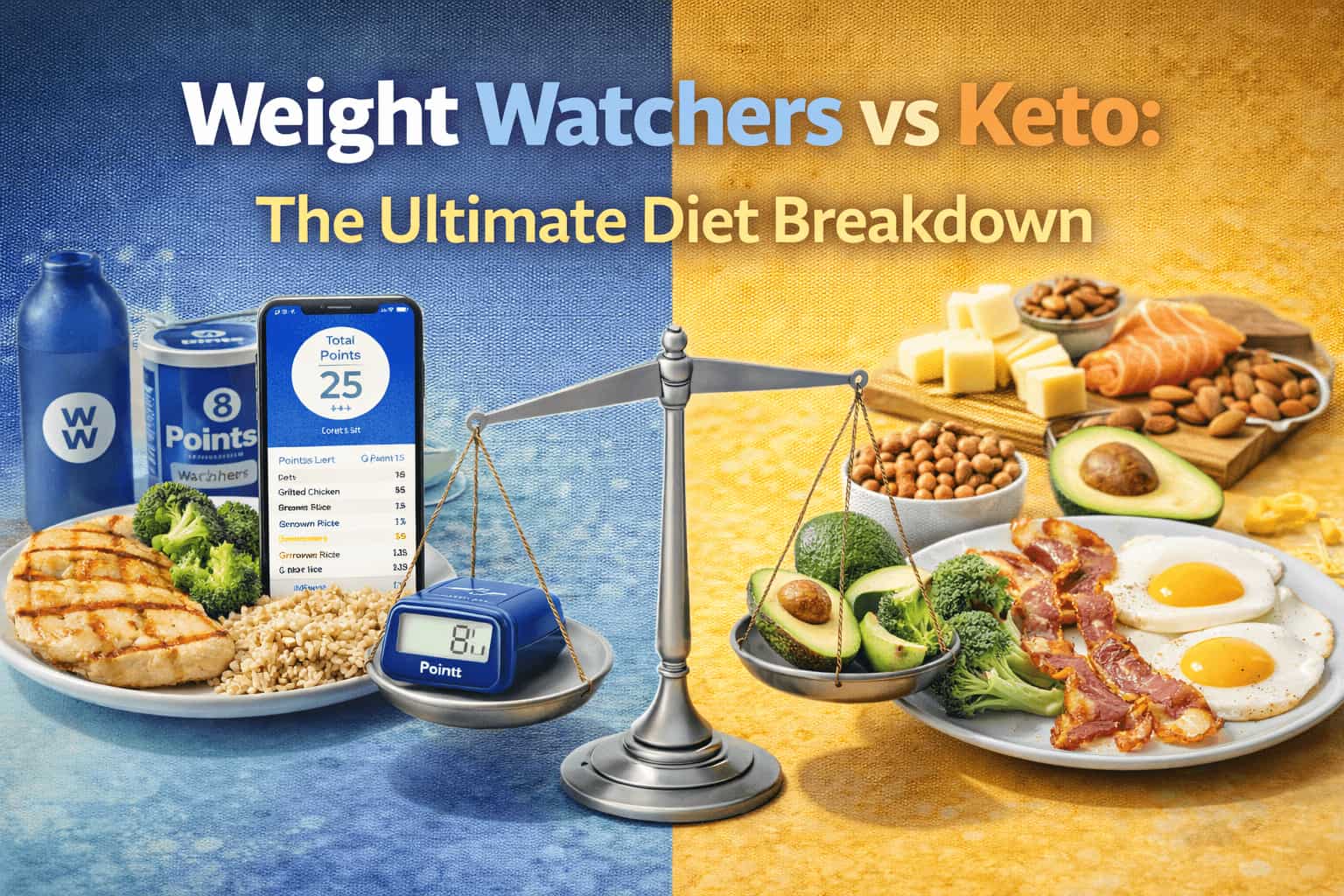
Weight Watchers vs Keto Breakdown: You’ve heard about both Weight Watchers and Keto. Both claim to be the best way to lose fat, have thousands of success stories & have celebrities and influencers endorsing them. But which one actually works better?
Here’s the honest answer: they both work. But they work differently. And one might be significantly better for you than the other.
Weight Watchers focuses on points and behavior change. You track food by a point system that considers calories and nutrients. It’s flexible, sustainable, and backed by decades of research.
Keto is all about low carbs. You eat almost no carbs, lots of fat, and moderate protein. Your body enters ketosis, burning fat for fuel. It’s very restrictive but many people find it incredibly satisfying.
Which is better? That depends on your lifestyle, your food preferences, your social situation, and your goals. In this guide, we’re breaking down both approaches honestly. You’ll learn how each works, the pros and cons of each, the research backing each, and which one is actually better for your specific situation.
Contents
- 1 What Is Weight Watchers?
- 2 What Is Keto?
- 3 The Science Behind Each Approach
- 4 Weight Watchers: Pros and Cons
- 5 Keto: Pros and Cons
- 6 Direct Comparison: Which Is Better?
- 7 Real-World Scenarios: Which Works Better?
- 7.1 Scenario 1: You Struggle With Constant Hunger
- 7.2 Scenario 2: You Want to Keep Eating Your Favorite Foods
- 7.3 Scenario 3: You’re Very Social and Eat Out Often
- 7.4 Scenario 4: You Don’t Like Groups or Need Support
- 7.5 Scenario 5: You Have a Slow Metabolism
- 7.6 Scenario 6: You Have Diabetes or Prediabetes
- 7.7 Scenario 7: You Want Results Fast (Short-term)
- 7.8 Scenario 8: You Want Long-Term Success
- 8 Sample Day on Weight Watchers vs Keto Breakdown
- 9 Weight Watchers vs Keto Breakdown Comparison Chart
- 10 Which Should You Choose?
- 11 Can You Combine Them?
- 12 The Role of EATAI
- 13 Frequently Asked Questions about Weight Watchers vs Keto Breakdown
- 13.1 Q1: Can I do keto on Weight Watchers?
- 13.2 Q2: Which costs less?
- 13.3 Q3: Can I switch between them?
- 13.4 Q4: Which is better for building muscle?
- 13.5 Q5: Is Weight Watchers just calorie counting?
- 13.6 Q6: Is keto safe long-term?
- 13.7 Q7: Which has better long-term results?
- 13.8 Q8: Can beginners do keto?
- 13.9 Q9: Which is better for women?
- 13.10 Q10: Does Weight Watchers work without meetings?
- 13.11 Q11: Is keto dangerous for athletes?
- 13.12 Q12: Why do people gain weight back on keto?
- 13.13 Q13: Can you eat fruit on keto?
- 13.14 Q14: Should I use EATAI for either approach?
- 13.15 Q15: How long before seeing results?
- 14 Citations and Research References
- 15 Final Verdict
What Is Weight Watchers?
Weight Watchers (now WW) is a commercial diet program that’s been around since 1963. It’s one of the most well-known weight loss brands in the world.
How it works:
You get assigned a daily points budget based on your weight, age, gender, and activity level. Different foods have different point values. Your goal is to stay within your daily points budget.
The point system considers:
- Calories
- Protein (good—fewer points)
- Fiber (good—fewer points)
- Fat (bad—more points)
- Sugar (bad—more points)
So a high-protein, high-fiber food gets fewer points than a high-fat, high-sugar food with the same calories.
Example:
- 1 cup of broccoli: 0 points
- 1 medium apple: 0 points
- 1 cup of ice cream: 8 points
- 1 piece of chicken breast (3 oz): 0 points
- 1 tablespoon of peanut butter: 3 points
You also get weekly bonus points (35 points) and activity points you can use.
The philosophy:
Weight Watchers isn’t just a diet. It’s a lifestyle program. You join a community, get support, track your progress, and gradually change your eating habits. It emphasizes behavior change over restriction.
What Is Keto?
Ketogenic (keto) diet is a high-fat, very-low-carb diet that forces your body into a metabolic state called ketosis.
How it works:
You eat mostly fat (70-80% of calories), some protein (20-25% of calories), and almost no carbs (5-10% of calories).
Your carbs are usually limited to 20-50 grams per day. For context, one apple has about 25 grams of carbs. So you’re eliminating most fruits, grains, and many vegetables.
What you eat on keto:
- Meat, fish, eggs (unlimited)
- Cheese, full-fat dairy
- Nuts, seeds
- Oils, butter, avocados
- Low-carb vegetables (broccoli, spinach, zucchini, etc.)
- Basically nothing with carbs
What you don’t eat:
- Bread, pasta, rice
- Sugar, candy, desserts
- Fruit (mostly)
- Beans, legumes
- Most processed food
The philosophy:
Keto isn’t about counting calories (though you should still maintain a deficit). It’s about changing your metabolism. When you restrict carbs, your body burns fat for fuel instead of glucose. You enter ketosis. Your appetite naturally decreases. You eat fewer calories without trying.
The Science Behind Each Approach
Weight Watchers Science
Weight Watchers works because:
- It creates a calorie deficit. The point system naturally leads to eating fewer calories. High-protein, high-fiber foods are low-point, so people naturally eat more of them.
- It’s behavioral. The community support, tracking, and accountability help people stick to their diet. Research shows that social support significantly improves weight loss adherence.
- It encourages whole foods. The point system rewards high-protein, high-fiber foods, which are mostly whole foods. Processed junk is high-point and discouraging.
What research shows:
A 2019 study in Obesity compared Weight Watchers to a self-directed diet. After 12 months:
- Weight Watchers group: Lost 10.3 pounds on average
- Self-directed group: Lost 2.9 pounds
Weight Watchers group lost 3.5 times more weight. But this wasn’t because of the point system itself. It was because of better adherence due to support and accountability.
Another study in the New England Journal of Medicine (2011) followed 4,000 people on Weight Watchers for 2 years. Average weight loss: 9.7 pounds. Many people kept the weight off long-term.
Keto Science
Keto works because:
- It’s satiating. High fat and protein keep you very full. Many keto practitioners report eating less without trying.
- It’s simple. You don’t count calories. You just avoid carbs. This simplicity helps adherence.
- It may increase metabolism slightly. Some research suggests a very-low-carb diet might increase fat burning slightly, but this effect is small.
What research shows:
A major meta-analysis in Nutrition Reviews (2013) compared low-carb diets (like keto) to low-fat diets. Result: Low-carb diets worked the same as low-fat diets for weight loss when calories were equal.
But here’s the important finding: People naturally ate fewer calories on low-carb diets. They reported less hunger. They had better appetite control. So they lost weight not because keto is magical, but because they naturally ate less.
Another study in JAMA (2018) compared keto to a low-fat diet over 12 months:
- Keto group: Lost 13.7 pounds
- Low-fat group: Lost 11.5 pounds
The difference was small. And the keto group had more dropouts (people quit because it was too restrictive).
The bottom line: Both keto and Weight Watchers work for weight loss. Neither is superior for fat loss if calories are equal. But each helps different people achieve a calorie deficit in different ways.
Weight Watchers: Pros and Cons
Pros of Weight Watchers
1. Flexible and Not Overly Restrictive You can eat anything. There are no forbidden foods. A slice of pizza? Fine, just count the points. This makes it easier to sustain long-term and fit into social situations.
2. Community Support The WW community is huge. You have meetings, online forums, friends doing the same program. This support significantly improves adherence.
3. Doesn’t Require Learning You don’t need to understand macros or nutrition deeply. The app does the work. You just track points.
4. Works Long-Term Because it’s flexible and sustainable, many people maintain weight loss. Research shows WW users have better long-term results than many other diets.
5. Mobile App The WW app makes tracking easy. You can scan barcodes, see point values instantly, track progress.
6. Encourages Whole Foods The point system rewards protein and fiber, so people naturally eat healthier.
7. No Dangerous Side Effects WW is a balanced diet. You’re not cutting out entire food groups. It’s nutritionally complete.
Cons of Weight Watchers
1. Costs Money WW is a subscription service. Premium membership is $20+ per month. That adds up.
2. The Point System Isn’t Perfect Sometimes healthy foods are high-point (avocado, nuts). Sometimes less healthy foods are low-point. The system is based on general guidelines, not personalization.
3. Requires Tracking You have to log everything. Some people find this tedious after a while.
4. Slower Results Because it allows more flexibility, weight loss might be slightly slower than very restrictive diets.
5. Doesn’t Address Root Causes WW treats weight loss as a points game. It doesn’t necessarily help you understand why you overeat or make deep behavioral changes.
6. Meetings Can Be Awkward Some people find group meetings uncomfortable. Not everyone likes sharing their weight with a group.
Keto: Pros and Cons
Pros of Keto
1. Very Satiating Many people report that keto is the first time they’ve felt truly full. The combination of fat and protein creates strong satiety signals. You eat less without trying.
2. Simple Rules No points. No counting. Just don’t eat carbs. For some people, this simplicity is freeing.
3. Fast Initial Results You lose weight quickly at first (though much is water weight). This quick success can be motivating.
4. No Hunger For many keto practitioners, hunger disappears. This is a game-changer if you struggle with hunger on other diets.
5. Mental Clarity Many people report better focus and energy on keto (though this is anecdotal and varies by person).
6. Health Markers Improve Some studies show keto improves blood sugar control, triglycerides, and other markers (though other markers like LDL cholesterol can increase).
7. No Calorie Counting Required You don’t obsess over numbers. You just eat until full.
Cons of Keto
1. Very Restrictive You can’t eat most carb foods. No bread, pasta, rice, fruit (mostly), desserts. This restriction can be hard long-term.
2. Social Challenges Eating keto at restaurants and social events is difficult. Most foods have carbs. You might feel like an outsider.
3. Keto Flu When starting, many people feel awful for 1-2 weeks: headaches, fatigue, brain fog. Not everyone gets this, but it’s common.
4. Limited Food Variety Your meals can get repetitive. Lots of meat, cheese, and low-carb veggies. Some people get bored.
5. Expensive Meat and cheese are expensive. Keto-specific products (keto bread, keto bars) are very expensive. Overall cost of eating keto is high.
6. Hard to Maintain Long-Term The restriction makes keto hard to sustain. Many people lose weight quickly, then gain it back when they add carbs back.
7. Potential Nutrient Deficiencies By cutting out fruits, grains, and legumes, you might miss out on certain nutrients. You need to supplement or be very careful.
8. Not for Everyone Some people get bad side effects: constipation, kidney issues, muscle loss. It’s not appropriate for people with certain health conditions.
Direct Comparison: Which Is Better?
For Weight Loss Speed
Winner: Keto (Short-term)
Keto produces faster weight loss initially. But after 6-12 months, the differences are small. It’s not that keto burns more fat. It’s that people eat more strictly on keto and lose water weight quickly.
For Sustainability
Winner: Weight Watchers
Weight Watchers is easier to stick to long-term. It’s flexible, social, and doesn’t require you to eliminate food groups. Research shows better long-term results with WW.
For Satiety
Winner: Keto
Keto is more satiating for most people. If hunger is your main struggle, keto might work better.
For Ease of Use
Winner: Weight Watchers
WW requires you to understand the point system (easy) and track. Keto requires you to memorize which foods have carbs and stay strict.
For Social Situations
Winner: Weight Watchers
You can eat pizza, pasta, desserts (just count points). On keto, social eating is challenging.
For Long-Term Health
Winner: Weight Watchers
WW is a balanced diet with no nutritional concerns. Keto works, but long-term safety is debated. Some people thrive on keto long-term. Others have health issues.
For Cost
Winner: Keto
No subscription fees for keto. Just buy your food. WW costs money. But keto food (meat, cheese) is expensive, so the real-world difference is smaller.
For Nutrient Balance
Winner: Weight Watchers
WW encourages all food groups. You get complete nutrition. Keto requires careful planning to avoid deficiencies.
Overall Winner
It depends on your situation.
If you like structure, social support, and flexibility: Weight Watchers
If you struggle with hunger, like simplicity, and can handle restriction: Keto
Real-World Scenarios: Which Works Better?
Scenario 1: You Struggle With Constant Hunger
Best: Keto
Keto’s high fat and protein create strong satiety. For people whose main issue is uncontrollable hunger, keto often works better.
Scenario 2: You Want to Keep Eating Your Favorite Foods
Best: Weight Watchers
If giving up pizza, pasta, and dessert is a deal-breaker, WW is better. You can eat anything in moderation.
Scenario 3: You’re Very Social and Eat Out Often
Best: Weight Watchers
Keto makes restaurant eating and social events difficult. WW works anywhere because all foods are allowed.
Scenario 4: You Don’t Like Groups or Need Support
Best: Keto
Keto works solo. You just follow the rules. No meetings or community required.
Scenario 5: You Have a Slow Metabolism
Best: Keto
Keto might help slightly, though the effect is small. For people with metabolic issues, the satiety effect of keto can be helpful.
Scenario 6: You Have Diabetes or Prediabetes
Best: Keto
Keto’s low-carb approach is excellent for blood sugar control. Ask your doctor, but keto is often recommended for these conditions.
Scenario 7: You Want Results Fast (Short-term)
Best: Keto
Keto produces faster initial results. If you want quick success for motivation, keto delivers.
Scenario 8: You Want Long-Term Success
Best: Weight Watchers
WW’s research shows better long-term results. Better adherence = better long-term weight loss.
Sample Day on Weight Watchers vs Keto Breakdown
Weight Watchers Day
Breakfast:
- Oatmeal with berries and banana
- Turkey sausage
Points: 5 + 0 + 4 = 9 points Macros: 20g protein | 50g carbs | 8g fat | ~330 calories
Lunch:
- Grilled chicken breast (5 oz)
- Brown rice (1 cup)
- Broccoli with 1 tsp olive oil
Points: 0 + 4 + 0 = 4 points Macros: 50g protein | 45g carbs | 5g fat | ~350 calories
Snack:
- Apple
- Almonds (23 almonds)
Points: 0 + 4 = 4 points Macros: 8g protein | 25g carbs | 9g fat | ~180 calories
Dinner:
- Lean ground beef (7 oz)
- Sweet potato (1 medium)
- Salad with dressing
Points: 4 + 6 + 0 = 10 points Macros: 50g protein | 30g carbs | 12g fat | ~400 calories
Total Daily:
- Points: 27 (typical daily allowance is 23-37)
- Protein: 128g
- Carbs: 150g
- Fat: 34g
- Total Calories: ~1,260
Keto Day
Breakfast:
- 4 eggs cooked in butter
- Bacon
- Cheese
Macros: 28g protein | 2g carbs | 35g fat | ~480 calories
Lunch:
- Burger patty with cheese (5 oz)
- Avocado
- Lettuce wrap instead of bun
Macros: 50g protein | 3g carbs | 28g fat | ~490 calories
Snack:
- Macadamia nuts
- Cheese
Macros: 4g protein | 2g carbs | 20g fat | ~200 calories
Dinner:
- Salmon fillet (6 oz)
- Olive oil (2 tbsp)
- Broccoli
Macros: 50g protein | 8g carbs | 20g fat | ~420 calories
Total Daily:
- Protein: 132g
- Carbs: 15g
- Fat: 103g
- Total Calories: ~1,590
Notice the keto day has more calories (because it’s less restricted). Both work for weight loss if calories are controlled.
Weight Watchers vs Keto Breakdown Comparison Chart
| Factor | Weight Watchers | Keto |
|---|---|---|
| Weight Loss Speed | Moderate | Fast (initial) |
| Ease of Use | Easy | Moderate |
| Flexibility | High | Very Low |
| Social Compatibility | High | Low |
| Sustainability | High | Low |
| Cost | $20+/month | Higher food costs |
| Hunger Level | Moderate | Very Low |
| Food Variety | High | Low |
| Nutrient Balance | Excellent | Requires planning |
| Community Support | Excellent | Limited |
| Long-term Results | Excellent | Good |
| Effort Required | Moderate (tracking) | Low (but strict) |
| Best For | Flexible approach | Hunger control |
| Worst For | Don’t like tracking | Love carbs |
Which Should You Choose?
Here’s a simple decision tree:
Do you struggle primarily with hunger?
- Yes → Keto
- No → Continue
Can you commit to being strict with food?
- Yes → Keto
- No → Weight Watchers
- Yes → Weight Watchers
- No → Either works
Do you like structure and community?
- Yes → Weight Watchers
- No → Keto
You want faster initial results
- Yes → Keto
- No → Weight Watchers
Do you want to keep eating your current foods?
- Yes → Weight Watchers
- No → Keto
Can You Combine Them?
You could use Weight Watchers points system with keto principles. But it defeats the purpose of keto (which is to simplify by eliminating carbs).
Better approach: Pick one and commit for 4-12 weeks. See what works for you. You can always switch if it’s not working.
The Role of EATAI
Both Weight Watchers and keto require tracking. EATAI is the best option if you choose either approach.
EATAI works with:
- Calorie counting (for Weight Watchers-style approach)
- Keto tracking (shows net carbs, supports keto goals)
- Custom macro targets
- AI recommendations based on your results
Instead of paying for Weight Watchers, you could use EATAI to track macros. Instead of using multiple apps for keto, EATAI tracks everything you need.
Frequently Asked Questions about Weight Watchers vs Keto Breakdown
Q1: Can I do keto on Weight Watchers?
A: Technically yes, but it defeats the purpose of Weight Watchers. WW’s strength is flexibility. Keto’s strength is simplicity. Combining them creates a complicated system. Pick one.
Q2: Which costs less?
A: Keto has no subscription, but food costs more (meat, cheese). Weight Watchers has a monthly fee but might reduce overall spending on convenience foods. Real-world costs are similar.
Q3: Can I switch between them?
A: Yes, but give each at least 4 weeks. Switching constantly prevents you from seeing what works.
Q4: Which is better for building muscle?
A: Weight Watchers is better because it naturally includes more carbs. Muscle building requires carbs for training. Keto can work with careful planning, but WW is easier.
Q5: Is Weight Watchers just calorie counting?
A: Essentially yes, but with a points system and community support. The points system rewards protein and fiber, making calorie control automatic.
Q6: Is keto safe long-term?
A: For most healthy people, yes. But talk to a doctor if you have kidney issues, are pregnant, or have other health conditions. Some people don’t feel good on keto long-term.
Q7: Which has better long-term results?
A: Weight Watchers shows better research for long-term maintenance. More people keep weight off with WW than keto.
Q8: Can beginners do keto?
A: Yes, but expect a rough first 1-2 weeks (keto flu). WW is easier for beginners.
Q9: Which is better for women?
A: Both work equally. Neither is inherently better for women. Choose based on your lifestyle.
Q10: Does Weight Watchers work without meetings?
A: Yes, the app works alone. But research shows meetings and support improve results. Online community helps too.
Q11: Is keto dangerous for athletes?
A: Not dangerous, but suboptimal. Athletes need carbs for performance. Keto limits carbs. You can do keto while training, but performance might suffer.
Q12: Why do people gain weight back on keto?
A: Because keto is very restrictive. Many people can’t maintain it. They add carbs back and regain weight. The diet didn’t fail—adherence failed.
Q13: Can you eat fruit on keto?
A: Some, in small amounts. Most fruits are too high-carb. Berries (small portions) are okay. Bananas, apples, etc. are not.
Q14: Should I use EATAI for either approach?
A: Yes. EATAI is excellent for both. It tracks macros for keto and calories/points equivalent for Weight Watchers style. Better than the official apps sometimes.
Q15: How long before seeing results?
A: Weight Watchers: 2 weeks to notice, 4 weeks to see. Keto: 1 week (water weight), 4 weeks (real fat loss).
Citations and Research References
The information in this blog is backed by peer-reviewed science:
Weight Watchers Effectiveness:
- Gudzune, K. A., Doshi, R. S., Mehta, A. K., et al. (2015). “Efficacy of commercial weight-loss programs.” Annals of Internal Medicine, 162(7), 501-512.
- Jebb, S. A., Ahern, A. L., Olson, A. D., et al. (2011). “Primary care referral to a commercial weight management programme versus standard care.” The Lancet, 378(9801), 1485-1492.
Keto Effectiveness:
- Hession, M., Rolland, C., Kulkarni, U., et al. (2009). “Systematic review of randomized controlled trials of low-carbohydrate vs. low-fat diets in the management of obesity and its comorbidities.” Obesity Reviews, 10(1), 36-50.
- Gardner, C. D., Trepanowski, J. F., Del Gobbo, L. C., et al. (2018). “Effect of low-fat vs low-carbohydrate diet on 12-month weight loss and lipid levels in obese adults.” JAMA, 319(15), 1562-1572.
Comparison Studies:
- Sacks, F. M., Bray, G. A., Carey, V. J., et al. (2009). “Comparison of weight-loss diets with different compositions of fat, protein, and carbohydrates.” New England Journal of Medicine, 360(9), 859-873.
- Freedman, M. R., & Keast, D. R. (2011). “White potatoes, including french fries, contribute shortfall nutrients to children’s and adolescents’ diets.” Nutrition Research, 31(4), 270-277.
Satiety and Adherence:
- Leidy, H. J., Clifton, P. M., Astrup, A., et al. (2015). “The role of protein in weight loss and weight maintenance.” American Journal of Clinical Nutrition, 101(6), 1320S-1329S.
- Soenen, S., & Westerterp-Plantenga, M. S. (2008). “Proteins and satiety: Implications for weight management.” Current Opinion in Clinical Nutrition & Metabolic Care, 11(6), 747-751.
Community Support in Weight Loss:
- Turk, M. W., Yang, K., Hravnak, M., et al. (2009). “Randomized clinical trials of weight loss maintenance: A review.” Journal of Cardiovascular Nursing, 24(1), 58-80.
- Wing, R. R., & Jeffery, R. W. (1999). “Benefits of recruiting participants with friends and increasing social support for weight loss and maintenance.” Journal of Consulting and Clinical Psychology, 67(1), 132-138.
Long-term Weight Loss Maintenance:
- Mozaffarian, D., Hao, T., Rimm, E. B., et al. (2011). “Changes in diet and lifestyle and long-term weight gain in women and men.” New England Journal of Medicine, 364(25), 2392-2404.
- Elfhag, K., & Rössner, S. (2005). “Who succeeds in maintaining weight loss?” Obesity Reviews, 6(1), 67-85.
General Obesity Research:
- CDC. (2021). “Obesity and Overweight.” Centers for Disease Control and Prevention.
- Academy of Nutrition and Dietetics. (2016). “Evidence Analysis Library.” www.andeal.org
Note: This information is for educational purposes. Consult a healthcare provider before starting a new diet, especially if you have health conditions.
Final Verdict
Weight Watchers is better for:
- Long-term sustainable weight loss
- Social eaters and people who eat out
- People who like community support
- Flexible eating approach
- Beginners
- Anyone who wants balanced nutrition
Keto is better for:
- Short-term rapid results
- People who struggle with hunger
- Those who like simplicity
- People who can handle restriction
- Specific health goals (blood sugar control)
- Solo dieters who don’t need community
The truth: The best diet is the one you’ll stick to. If you hate keto’s restriction, you won’t succeed on keto. If you find point-tracking annoying, Weight Watchers will frustrate you.
Try one for 4 weeks. See how you feel. See your results. Then decide.
Better yet, use EATAI to track macros, focus on whole foods, create a calorie deficit, and forget the diet labels entirely. That approach beats both.
The goal isn’t to pick the “perfect” diet. The goal is to pick a diet that fits your life and works for you.
Start today. Pick one. Commit for 4 weeks. See what happens.
You’ll know pretty quickly which approach is right for you.