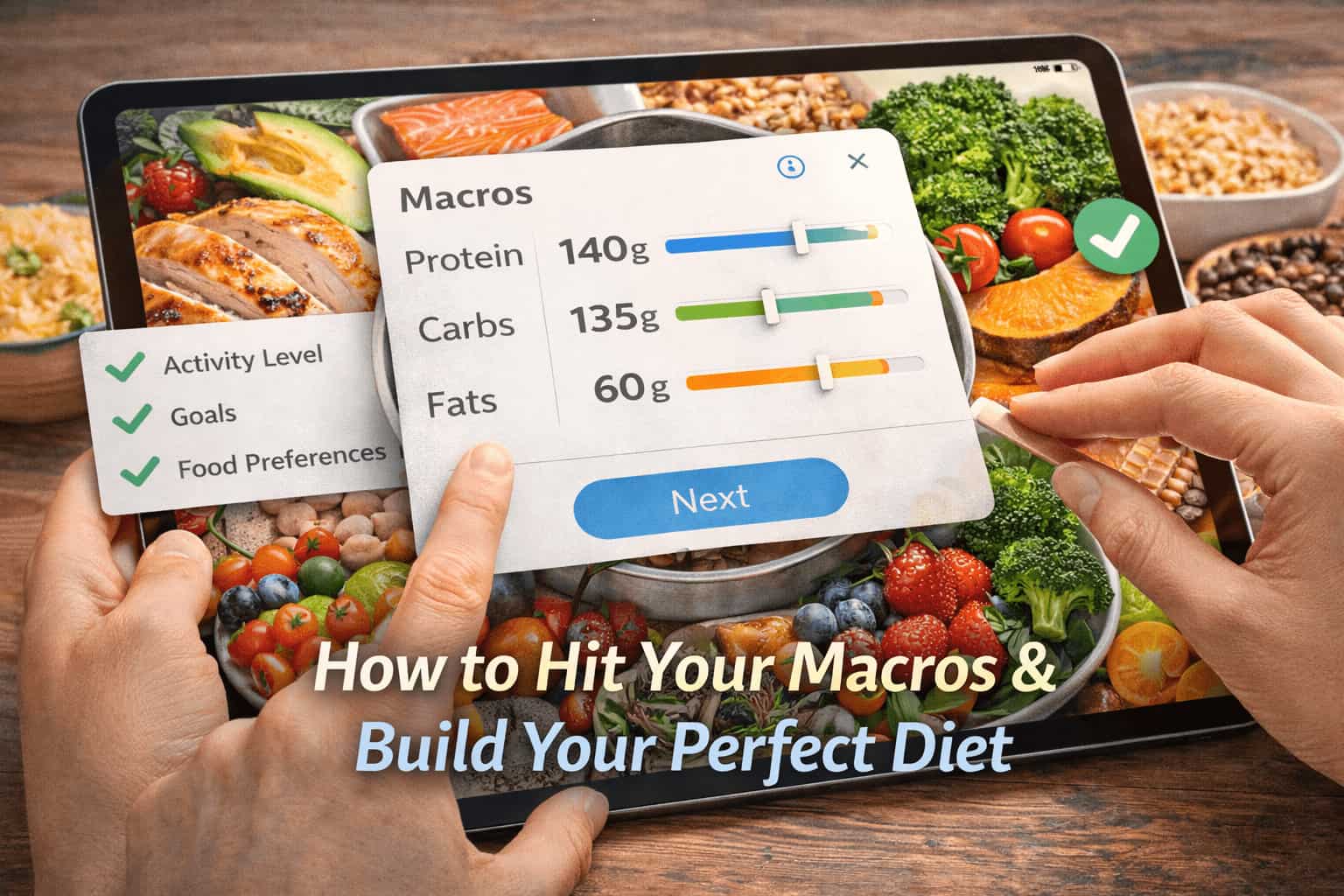
Build the Perfect Diet for Your Body in 2026:You’ve calculated your macros. You know exactly what you need: 150g protein, 200g carbs, 60g fat daily. Yet, when you try to hit these targets, you struggle. Furthermore, you either overshoot protein or undershoot carbs. Consequently, you feel like you’re failing.
Here’s the truth: hitting your macros isn’t about perfection. Rather, it’s about strategy, planning, and using the right tools.
The good news is this: building a personalized diet that hits your macros consistently is entirely learnable.Importantly, it doesn’t require complicated meal plans or exotic foods. Furthermore, it doesn’t mean eating boring chicken and broccoli every day.
In this guide, we’re showing you exactly how to hit your macros, building a sustainable diet that works for your body, providing meal frameworks and examples, and teaching you how to maintain flexibility while staying on track. Moreover, we’re revealing how EATAI makes macro hitting effortless.
Contents
- 1 Understanding Your Macro Targets: Build the Perfect Diet for Your Body
- 2 Step 1: Calculate Your Personalized Macro Targets
- 3 Step 2: Build Your Foundation Foods
- 4 Step 3: Create Your Meal Framework
- 5 Step 4: Use EATAI for Precision Tracking
- 6 Step 5: Build Flexibility Into Your Diet
- 7 Comparison Chart: Different Macro Hitting Approaches
- 8 Real-World Example: Build the Perfect Diet for Your Body
- 8.1 Person: 160-pound woman, weight loss goal, training 3x per week
- 8.1.1 Step–1: Calculate targets with EATAI
- 8.1.2 Step -: Distribute macros
- 8.1.3 Step-3: Build breakfast (30g protein, 30g carbs, 10g fat) Using EATAI recommendations:
- 8.1.4 Step-4: Build lunch (40g protein, 40g carbs, 15g fat)
- 8.1.5 Step-5: Build dinner (45g protein, 50g carbs, 12g fat)
- 8.1.6 Step-6: Fill remaining with snacks
- 8.1 Person: 160-pound woman, weight loss goal, training 3x per week
- 9 Frequently Asked Questions (FAQ about Build the Perfect Diet for Your Body)
- 9.1 Q1: How exact do my macros need to be?
- 9.2 Q2: What if I can’t hit my macro targets exactly?
- 9.3 Q3: How long before I stop needing to track?
- 9.4 Q4: Can I have flexibility while hitting macros?
- 9.5 Q5: Should I weigh all my food?
- 9.6 Q6: How do I handle eating with family or friends?
- 9.7 Q7: What if my macros don’t fit my preferences?
- 9.8 Q8: Can EATAI help me build a personalized diet?
- 9.9 Q9: How do I prevent macro tracking from becoming obsessive?
- 9.10 Q10: What’s the best timing for eating macros?
- 9.11 Q11: Do I need to eat the same meals every day?
- 9.12 Q12: How do I adjust macros if progress stalls?
- 9.13 Q13: Should I track vitamins and minerals too?
- 9.14 Q14: Can I build muscle hitting macros in a deficit?
- 9.15 Q15: Is hitting macros necessary for results?
- 10 Citations and Research References
- 11 Your Personalized Diet Building Action Plan
- 12 Final Thoughts on Build the Perfect Diet for Your Body
Understanding Your Macro Targets: Build the Perfect Diet for Your Body
Before you can hit your macros, you need to understand exactly what you’re targeting. Importantly, clarity prevents confusion.
The Three Macronutrients Explained
Protein (4 calories per gram): Your body uses protein to build and repair muscle tissue, produce hormones, create enzymes, and support immune function. Furthermore, protein is the most satiating macronutrient, meaning it keeps you fullest the longest.
Role in your diet: 25-35% of daily calories Example target: 150-200g daily for most active adults
Carbohydrates (4 calories per gram): Your body uses carbs to fuel training, support brain function, produce energy, and regulate hormones. Furthermore, carbs directly impact training performance and recovery.
Role in your diet: 40-50% of daily calories (varies by activity) Example target: 150-250g daily for active individuals
Fat (9 calories per gram): Your body uses fat to produce hormones, absorb fat-soluble vitamins, maintain cellular function, and provide energy. Importantly, fat is essential for hormonal health.
Role in your diet: 20-35% of daily calories Example target: 50-80g daily for most adults
Why Macro Balance Matters
Here’s the crucial insight: the same calories from different macro distributions produce different results.
Consider two scenarios:
- Person A: 2,000 calories as 100g protein / 250g carbs / 44g fat
- Person B: 2,000 calories as 200g protein / 120g carbs / 67g fat
Same calories. Dramatically different outcomes:
- Person A experiences more hunger, less muscle preservation, lower training performance
- Person B experiences better satiety, superior muscle building, improved training performance
Therefore, macro balance matters as much as total calories.
Step 1: Calculate Your Personalized Macro Targets
The first step toward hitting your macros is knowing exactly what to aim for. Furthermore, targets should be personalized to your goals and activity level.
Determining Your Calorie Target
First, establish your total daily energy expenditure (TDEE). Importantly, this is where EATAI excels.
Using EATAI:
- Input your height, weight, age, and activity level
- EATAI calculates your maintenance calories
- Add or subtract based on your goal:
- Weight loss: 300-500 calories below maintenance
- Muscle gain: 300-500 calories above maintenance
- Maintenance: Equal to maintenance calories
Example:
- Maintenance: 2,500 calories
- Weight loss goal: 2,000-2,200 calories daily
- Muscle gain goal: 2,800-3,000 calories daily
Setting Protein Targets
Protein targets depend on your goal and activity level:
Weight loss goal:
- 1.0-1.2 grams per pound of body weight
- Higher protein preserves muscle during deficit
- Example: 180-pound person = 180-216g daily
Muscle gain goal:
- 0.8-1.0 grams per pound of body weight
- Adequate protein supports muscle synthesis
- Example: 180-pound person = 144-180g daily
General health (sedentary) goal:
- 0.6-0.8 grams per pound of body weight
- Maintains basic health and function
- Example: 150-pound person = 90-120g daily
Determining Carb and Fat Ratios
After setting protein, distribute remaining calories between carbs and fat. Furthermore, this can vary based on preference and activity.
Weight loss (lower carb approach):
- Protein: 40% of calories
- Carbs: 30% of calories
- Fat: 30% of calories
Muscle gain (higher carb approach):
- Protein: 30% of calories
- Carbs: 45% of calories
- Fat: 25% of calories
Maintenance (balanced approach):
- Protein: 30% of calories
- Carbs: 40% of calories
- Fat: 30% of calories
Complete Example: Personalized Macros
Person: 180-pound man, weight loss goal, trains 4x per week
Step–1 – Calculate TDEE: EATAI calculates: 2,600 calories
Step–2 – Determine calorie target: 2,600 – 400 = 2,200 calories (moderate deficit)
Step–3 – Set protein: 180 pounds × 1.0 = 180g protein (720 calories, 33%)
Step-4 – Distribute remaining: 2,200 – 720 = 1,480 remaining calories
- Carbs: 40% = 880 calories = 220g carbs
- Fat: 27% = 600 calories = 67g fat
Final macros:
- Protein: 180g
- Carbs: 220g
- Fat: 67g
- Total: 2,200 calories
Step 2: Build Your Foundation Foods
Successful macro hitting starts with “foundation foods”—nutritious, calorie-predictable foods that form the basis of your diet.
Foundation Protein Sources
These are your go-to proteins. Importantly, they’re reliable, affordable, and nutritious:
Lean meats:
- Chicken breast: 165 cal, 31g protein, 3.6g fat per 100g
- Turkey breast: 135 cal, 29g protein, 1.3g fat per 100g
- Beef (93% lean): 155 cal, 24g protein, 6.4g fat per 100g
Fish and seafood:
- Salmon: 206 cal, 22g protein, 13g fat per 100g
- Tilapia: 96 cal, 20g protein, 1.2g fat per 100g
- Tuna (canned in water): 60 cal, 13g protein, 0.2g fat per 100g
Eggs and dairy:
- Whole eggs: 155 cal, 13g protein, 11g fat per 100g
- Egg whites: 52 cal, 11g protein, 0.2g fat per 100g
- Greek yogurt (0%): 59 cal, 10g protein, 0.2g fat per 100g
Legumes and plant-based:
- Lentils (cooked): 116 cal, 9g protein, 0.4g fat per 100g
- Chickpeas (cooked): 134 cal, 7.2g protein, 2.1g fat per 100g
- Tofu: 76 cal, 8g protein, 4.8g fat per 100g
Foundation Carb Sources
These carbs provide energy, fiber, and satiety:
Whole grains:
- Brown rice (cooked): 111 cal, 2.6g protein, 26g carbs per 100g
- Oats (dry): 389 cal, 17g protein, 66g carbs per 100g
- Whole wheat bread: 265 cal, 13g protein, 43g carbs per 100g
Starchy vegetables:
- Sweet potato (cooked): 103 cal, 2g protein, 24g carbs per 100g
- White potato (cooked): 77 cal, 1.7g protein, 17g carbs per 100g
- Corn: 86 cal, 3.3g protein, 19g carbs per 100g
Fruits:
- Banana: 89 cal, 1.1g protein, 23g carbs per 100g
- Apple: 52 cal, 0.3g protein, 14g carbs per 100g
- Berries: 57 cal, 0.7g protein, 14g carbs per 100g
Non-starchy vegetables:
- Broccoli: 34 cal, 2.8g protein, 7g carbs per 100g
- Spinach: 23 cal, 2.9g protein, 3.6g carbs per 100g
- Peppers: 31 cal, 1g protein, 7.3g carbs per 100g
Foundation Fat Sources
These provide essential fatty acids and calories:
Oils and cooking fats:
- Olive oil: 119 cal, 0g protein, 14g fat per tablespoon
- Coconut oil: 117 cal, 0g protein, 14g fat per tablespoon
- Butter: 102 cal, 0g protein, 11.5g fat per tablespoon
Nuts and seeds:
- Almonds: 579 cal, 21g protein, 50g fat per 100g
- Peanut butter: 588 cal, 25g protein, 50g fat per 100g
- Chia seeds: 486 cal, 17g protein, 31g fat per 100g
Whole food sources:
- Avocado: 160 cal, 2g protein, 15g fat per 100g
- Salmon: 206 cal, 22g protein, 13g fat per 100g
- Eggs: 155 cal, 13g protein, 11g fat per 100g
Step 3: Create Your Meal Framework
Rather than rigid meal plans, successful macro hitting uses flexible meal frameworks. Furthermore, this provides structure while enabling variation.
The Simple Macro-Based Meal Framework
Each main meal should contain:
- A protein source (30-50g protein)
- A carb source (50-80g carbs)
- A fat source (15-25g fat)
- Vegetables (unlimited, minimal calories)
This framework ensures you build balanced macros throughout the day.
Building Breakfast (Example: Weight Loss Macros)
Target: 180g protein, 220g carbs, 67g fat daily
Breakfast allocation: 30g protein, 50g carbs, 15g fat
Option 1: Oatmeal-Based
- ½ cup dry oats: 150 cal, 5g protein, 27g carbs, 3g fat
- 1 scoop whey protein: 120 cal, 24g protein, 1g carbs, 2g fat
- ½ cup berries: 40 cal, 0g protein, 10g carbs, 0g fat
- 1 tsp honey: 17 cal, 0g protein, 5g carbs, 0g fat
Total: 327 cal, 29g protein, 43g carbs, 5g fat (Slightly under, but flexible—not an issue)
Option 2: Egg-Based
- 3 whole eggs: 155 cal, 13g protein, 1.1g carbs, 11g fat
- 2 slices whole wheat toast: 160 cal, 8g protein, 28g carbs, 2g fat
- 1 tbsp peanut butter: 96 cal, 4g protein, 3.5g carbs, 8g fat
Total: 411 cal, 25g protein, 32.6g carbs, 21g fat (Higher fat, but fits within targets)
Option 3: Yogurt-Based
- 1 cup Greek yogurt (0%): 130 cal, 20g protein, 7g carbs, 0g fat
- ¾ cup granola: 270 cal, 6g protein, 48g carbs, 8g fat
- ½ banana: 45 cal, 0.5g protein, 12g carbs, 0g fat
Total: 445 cal, 26.5g protein, 67g carbs, 8g fat (Higher carbs, adjusting lunch accordingly)
Building Lunch (Continuing Example)
After breakfast (Option 1), remaining daily macros:
- Protein: 180 – 29 = 151g remaining
- Carbs: 220 – 43 = 177g remaining
- Fat: 67 – 5 = 62g remaining
Lunch allocation: 50g protein, 60g carbs, 20g fat
Example lunch:
- 8 oz chicken breast: 280 cal, 53g protein, 0g carbs, 6g fat
- 1 cup brown rice: 215 cal, 5g protein, 45g carbs, 2g fat
- 1 tbsp olive oil: 119 cal, 0g protein, 0g carbs, 14g fat
- Vegetables (broccoli, spinach): 50 cal, 5g protein, 8g carbs, 0g fat
Total: 664 cal, 63g protein, 53g carbs, 22g fat
Remaining after lunch:
- Protein: 151 – 63 = 88g
- Carbs: 177 – 53 = 124g
- Fat: 62 – 22 = 40g
Building Dinner and Snacks
Dinner allocation: 60g protein, 80g carbs, 20g fat
Example dinner:
- 8 oz salmon: 245 cal, 30g protein, 0g carbs, 15g fat
- 1.5 medium sweet potatoes: 155 cal, 3g protein, 35g carbs, 0g fat
- 1 tbsp olive oil: 119 cal, 0g protein, 0g carbs, 14g fat
- Vegetables: 50 cal, 3g protein, 8g carbs, 0g fat
Total: 569 cal, 36g protein, 43g carbs, 29g fat
Remaining after dinner:
- Protein: 88 – 36 = 52g
- Carbs: 124 – 43 = 81g
- Fat: 40 – 29 = 11g
Evening snack: 50g protein, 80g carbs, 11g fat
Example snacks:
- Protein shake: 40g protein, 50g carbs (fruit and carb source), 2g fat
- Rice cakes with peanut butter: 10g protein, 30g carbs, 9g fat
Daily total: ~180g protein, ~220g carbs, ~67g fat ✓
Step 4: Use EATAI for Precision Tracking
While the framework above works, EATAI automates and optimizes the entire process.
How EATAI Simplifies Macro Hitting
Feature–1: Automatic Calculation
- Input your stats
- EATAI calculates exact targets
- No manual math required
Feature–2: Food Database with Accurate Data
- Verified nutrition information
- Barcode scanning for accuracy
- No guessing or estimating
Feature–3: Real-Time Feedback
- See macros update as you log
- Know exactly where you stand
- Visual progress toward targets
Feature–4: Meal Recommendations
- EATAI suggests foods fitting your targets
- Varied options (no meal boredom)
- Personalized to your preferences
Feature-r5: Smart Adjustments
- Automatic recalculation as weight changes
- Recommendations when progress stalls
- Optimization without guesswork
Example Day Using EATAI
Morning:
- Log breakfast (oatmeal with protein powder)
- EATAI shows: 29g protein, 43g carbs, 5g fat
Remaining targets show:
- Protein: 151g
- Carbs: 177g
- Fat: 62g
Lunch:
- Search “chicken breast 8oz” in EATAI
- Add brown rice from database
- Add oil and vegetables
- EATAI shows exact macros
Afternoon:
- Check macros: On track for the day
- EATAI suggests snack matching remaining macros
- Pick something you actually want to eat
Dinner:
- Log salmon, sweet potato, and veggies
- Verify daily totals are within 5% of targets
- Job done.
Result: Consistent macro hitting without stress or guesswork.
Step 5: Build Flexibility Into Your Diet
Sustainable macro hitting requires flexibility. Furthermore, this means adapting to real life.
Eating Out While Hitting Macros
Restaurant strategy:
- Check nutrition info beforehand (most restaurants provide it)
- Choose protein source (chicken, fish, lean beef)
- Choose starch (rice, potato, bread)
- Add vegetables
- Log estimated macros in EATAI
- Adjust other meals accordingly if needed
Example: Chipotle
- Chicken burrito bowl: ~50g protein, 70g carbs, 20g fat
- Simply log it and continue with your day
- Your other meals adjust to hit targets
Strategy–1: Plan ahead
- Check restaurant menu beforehand
- Decide what you’ll eat
- Plan other meals to accommodate
Strategy–2: Flexible targets
- Treat daily targets as ranges (±10%)
- One meal over/under isn’t failure
- Weekly averages matter more than daily perfection
Strategy–3: Portion awareness
- Even at parties, you can estimate portions
- Use hand-based portions if scales unavailable
- Log estimates and move forward
Strategy–4: Prioritize protein
- At any event, choose protein first
- Then carbs and fat
- This maintains progress even with approximations
Building Your Perfect Personal Diet
Your perfect diet includes:
- 60% familiar foods: Foods you eat regularly and know well
- 30% tried-and-tested: Foods you’ve tested and like
- 10% experimenting: New foods to prevent boredom
This 60/30/10 rule maintains consistency while enabling variation.
Comparison Chart: Different Macro Hitting Approaches
| Approach | Ease of Use | Accuracy | Sustainability | Flexibility | Best For |
|---|---|---|---|---|---|
| Meal plans | Very easy | High | Low | Very low | Short-term results |
| Manual tracking | Moderate | Variable | Moderate | Moderate | Learning nutrition |
| EATAI tracking | Very easy | Very high | Very high | High | Long-term success |
| Intuitive eating | Very easy | Very low | Low | Very high | Impossible long-term |
| Macro frameworks | Moderate | Moderate | High | Very high | Flexibility priority |
Key Insight: EATAI combines ease of use with accuracy, enabling both short-term results and long-term sustainability.
Real-World Example: Build the Perfect Diet for Your Body
Let’s show someone building their personalized diet from scratch:
Person: 160-pound woman, weight loss goal, training 3x per week
Step–1: Calculate targets with EATAI
- TDEE: 2,100 calories
- Weight loss target: 1,700 calories (400 deficit)
- Protein: 160g (1.0g per pound)
- Remaining for carbs/fat: 1,060 calories
Step -: Distribute macros
- Protein: 160g (640 calories, 38%)
- Carbs: 150g (600 calories, 35%)
- Fat: 42g (378 calories, 22%)
- Total: 1,700 calories
Step-3: Build breakfast (30g protein, 30g carbs, 10g fat) Using EATAI recommendations:
- Greek yogurt (1 cup, 0%): 20g protein, 7g carbs, 0g fat
- Granola (½ cup): 6g protein, 45g carbs, 8g fat
- Berries (½ cup): 1g protein, 9g carbs, 0g fat
- Honey (1 tsp): 0g protein, 5g carbs, 0g fat
Breakfast total: 27g protein, 66g carbs, 8g fat (Slightly over carbs, but flexible)
Step-4: Build lunch (40g protein, 40g carbs, 15g fat)
- Salmon (5 oz): 35g protein, 0g carbs, 13g fat
- White rice (1 cup): 4g protein, 45g carbs, 0g fat
- Olive oil (1 tsp): 0g protein, 0g carbs, 5g fat
- Vegetables (unlimited): 2g protein, 4g carbs, 0g fat
Lunch total: 41g protein, 49g carbs, 18g fat
Step-5: Build dinner (45g protein, 50g carbs, 12g fat)
- Chicken breast (6 oz): 42g protein, 0g carbs, 6g fat
- Sweet potato (medium): 2g protein, 27g carbs, 0g fat
- Broccoli with oil: 3g protein, 6g carbs, 8g fat
- Olive oil (½ tsp): 0g protein, 0g carbs, 2g fat
Dinner total: 47g protein, 33g carbs, 16g fat
Step-6: Fill remaining with snacks
Remaining after meals:
- Protein: 160 – 27 – 41 – 47 = 45g
- Carbs: 150 – 66 – 49 – 33 = 2g
- Fat: 42 – 8 – 18 – 16 = 0g
Snacks (45g protein, 2g carbs, 0g fat):
- Protein shake (1 scoop): 25g protein, 2g carbs, 1g fat
- Lean ground turkey (4 oz): 22g protein, 0g carbs, 6g fat
Final daily total: ~160g protein, 150g carbs, 42g fat = 1,700 calories ✓
Sustainability check:
- Familiar foods (salmon, chicken, yogurt): ✓
- Enjoyable meals: ✓
- Realistic portions: ✓
- Flexible enough for variations: ✓
- Uses EATAI for precision: ✓
Result: A personalized diet she can maintain indefinitely.
Frequently Asked Questions (FAQ about Build the Perfect Diet for Your Body)
Q1: How exact do my macros need to be?
A: Approximately. Furthermore, within ±5-10g is excellent. Additionally, weekly averages matter more than daily perfection. Therefore, don’t obsess over hitting exact numbers daily.
Q2: What if I can’t hit my macro targets exactly?
A: That’s normal and acceptable. Furthermore, targets should be ranges (±10%), not exact numbers. Therefore, close is good enough. Moreover, consistency matters more than perfection.
Q3: How long before I stop needing to track?
A: For most people, 3-6 months of consistent tracking builds intuition. Furthermore, many people then transition to periodic checking. However, some prefer long-term tracking. Therefore, tracking needs vary by individual.
Q4: Can I have flexibility while hitting macros?
A: Absolutely, yes. Furthermore, flexibility is a feature, not a bug. Specifically, any foods fit if macros allow. Therefore, you can eat pizza, desserts, alcohol—just account for it in your macros. Moreover, EATAI enables this flexibility.
Q5: Should I weigh all my food?
A: Initially, yes. Furthermore, weighing teaches portion sizes. However, after 2-3 months, you can estimate many foods. Therefore, precision matters initially but becomes intuitive over time.
Q6: How do I handle eating with family or friends?
A: Plan ahead or estimate macros. Furthermore, EATAI makes estimation easy with verified data. Therefore, social eating is completely compatible with macro tracking.
Q7: What if my macros don’t fit my preferences?
A: Adjust your macros. Furthermore, there’s flexibility in macro ratios. Specifically, if your targets feel unsustainable, they’re wrong. Therefore, recalculate with EATAI for a more sustainable approach.
Q8: Can EATAI help me build a personalized diet?
A: Absolutely. Furthermore, EATAI is specifically designed for this. Moreover, it calculates targets and recommends meals fitting your goals. Therefore, EATAI makes diet building effortless.
Q9: How do I prevent macro tracking from becoming obsessive?
A: Set boundaries. Furthermore, treat targets as ranges (±10%), not exact numbers. Additionally, some days being off is fine. Therefore, flexibility prevents obsession.
Q10: What’s the best timing for eating macros?
A: Total daily macros matter more than timing. Furthermore, spreading protein across the day is slightly beneficial. However, overall intake matters far more than timing. Therefore, don’t worry about meal timing.
Q11: Do I need to eat the same meals every day?
A: No, absolutely not. Furthermore, variation prevents boredom. Specifically, same macros, different meals is ideal. Therefore, EATAI enables varied meal options fitting targets.
Q12: How do I adjust macros if progress stalls?
A: Several options: reduce calories by 100-150, increase training volume, verify tracking accuracy, adjust macro ratios. Furthermore, EATAI recommends adjustments. Therefore, diagnose first, then adjust.
Q13: Should I track vitamins and minerals too?
A: Ideally, yes. Furthermore, EATAI tracks micronutrients beyond macros. Therefore, comprehensive tracking ensures complete nutrition. Moreover, tracking shows if you’re getting adequate micronutrients.
Q14: Can I build muscle hitting macros in a deficit?
A: Difficult but possible, especially for beginners. Furthermore, higher protein helps preserve muscle in deficit. However, muscle building is easier in a surplus. Therefore, body recomposition is possible but slower.
Q15: Is hitting macros necessary for results?
A: Helpful but not required. Furthermore, calorie tracking alone works. However, macro tracking produces better results (especially for muscle). Therefore, macros accelerate progress.
Citations and Research References
The information in this blog is backed by peer-reviewed science:
Macro Composition and Body Composition
- Sacks, F. M., Bray, G. A., Carey, V. J., et al. (2009). “Comparison of weight-loss diets with different compositions of fat, protein, and carbohydrates.” New England Journal of Medicine, 360(9), 859-873.
- Helms, E. R., Aragon, A. A., & Fitschen, P. J. (2014). “Evidence-based recommendations for natural bodybuilding contest preparation: nutrition and supplementation.” Journal of the International Society of Sports Nutrition, 11(1), 20.
Protein Requirements and Satiety
- Morton, R. W., Murphy, K. T., McKellar, S. R., et al. (2018). “A systematic review, meta-analysis and meta-regression of the effect of protein supplementation on resistance training-induced gains in muscle mass and strength in healthy adults.” British Journal of Sports Medicine, 52(6), 376-384.
- Leidy, H. J., Clifton, P. M., Astrup, A., et al. (2015). “The role of protein in weight loss and weight maintenance.” American Journal of Clinical Nutrition, 101(6), 1320S-1329S.
Calorie Deficit and Weight Loss
- Hall, K. D., Sacks, G., Chandramohan, D., et al. (2011). “Quantification of the effect of energy imbalance on bodyweight.” The Lancet, 378(9793), 826-837.
- Thomas, D. M., Schoeller, D. A., Redman, L. M., et al. (2014). “A computational model to determine how much food intake change is needed to achieve a target change in bodyweight.” International Journal of Obesity, 39(3), 369-377.
Carbohydrate Function and Performance
- Burke, L. M., Hawley, J. A., Wong, S. H., et al. (2011). “Carbohydrates for training and competition.” Journal of Sports Sciences, 29(1), 17-27.
- Ivy, J. L. (2004). “Dietary strategies to promote glycogen resynthesis after exercise.” International Journal of Sport Nutrition and Exercise Metabolism, 14(1), 83-92.
Fat and Hormone Health
- Montani, J. P., Vieceli, A. K., Prabhu, K. S., et al. (2015). “Assessing the evidence for relationships between vitamin D and obesity.” Current Nutrition Reports, 4(2), 121-133.
- Holick, M. F. (2007). “Vitamin D deficiency.” New England Journal of Medicine, 357(3), 266-281.
Self-Monitoring and Adherence
- Burke, L. E., Wang, J., & Sevick, M. A. (2011). “Self-monitoring in weight loss: A systematic review of the literature.” Journal of the American Dietetic Association, 111(1), 92-102.
- Svetkey, L. P., Stevens, V. J., Brantley, P. J., et al. (2008). “Comparison of strategies for sustaining weight loss: The weight loss maintenance randomized controlled trial.” Journal of the American Medical Association, 299(10), 1139-1148.
Meal Frequency and Metabolism
- Schoenfeld, B. J., Aragon, A. A., & Krieger, J. W. (2015). “Effects of meal frequency on weight loss and body composition: A meta-analysis.” Nutrition Reviews, 73(2), 69-82.
- Cameron, J. D., Cyr, M. J., & Doucet, E. (2010). “Increased meal frequency does not promote greater weight loss in subjects who were prescribed an 8-week equated energy diet.” Nutrition Research, 30(8), 527-534.
Food Quality and Health
- Mozaffarian, D., Appel, L. J., & Van Horn, L. (2016). “Components of a cardioprotective diet: New insights.” Circulation, 123(24), 2870-2891.
- Rolls, B. J. (2009). “The relationship between dietary energy density and energy intake.” Physiology & Behavior, 97(5), 609-615.
Note: This information is for educational purposes. Consult a healthcare provider before starting a new nutrition program, especially if you have health conditions.
Your Personalized Diet Building Action Plan
To build and hit your perfect diet:
Week–1: Foundation
- Calculate targets with EATAI
- Write down 10 protein sources you enjoy
- Write down 10 carb sources you enjoy
- Write down 10 fat sources you enjoy
Week–2-3: Framework Development
- Build 3-4 breakfast options
- Build 3-4 lunch options
- Build 3-4 dinner options
- Build 2-3 snack options
- Use EATAI for nutrition information
Week–4-6: Tracking and Learning
- Log daily with EATAI
- Notice patterns in what you enjoy
- Adjust meals as needed
- Build flexibility into meal choices
Week-7-12: Optimization
- Identify your favorite macro-fitting meals
- Build weekly meal rotation
- Develop eating-out strategies
- Transition to less obsessive tracking if desired
Month 4+: Maintenance
- Continue tracking with EATAI as needed
- Periodic check-ins (monthly or quarterly)
- Adjust as life changes
- Maintain flexibility within targets
Final Thoughts on Build the Perfect Diet for Your Body
Here’s the truth about hitting your macros and building the perfect diet:
Your perfect diet isn’t one rigid meal plan. Rather, it’s a flexible framework of foods you enjoy that hit your targets consistently. Furthermore, it enables you to eat out, have social meals, and maintain flexibility while achieving results.
The process is straightforward:
- Calculate targets (with EATAI)
- Build meal frameworks
- Track consistently (with EATAI)
- Adjust as needed
- Maintain flexibility
Most importantly, use EATAI to remove complexity from the equation. Furthermore, EATAI provides accurate tracking, meal recommendations, and intelligent adjustments—enabling you to hit your macros with minimal effort.
Therefore, building your perfect diet isn’t complicated or restrictive. Rather, it’s empowering and flexible.
Start today. Calculate your targets with EATAI. Build your first meal frameworks. Start tracking.
Watch your diet become exactly what you need it to be.
You’ve got this.