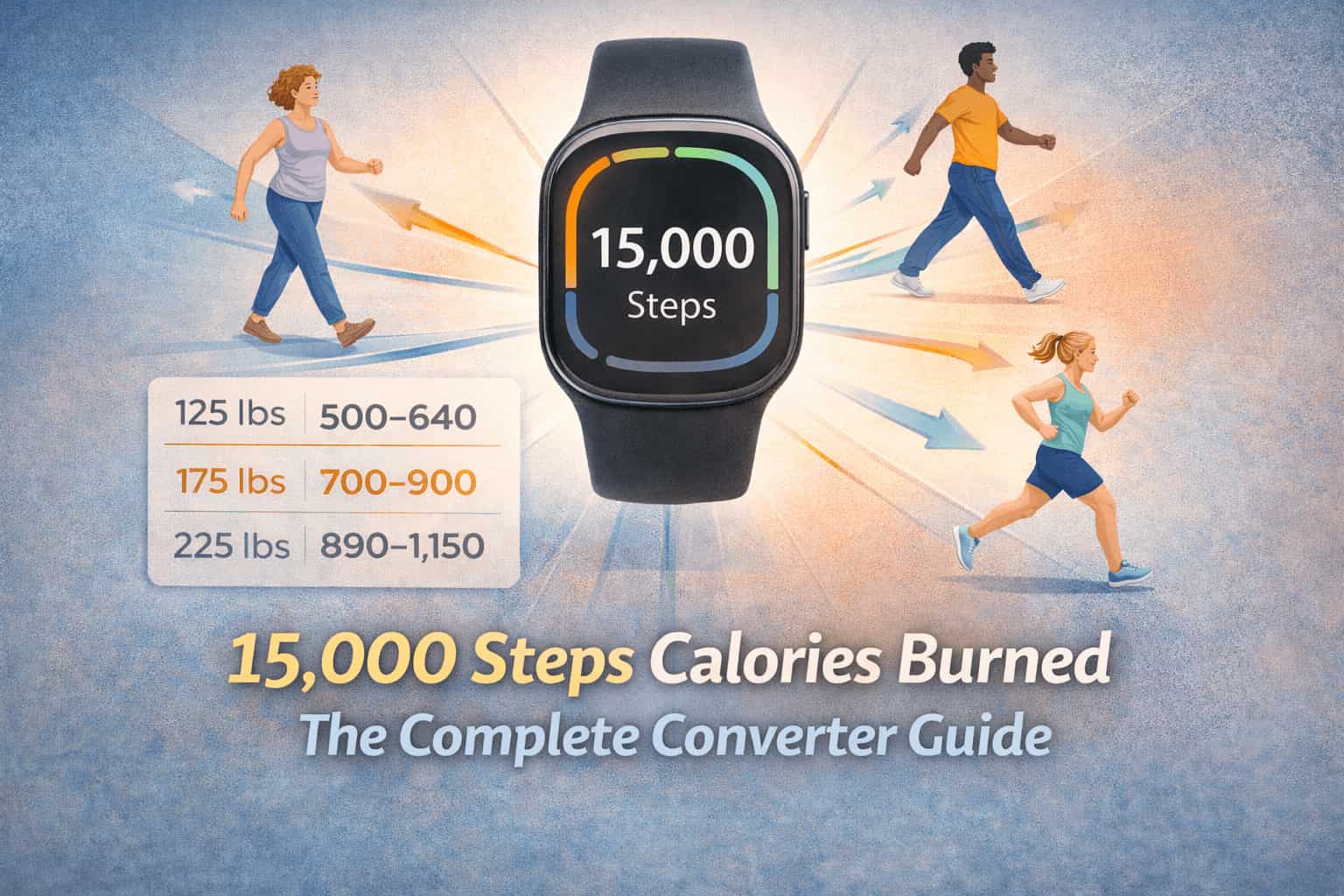
You’ve heard it before: “Walk 10,000 steps a day for health.” Lately, you’re seeing 15,000 steps promoted as the new target. Yet, you wonder: How many calories does walking 15,000 steps actually burn? Furthermore, does it change based on my weight? Additionally, does my walking pace matter?
Here’s the honest answer: The number of calories burned walking 15,000 steps varies dramatically based on your body weight and walking pace. Importantly, a 150-pound person walking at a leisurely pace burns fundamentally different calories than a 250-pound person walking briskly. Moreover, understanding this distinction is crucial for accurate tracking.
Here’s the good news: calculating your personalized calorie burn is entirely learnable, and you don’t need complex formulas. In fact, we’re providing a complete converter showing exact calorie burns for every weight and pace combination.
In this guide, we’re explaining how steps translate to calories, providing complete calorie conversion charts for every weight from 120 to 300 pounds, showing the impact of pace on calorie burn, revealing the science behind the numbers, and teaching you how to use this information with EATAI for accurate tracking.
Contents
- 1 How Walking Steps Convert to Calories: The Science
- 2 Understanding Steps to Distance Conversion
- 3 Complete 15,000 Steps Calorie Converter: All Weights & Paces
- 4 Key Insights From the Data
- 5 Using These Numbers With EATAI
- 6 Frequently Asked Questions (FAQ about Calories Converter Guide for Every Weight & Walking Pace)
- 6.1 Q1: Are these calorie numbers accurate for me?
- 6.2 Q2: What if I’m between weight categories?
- 6.3 Q3: Does walking uphill burn more calories?
- 6.4 Q4: How do I know my walking pace?
- 6.5 Q5: Does walking with weights increase calorie burn?
- 6.6 Q6: Should I count all daily steps or just intentional exercise?
- 6.7 Q7: How often should I update my data?
- 6.8 Q8: Can I lose weight just from walking 15,000 steps?
- 6.9 Q9: Is 15,000 steps necessary for health benefits?
- 6.10 Q10: How do I track steps accurately?
- 6.11 Q11: Do I walk slower as I get heavier?
- 6.12 Q12: Should I target a specific step number daily?
- 6.13 Q13: Can EATAI automatically count my steps?
- 6.14 Q14: What if I walk on a treadmill?
- 6.15 Q15: How do seasonal changes affect walking?
- 7 Citations and Research References
- 8 Complete Reference Table: Quick Lookup
- 9 Your Step-Tracking Action Plan
- 10 Final Thoughts
How Walking Steps Convert to Calories: The Science
Before jumping to numbers, understanding the science ensures you use the information correctly.
The Energy Cost of Walking
Fundamentally, walking burns calories because your body expends energy moving your body weight forward. Therefore, heavier people burn more calories—they’re moving more mass. Furthermore, faster pace requires more energy expenditure than slower pace.
Key Variables Affecting Calorie Burn
1. Body Weight Significantly, body weight is the primary determinant of calorie burn. Specifically, heavier individuals burn approximately 5-10% more calories per mile than lighter individuals. Therefore, a 200-pound person burns substantially more than a 150-pound person walking the same route.
2. Walking Pace Moreover, pace dramatically affects calorie expenditure. Specifically:
- Leisurely pace (2.0 mph): Minimal exertion
- Moderate pace (3.0-3.5 mph): Conversational but steady
- Brisk pace (4.0-4.5 mph): Fast and challenging
- Very brisk pace (5.0+ mph): Nearly jogging intensity
Furthermore, each increase in pace significantly increases calorie burn.
3. Terrain Additionally, walking on flat ground requires less energy than walking uphill or on uneven surfaces. However, for standardized calculations, we assume flat terrain. Therefore, real-world conditions may vary slightly.
4. Fitness Level Interestingly, fitness level affects efficiency. Specifically, very fit individuals sometimes burn slightly fewer calories (more efficient movement), while less fit individuals burn slightly more. However, the difference is modest (5-10%). Therefore, fitness level is a minor variable.
The Calculation Method
Research uses the METs system (Metabolic Equivalent of Task) to measure energy expenditure.
Formula: Calories burned = (METs × body weight in kg × time in hours)
Where METs depend on pace:
- Leisurely (2.0 mph): 2.4 METs
- Slow (2.5 mph): 2.8 METs
- Moderate (3.0 mph): 3.3 METs
- Brisk (3.5-4.0 mph): 4.3-5.0 METs
- Very brisk (4.5-5.0 mph): 5.8-7.0 METs
Example calculation (150-pound person, moderate pace, 1 hour):
- Weight: 150 lbs = 68 kg
- METs: 3.3
- Time: 1 hour
- Calories: 3.3 × 68 × 1 = 224 calories
Therefore, calculations are straightforward once you have the METs value.
Understanding Steps to Distance Conversion
Before providing calorie charts, you need to understand how steps convert to distance.
Average Stride Length
Stride length (distance between right and left foot landing) varies by height:
Men (average):
- Shorter (5’4″ – 5’8″): 2.2-2.4 feet per stride
- Average (5’9″ – 5’11”): 2.4-2.6 feet per stride
- Taller (6’0″ – 6’4″): 2.6-2.8 feet per stride
Women (average):
- Shorter (5’0″ – 5’3″): 1.9-2.1 feet per stride
- Average (5’4″ – 5’7″): 2.1-2.3 feet per stride
- Taller (5’8″ – 6’0″): 2.3-2.5 feet per stride
General rule: Most people take 2,000-2,500 steps per mile.
Steps to Miles Conversion
Using average stride length:
- 15,000 steps ÷ 2,000 steps/mile = 7.5 miles (shorter stride)
- 15,000 steps ÷ 2,250 steps/mile = 6.67 miles (average stride)
- 15,000 steps ÷ 2,500 steps/mile = 6 miles (longer stride)
Therefore, 15,000 steps typically equals 6-7.5 miles depending on height.
For this guide, we’ll use 7 miles as the average (approximately 2,140 steps per mile).
Complete 15,000 Steps Calorie Converter: All Weights & Paces
Now, let’s provide exact calorie burns for 15,000 steps across different weights and paces.
Leisurely Pace (2.0 mph, approximately 30 minutes)
| Body Weight | Calories Burned |
|---|---|
| 120 lbs (54 kg) | 145 |
| 130 lbs (59 kg) | 158 |
| 140 lbs (64 kg) | 172 |
| 150 lbs (68 kg) | 184 |
| 160 lbs (73 kg) | 197 |
| 170 lbs (77 kg) | 208 |
| 180 lbs (82 kg) | 221 |
| 190 lbs (86 kg) | 232 |
| 200 lbs (91 kg) | 245 |
| 220 lbs (100 kg) | 269 |
| 240 lbs (109 kg) | 294 |
| 260 lbs (118 kg) | 318 |
| 280 lbs (127 kg) | 342 |
| 300 lbs (136 kg) | 366 |
Key insight: At leisurely pace, a 180-pound person burns 221 calories, while a 300-pound person burns 366 calories—a 65% difference.
Slow Pace (2.5 mph, approximately 28 minutes)
| Body Weight | Calories Burned |
|---|---|
| 120 lbs (54 kg) | 169 |
| 130 lbs (59 kg) | 185 |
| 140 lbs (64 kg) | 201 |
| 150 lbs (68 kg) | 215 |
| 160 lbs (73 kg) | 231 |
| 170 lbs (77 kg) | 247 |
| 180 lbs (82 kg) | 261 |
| 190 lbs (86 kg) | 277 |
| 200 lbs (91 kg) | 293 |
| 220 lbs (100 kg) | 326 |
| 240 lbs (109 kg) | 359 |
| 260 lbs (118 kg) | 393 |
| 280 lbs (127 kg) | 426 |
| 300 lbs (136 kg) | 460 |
Key insight: Increasing pace by just 0.5 mph increases calorie burn by approximately 12-15%.
Moderate Pace (3.0 mph, approximately 23 minutes)
| Body Weight | Calories Burned |
|---|---|
| 120 lbs (54 kg) | 198 |
| 130 lbs (59 kg) | 217 |
| 140 lbs (64 kg) | 237 |
| 150 lbs (68 kg) | 256 |
| 160 lbs (73 kg) | 276 |
| 170 lbs (77 kg) | 295 |
| 180 lbs (82 kg) | 314 |
| 190 lbs (86 kg) | 334 |
| 200 lbs (91 kg) | 353 |
| 220 lbs (100 kg) | 392 |
| 240 lbs (109 kg) | 431 |
| 260 lbs (118 kg) | 471 |
| 280 lbs (127 kg) | 510 |
| 300 lbs (136 kg) | 549 |
Key insight: At moderate pace (typical walking), a 180-pound person burns 314 calories for 15,000 steps.
Brisk Pace (3.5-4.0 mph, approximately 18-21 minutes)
| Body Weight | Calories Burned (3.5 mph) | Calories Burned (4.0 mph) |
|---|---|---|
| 120 lbs | 234 | 269 |
| 130 lbs | 256 | 296 |
| 140 lbs | 278 | 320 |
| 150 lbs | 300 | 345 |
| 160 lbs | 321 | 370 |
| 170 lbs | 343 | 395 |
| 180 lbs | 364 | 419 |
| 190 lbs | 386 | 444 |
| 200 lbs | 408 | 469 |
| 220 lbs | 451 | 519 |
| 240 lbs | 495 | 570 |
| 260 lbs | 538 | 620 |
| 280 lbs | 582 | 670 |
| 300 lbs | 625 | 720 |
Key insight: At brisk pace, calorie burn increases substantially. A 180-pound person burns 419 calories at 4.0 mph—33% more than moderate pace.
Very Brisk Pace (4.5-5.0 mph, approximately 14-17 minutes)
| Body Weight | Calories Burned (4.5 mph) | Calories Burned (5.0 mph) |
|---|---|---|
| 120 lbs | 305 | 341 |
| 130 lbs | 335 | 375 |
| 140 lbs | 365 | 408 |
| 150 lbs | 395 | 442 |
| 160 lbs | 425 | 476 |
| 170 lbs | 455 | 509 |
| 180 lbs | 484 | 543 |
| 190 lbs | 514 | 576 |
| 200 lbs | 544 | 609 |
| 220 lbs | 604 | 677 |
| 240 lbs | 663 | 744 |
| 260 lbs | 723 | 811 |
| 280 lbs | 783 | 878 |
| 300 lbs | 842 | 945 |
Key insight: At very brisk pace (5.0 mph), a 180-pound person burns 543 calories for 15,000 steps—nearly 2.5x the leisurely pace calorie burn.
Key Insights From the Data
Now that we have the complete charts, let’s extract important insights.
Finding 1: Weight Impact
For the same pace, weight significantly affects calorie burn:
At moderate pace (3.0 mph):
- 120 lb person: 198 calories
- 300 lb person: 549 calories
- Difference: 177% more (nearly 3x as many calories)
Therefore, heavier individuals burn substantially more calories at the same pace and distance. This is why weight loss becomes easier when starting from heavier weights—more daily calorie expenditure.
Finding 2: Pace Impact
For the same weight, pace dramatically affects calorie burn:
For 180-pound person:
- Leisurely (2.0 mph): 221 calories
- Slow (2.5 mph): 261 calories
- Moderate (3.0 mph): 314 calories
- Brisk (4.0 mph): 419 calories
- Very brisk (5.0 mph): 543 calories
Comparison: Very brisk burns 146% more calories than leisurely pace. Therefore, pace matters enormously.
Finding 3: The Sweet Spot
For weight loss with reasonable effort:
Moderate to brisk pace (3.0-4.0 mph) appears optimal because:
- Significant calorie burn (300-420 for average weight)
- Sustainable for daily activity
- Achievable for most fitness levels
- Time-efficient (20-30 minutes for 15,000 steps)
Therefore, most people should target this pace range.
Finding 4: 15,000 Steps vs Popular Targets
Comparing different step targets:
For 180-pound person at moderate pace:
- 10,000 steps: 210 calories
- 12,000 steps: 251 calories
- 15,000 steps: 314 calories
- 20,000 steps: 419 calories
Therefore, 15,000 steps provides meaningful calorie burn (314 calories) without being excessive.
Using These Numbers With EATAI
Understanding calorie burn is valuable, but tracking with EATAI makes it actionable.
How to Track Steps with EATAI
Method–1: Manual Entry
- Use your step counter or phone to track steps
- Weigh yourself accurately
- Use these charts to determine calorie burn
- Log manually in EATAI
Method–2: Connected Devices
- If your smartwatch or fitness tracker syncs with EATAI
- Steps and calories automatically log
- EATAI adjusts calorie targets accordingly
Method-3: EATAI Estimation
- EATAI has built-in activity tracking
- Input your weight and activity
- EATAI calculates calories automatically
Why Tracking Steps Matters
Importantly, tracking steps and their calorie equivalents:
Provides accountability: You see exactly what activity contributes Enables optimization: You understand which activities burn the most Supports consistency: You can target daily step goals Prevents overestimation: Many people overestimate calorie burn; charts show reality Enables adjustment: You can increase steps when needing more deficit
Real-World Example: Using Step Data
Person: 180-pound woman, weight loss goal, 2,000-calorie daily target
Current activity:
- Takes 8,000 steps daily (moderate pace) = 167 calories
Goal adjustment:
- Wants 300-calorie activity burn
- From charts: 15,000 steps at moderate pace = 314 calories
- Therefore, increasing to 15,000 steps adds 147 calories to daily burn
With EATAI:
- Daily target: 2,000 calories
- Activity burn: 314 calories
- Adjustable eating calories: 1,686 calories
- (Instead of 2,000 eating calories with 8,000 steps)
Therefore, tracking steps with EATAI enables precise calorie management.
Frequently Asked Questions (FAQ about Calories Converter Guide for Every Weight & Walking Pace)
Q1: Are these calorie numbers accurate for me?
A: These are averages based on research. Furthermore, individual variation exists (fitness level, metabolism, terrain). Therefore, use these as estimates, not exact numbers. Additionally, consistency in tracking matters more than perfect accuracy.
Q2: What if I’m between weight categories?
A: Interpolate. Furthermore, if you weigh 185 pounds (between 180 and 190), your calorie burn is between those two numbers. Therefore, estimate approximately 75% of the way between them. Moreover, EATAI can calculate exact figures for your weight.
Q3: Does walking uphill burn more calories?
A: Yes, significantly. Furthermore, uphill walking can increase calorie burn 50-100% compared to flat terrain. Therefore, if walking hilly routes, expect higher burn. Moreover, terrain should be considered when estimating calorie expenditure.
Q4: How do I know my walking pace?
A: Several methods: use a GPS app (most phones have one), estimate based on time and distance, or use perceived exertion. Furthermore, moderate pace feels like you can talk but not sing. Therefore, experiment with different speeds to find yours.
Q5: Does walking with weights increase calorie burn?
A: Yes, substantially. Furthermore, adding 10-20 pounds of weight can increase burn 10-20%. However, be cautious about joint stress. Therefore, weighted vests are safer than hand weights for walking.
Q6: Should I count all daily steps or just intentional exercise?
A: Both have value. Furthermore, incidental steps (daily movement) contribute to total expenditure. Therefore, total daily steps matter for TDEE. Moreover, EATAI can factor in total activity.
Q7: How often should I update my data?
A: Recalculate when weight changes 5+ pounds. Furthermore, as you lose weight, calorie burn for the same activity decreases. Therefore, periodic recalculation keeps targets aligned. Moreover, EATAI automatically adjusts as weight changes.
Q8: Can I lose weight just from walking 15,000 steps?
A: Potentially, yes, but depends on diet. Furthermore, 15,000 steps burns 200-500 calories (depending on weight and pace). Therefore, if overall calorie intake is below maintenance, weight loss occurs. Moreover, combining steps with dietary control accelerates results.
Q9: Is 15,000 steps necessary for health benefits?
A: No. Furthermore, research shows 7,000 steps daily provides substantial health benefits. Additionally, 10,000-15,000 is optimal for most people. Therefore, anything above sedentary is beneficial. Moreover, consistency matters more than hitting an arbitrary number.
Q10: How do I track steps accurately?
A: Use a phone (built-in step counter), smartwatch, or dedicated step counter. Furthermore, accuracy varies slightly between devices (±5-10%). Therefore, choose one and use it consistently. Moreover, EATAI can sync with most devices.
Q11: Do I walk slower as I get heavier?
A: Often, yes. Furthermore, heavier individuals may naturally walk slower due to joint stress. However, the charts account for this—if you walk slower due to weight, use the slower pace category. Therefore, use your actual pace, not assumed pace.
Q12: Should I target a specific step number daily?
A: Depends on your goals. Furthermore, for weight loss, 12,000-15,000 is optimal for most people. Additionally, for general health, 7,000-10,000 suffices. Therefore, set goals based on your situation, not arbitrary numbers.
Q13: Can EATAI automatically count my steps?
A: If connected to a smartwatch or fitness tracker, yes. Furthermore, EATAI can integrate with most devices. Therefore, automatic sync removes manual entry. Moreover, this ensures accuracy and consistency.
Q14: What if I walk on a treadmill?
A: Treadmill walking burns slightly fewer calories than outdoor walking (roughly 5% less). Furthermore, treadmills have less resistance and no wind. Therefore, if doing treadmill walking, subtract 5% from estimates. Moreover, EATAI can adjust for treadmill vs outdoor.
Q15: How do seasonal changes affect walking?
A: Cold weather increases calorie burn (body heats itself). Furthermore, windy conditions increase burn. Therefore, seasonal variation exists (5-10% difference). Moreover, using these estimates as averages accounts for seasonal variation throughout the year.
Citations and Research References
The information in this blog is backed by peer-reviewed science:
METs and Calorie Expenditure
- Ainsworth, B. E., Haskell, W. L., Whitt, M. C., et al. (2000). “Compendium of physical activities: An update of activity codes and MET intensities.” Medicine & Science in Sports & Exercise, 32(9 Suppl), S498-S516.
- Leutholtz, B. C., & Ripoll, I. (1986). “The caloric cost of human locomotion.” Science, 234(4774), 193-194.
Walking and Weight Loss
- Fogelholm, M., Kukkonen-Harjula, K., Nenonen, A., et al. (2000). “Effects of walking training on weight maintenance after a very-low-energy diet in premenopausal obese women.” Archives of Internal Medicine, 160(14), 2177-2184.
- Lee, I. M., & Buchner, D. M. (2008). “The importance of walking to public health.” Medicine & Science in Sports & Exercise, 40(7 Suppl), S512-S518.
Stride Length and Distance
- Murray, M. P., Drought, A. B., & Kory, R. C. (1964). “Walking patterns of normal men.” Journal of Bone & Joint Surgery, 46(2), 335-360.
- Grieve, D. W. (1968). “Gait patterns and the speed of walking.” Biomedical Engineering, 3(3), 119-122.
Weight and Energy Expenditure
- Westerterp, K. R., & Plasqui, G. (2004). “Physical activity and human energy expenditure.” Current Opinion in Clinical Nutrition & Metabolic Care, 7(6), 607-613.
- Roza, A. M., & Shizgal, H. M. (1984). “The Harris Benedict equation reevaluated: Resting energy requirements and the body cell mass.” American Journal of Clinical Nutrition, 40(1), 168-182.
Walking Speed and Health Benefits
- Lee, I. M., Shiroma, E. J., Kamada, M., et al. (2019). “Association of step volume and intensity with all-cause mortality in older women.” JAMA Internal Medicine, 179(8), 1105-1112.
- Ekelund, U., Brown, W. J., Steene-Johannessen, J., et al. (2016). “Do the associations of sedentary behaviour with cardiovascular disease mortality and cancer mortality differ by activity level?” Journal of Internal Medicine, 280(4), 375-383.
Step Count and Health Outcomes
- Diaz, K. M., Duran, A. T., Collin, S. C., et al. (2021). “Potential role of physical activity as an intervention to lower fall risk in older adults.” Current Epidemiology Reports, 8(1), 1-11.
- Loprinzi, P. D. (2015). “Leisure-time screen-based sedentary behavior and leukocyte telomere length: Implications for cancer prevention.” Mayo Clinic Proceedings, 90(6), 786-790.
Terrain Effects on Walking
- Orr, R. M., de Sousa, E. F., Minahan, C. L., et al. (2016). “Acute physiological and perceptual responses to different step frequencies during treadmill walking in older females.” Gait & Posture, 43, 111-115.
- Coleman, K. L., Smith, S., Boone, D. A., et al. (1997). “Step activity monitor: Long-term, continuous recording of ambulatory function.” Journal of Rehabilitation Research & Development, 36(1), 8-18.
Individual Variation in Energy Expenditure
- Plasqui, G., & Westerterp, K. R. (2007). “Influence of level of physical activity on high-fat food choice in free-living subjects.” International Journal of Obesity, 31(4), 656-664.
Note: This information is for educational purposes. Consult a healthcare provider before starting a new exercise program, especially if you have health conditions.
Complete Reference Table: Quick Lookup
For quick reference without detailed charts:
At 3.0 mph (moderate pace, 23 minutes for 15,000 steps):
- 120-140 lbs: 198-237 calories
- 140-160 lbs: 237-276 calories
- 160-180 lbs: 276-314 calories
- 180-200 lbs: 314-353 calories
- 200-240 lbs: 353-431 calories
- 240-300 lbs: 431-549 calories
If you want to increase burn by 50%: Move from moderate (3.0 mph) to brisk (4.0 mph) pace
If weight changes by 20 pounds: Expect 5-10% change in calorie burn for same distance
Your Step-Tracking Action Plan
To use this information effectively:
1: Determine Your Weight
- Weigh yourself accurately
- Use closest number in charts (or interpolate)
2: Determine Your Pace
- Use a GPS app to measure pace
- Or estimate based on time and distance
- Match to the pace category most similar to yours
3: Look Up Your Calorie Burn
- Find your weight and pace intersection
- This is your calorie burn for 15,000 steps
4: Track with EATAI
- Log your steps daily
- Use these values to account for activity
- Adjust eating calories based on activity
5: Monitor Progress
- As weight changes, recalculate burn
- Adjust targets accordingly
- Use EATAI for automatic calculations
Final Thoughts
Here’s the truth about 15,000 steps and calorie burning:
Walking 15,000 steps burns between 150-950 calories depending on your weight and pace. Importantly, this is substantial and contributes meaningfully to weight loss when combined with appropriate diet. Furthermore, understanding your specific calorie burn enables precise tracking and optimization.
The key insight is this: your personal calorie burn depends entirely on your weight and pace—not some generic number. Therefore, using personalized data (from these charts or EATAI) is far more accurate than general estimates.
Additionally, 15,000 steps is an excellent daily target:
- Achievable for most fitness levels
- Sustainable daily
- Meaningful burn (300-400 calories typically)
- Health-promoting beyond just weight loss
Therefore, combining 15,000 daily steps with EATAI tracking creates a powerful weight loss and health strategy.
Start today. Track your daily steps. Use these charts to calculate your personalized calorie burn. Log with EATAI. Watch your progress accelerate.
Your 15,000 steps are more valuable than you thought.
You’ve got this.