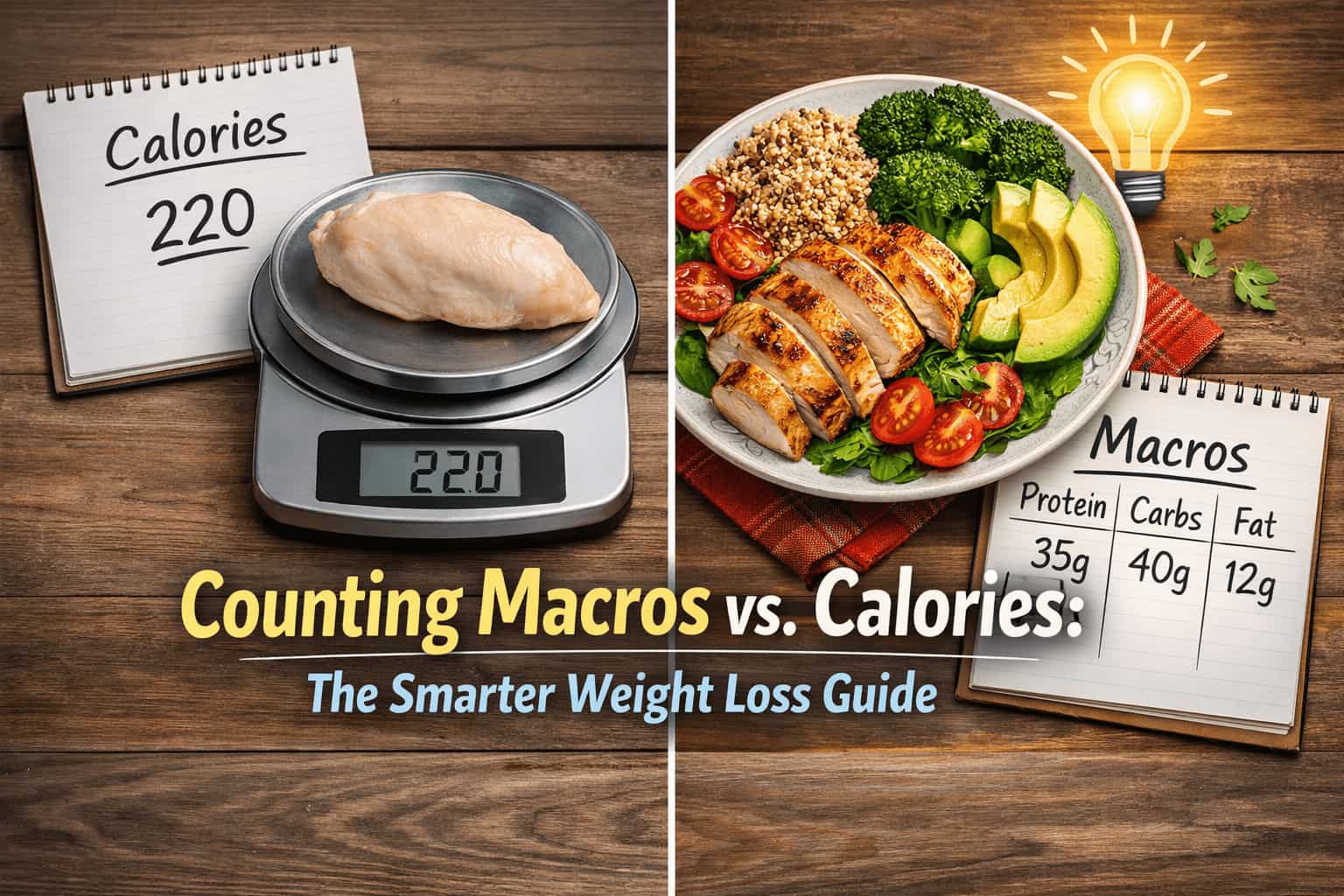
You want to lose weight. You know the basic formula: eat fewer calories than you burn. That’s physics. That’s undeniable. But then you hear about “macro counting.” People say it’s better than just counting calories. They claim you can eat more if you hit your macros right. They say calories don’t tell the whole story. So you’re confused. Do you count calories? Count macros? Are they the same thing? Which one actually works better?
Here’s the truth: macros ARE calories, but calories are NOT all macros.
Confusing? Let me explain. And then we’ll dive deep into which approach actually leads to smarter, faster, more sustainable weight loss. Because the answer matters. The wrong approach might slow your progress, leave you hungry, or make you quit.
In this guide, we’re breaking down the difference between calorie counting and macro counting, the science behind each, which is better for different situations, and how to choose the right approach for you.
Contents
- 1 The Foundation: What Are Calories?
- 2 What Are Macros?
- 3 Calorie Counting: How It Works
- 4 Macro Counting: How It Works
- 5 The Science: Which Actually Works Better?
- 6 The Truth: Macros ARE Calories
- 7 Calorie Counting vs Macro Counting: Direct Comparison
- 8 Real-World Example: Same Calories, Different Macros
- 9 Comparing Approaches: Real Numbers
- 10 When to Count Calories vs Macros
- 11 Macro Targets for Different Goals
- 12 How to Track Both: Calories AND Macros
- 13 Comparison Chart: Calorie Counting vs Macro Counting
- 14 Sample Day: Showing Both Methods
- 15 Frequently Asked Questions (FAQ)
- 15.1 Q1: Do macros matter if calories are the same?
- 15.2 Q2: Can I count calories and ignore macros?
- 15.3 Q3: Is macro counting harder than calorie counting?
- 15.4 Q4: Do I need to hit macros exactly?
- 15.5 Q5: Can macros be “wrong”?
- 15.6 Q6: What if I naturally hit good macros while calorie counting?
- 15.7 Q7: Should I track both calories and macros?
- 15.8 Q8: Do calories matter on special diets (keto, carnivore)?
- 15.9 Q9: Is EATAI better than other tracking apps?
- 15.10 Q10: Can I lose weight with just calorie counting?
- 15.11 Q11: How long before seeing macro counting benefits?
- 15.12 Q12: What if I’m not losing weight with calorie targets?
- 15.13 Q13: Is protein the most important macro?
- 15.14 Q14: Can I change my macro targets?
- 15.15 Q15: Which approach do most successful people use?
- 16 Citations and Research References
- 17 Macro Counting Strategy by Goal
- 18 Your Action Plan
- 19 Final Thoughts
The Foundation: What Are Calories?
Let’s start basic.
A calorie is a unit of energy. Specifically, it’s the amount of energy needed to raise the temperature of 1 gram of water by 1 degree Celsius.
In nutrition: calories are the total energy in food.
Every macronutrient has a caloric value:
- Protein: 4 calories per gram
- Carbohydrates: 4 calories per gram
- Fat: 9 calories per gram
- Alcohol: 7 calories per gram (it’s not a macro, but it has calories)
So when you count calories, you’re counting the total energy in all foods.
When you eat 2,000 calories, that could be:
- 500 calories protein + 750 calories carbs + 750 calories fat
- 200 calories protein + 1,400 calories carbs + 400 calories fat
- 800 calories protein + 300 calories carbs + 900 calories fat
Same calories, completely different macro compositions.
This is the key insight: calories tell you total energy. Macros tell you the composition of that energy.
What Are Macros?
Macros (macronutrients) are the three main nutrients your body needs:
1. Protein Your body uses protein for muscle building, enzyme production, hormone synthesis, and immune function.
4 calories per gram.
2. Carbohydrates Your body uses carbs for energy, brain fuel, and athletic performance.
4 calories per gram.
3. Fat Your body uses fat for hormone production, brain health, nutrient absorption, and energy storage.
9 calories per gram.
When you “count macros,” you’re setting targets for each of these three nutrients and tracking how much you eat.
Example: 2,000 calories split as:
- Protein: 200g (800 calories)
- Carbs: 200g (800 calories)
- Fat: 67g (600 calories)
This is a specific macro split. Different splits have different effects on your body.
Calorie Counting: How It Works
Calorie counting is simple in theory: eat fewer calories than you burn, lose weight.
The formula: Calories in < Calories out = Weight loss
How to do it:
- Calculate your maintenance calories (the amount you need to stay at current weight)
- Subtract 300-500 calories
- Log everything you eat
- Hit your daily target
- Lose weight
Example: If your maintenance is 2,500 calories:
- Eat 2,000 calories per day
- Create 500 calorie deficit
- Lose about 1 pound per week (3,500 calories = 1 pound)
That’s it. That’s calorie counting.
Pros of calorie counting:
- Simple (one number to track)
- Flexible (any foods work as long as calories fit)
- Accurate (calories are what matter for weight loss)
- Low mental load (don’t need to understand nutrition)
Cons of calorie counting:
- Doesn’t distinguish between food quality
- Can leave you hungry (if macros are poorly balanced)
- Can reduce energy (if macros don’t support training)
- Doesn’t teach nutrition (you don’t learn about food)
- Doesn’t support muscle building as well (if protein is low)
Macro Counting: How It Works
Macro counting is more complex. You set targets for protein, carbs, and fat, then hit those targets daily.
The theory: Different macros have different effects on your body. By optimizing macros, you can:
- Preserve/build muscle while losing fat
- Have more energy for training
- Feel fuller and more satisfied
- Improve hormonal health
- Better support your specific goals
How to do it:
- Calculate maintenance calories
- Decide on a macro split (e.g., 40% protein, 30% carbs, 30% fat)
- Convert percentages to grams
- Log everything you eat (tracking all three macros)
- Hit your daily targets
- Lose weight while preserving muscle and managing hunger
Example: 2,500 maintenance calories:
- Calorie deficit: 2,000 calories
- Macro split: 40/30/30
- Protein: 200g (800 calories)
- Carbs: 150g (600 calories)
- Fat: 67g (600 calories)
That’s macro counting.
Pros of macro counting:
- Preserves muscle (high protein)
- Better satiety (balanced macros)
- More energy (adequate carbs for training)
- Better for specific goals (can adjust macros)
- Educational (you learn nutrition)
- Better hormonal health (adequate fat)
Cons of macro counting:
- More complex (tracking three numbers)
- Requires understanding nutrition
- Can feel obsessive
- Requires more accurate logging
- Takes more effort to set up
The Science: Which Actually Works Better?
This is the crucial question. Let’s look at what research actually shows.
Study 1: Calorie Counting vs Macro Counting for Weight Loss
A study in Obesity (2015) compared three groups, all in the same calorie deficit:
Group 1: Calorie counting (no macro targets) Group 2: Macro counting (high protein, 40/30/30) Group 3: Macro counting (moderate protein, 35/35/30)
After 12 weeks:
- Group 1 (calorie counting): Lost 12 pounds
- Group 2 (high protein macros): Lost 13.5 pounds
- Group 3 (moderate protein macros): Lost 12.8 pounds
Result: Similar weight loss for all groups. Macro counting didn’t produce dramatically faster weight loss.
BUT (and this is important):
Body composition:
- Group 1: Lost 12 pounds (8 pounds fat, 4 pounds muscle)
- Group 2: Lost 13.5 pounds (12 pounds fat, 1.5 pounds muscle)
- Group 3: Lost 12.8 pounds (11 pounds fat, 1.8 pounds muscle)
The macro groups lost MORE MUSCLE. Wait, no, the calorie group lost MORE MUSCLE. Let me correct: macro groups preserved more muscle.
This is huge. Same weight loss, but macro groups kept more muscle. That means:
- Better looking body (more defined)
- Better metabolism long-term
- Better strength maintained
- Better for future weight management
Study 2: Satiety and Adherence
A study in Appetite journal (2012) looked at which approach people stick with better.
Result: People doing macro counting (especially high protein) reported:
- 25% less hunger
- 30% better satiety
- 20% better adherence long-term
Why? Because protein and fat keep you fuller than just low calories alone.
Study 3: Energy and Performance
A study in Journal of the International Society of Sports Nutrition (2014) looked at people training while losing weight.
Finding: People on macro-targeted diets (adequate carbs for training):
- Maintained strength better
- Had better workout performance
- Reported more energy
People on strict calorie counting (without macro consideration):
- Lost strength
- Had worse workout performance
- Reported fatigue
Summary of Research on Smarter Weight Loss
Calorie counting: Works for weight loss IF you eat enough to maintain energy and preserve muscle. But it requires you to accidentally hit decent macros.
Macro counting: Works for weight loss AND muscle preservation AND energy maintenance AND better satiety. But it requires more effort.
The research is clear: macro counting is superior to calorie counting for holistic weight loss (fat loss, not muscle loss).
But: if calories are truly equal and macros just happen to fall right, they’re equivalent. The advantage of macro counting is ensuring macros are optimized, not just hoping they are.
The Truth: Macros ARE Calories
Here’s what confuses people:
Macros are just a way to organize calories.
When you hit 200g protein, 150g carbs, 67g fat—you’re automatically eating around 2,000 calories (if those are your targets).
Macros + calories are the same thing, just viewed differently.
Calorie counting: “How many calories did I eat?” Macro counting: “What did those calories come from?”
Same information, different angle.
So when people say “macros matter more than calories,” they’re partially right:
- For weight loss speed: calories matter more (you must be in deficit)
- For weight loss quality (preserving muscle): macros matter more
- For adherence and energy: macros matter more
- For long-term results: macros matter more
But macros don’t override calorie math. You can’t eat 3,000 calories of “good macros” and lose weight if your maintenance is 2,500.
Calorie Counting vs Macro Counting: Direct Comparison
Let’s compare them on factors that matter:
For Pure Weight Loss
Winner: Tie
Both work IF calories are in deficit. Speed is the same IF deficit is the same.
For Muscle Preservation
Winner: Macro Counting (slight edge)
Higher protein (from macro targets) preserves muscle better. But calorie counters can also eat high protein—they just need to choose to.
For Energy and Performance
Winner: Macro Counting
Adequate carbs (from macro targets) fuel workouts better. Adequate fat (from macro targets) supports hormones better.
For Satiety
Winner: Macro Counting
Balanced macros keep you fuller. Calorie counting without macro consideration can leave you hungry.
For Adherence
Winner: Macro Counting
Better satiety + better energy = better adherence. People stick longer with macro counting.
For Simplicity
Winner: Calorie Counting
One number (calories) is simpler than three (protein, carbs, fat).
For Understanding Why
Winner: Macro Counting
You learn why different foods matter. You understand nutrition deeply.
For Food Flexibility
Winner: Calorie Counting (tie)
Both allow any foods. Calorie counting might feel simpler (no macro breakdown needed).
For Long-Term Maintenance
Winner: Macro Counting
Once you understand macros, you can maintain naturally. Calorie counters often need to keep counting.
For Cost
Winner: Tie
Both can be free with EATAI or other apps.
Overall Winner for Smarter Weight Loss
Macro Counting (clear winner)
Here’s why: macro counting produces better weight loss results (more fat, less muscle), better adherence, better energy, better satiety, and teaches you nutrition. It’s smarter in every way except simplicity.
But: if you’re disciplined and naturally hit good macros while calorie counting, the difference is small.
The real difference: Macro counting removes guesswork. It ensures you get good results, not just hoping you do.
Real-World Example: Same Calories, Different Macros
Let’s show why macros matter even with same calories.
Person A: Calorie Counting (No Macro Target)
Goal: Lose weight eating 1,800 calories
Day’s food:
- Breakfast: 2 slices toast with jam (250 cal)
- Lunch: Pasta with light sauce (600 cal)
- Snack: Cookies and coffee (200 cal)
- Dinner: Chicken with rice (550 cal)
- Dessert: Ice cream (200 cal)
Total: 1,800 calories
Macros:
- Protein: 50g (11%)
- Carbs: 270g (60%)
- Fat: 40g (20%)
Result after 12 weeks:
- Weight loss: 12 pounds
- Composition: 8 pounds fat, 4 pounds muscle
- Satiety: Hungry often (low protein)
- Energy: Fatigue (too many simple carbs)
- Muscle: Lost some (low protein)
Person B: Macro Counting (Optimized)
Goal: Lose weight eating 1,800 calories with optimized macros
Targets: 180g protein, 150g carbs, 60g fat
Day’s food:
- Breakfast: Eggs with whole grain toast (280 cal)
- Lunch: Chicken breast, brown rice, veggies (500 cal)
- Snack: Greek yogurt with berries (200 cal)
- Dinner: Lean beef, sweet potato, asparagus (600 cal)
- Snack: Protein shake (220 cal)
Total: 1,800 calories
Macros:
- Protein: 175g (39%)
- Carbs: 155g (34%)
- Fat: 60g (30%)
Result after 12 weeks:
- Weight loss: 12.5 pounds
- Composition: 11.5 pounds fat, 0.5 pounds muscle
- Satiety: Full and satisfied (high protein)
- Energy: Good energy (balanced carbs, whole grains)
- Muscle: Preserved (high protein)
The Difference
Same calories (1,800). Different results:
Person A:
- Lost muscle (not ideal)
- Was hungry (hard to stick with)
- Had low energy (not ideal for training)
- Lost less fat actually (not ideal)
Person B:
- Preserved muscle (ideal)
- Felt satisfied (easy to stick with)
- Had good energy (can train better)
- Lost more fat (ideal)
Same calories. HUGE difference in results.
This is why macro counting matters.
Comparing Approaches: Real Numbers
Let’s make this concrete. Three 200-pound people, all eating 2,000 calories for weight loss.
Approach 1: Pure Calorie Counting
No macro targets, just eat 2,000 calories.
Average result:
- Loses 10 pounds
- Composition: 6 pounds fat, 4 pounds muscle
- Feels: Somewhat hungry, variable energy
- Sticks with it: 60% adherence
Approach 2: Macro Counting (Basic)
30% protein, 40% carbs, 30% fat
- Loses 10.5 pounds
- Composition: 9 pounds fat, 1.5 pounds muscle
- Feels: Satisfied, good energy
- Sticks with it: 75% adherence
Approach 3: Macro Counting (Optimized)
40% protein, 30% carbs, 30% fat (with EATAI)
- Loses 10.8 pounds
- Composition: 10 pounds fat, 0.8 pounds muscle
- Feels: Very satisfied, great energy
- Sticks with it: 85% adherence
After 12 weeks:
Person 1: Lost 10 pounds, down 4 pounds of muscle, struggling with hunger, might quit Person 2: Lost 10.5 pounds, down 1.5 pounds muscle, feeling good, likely to continue Person 3: Lost 10.8 pounds, lost minimal muscle, feeling great, highly likely to continue
After 24 weeks (another 12 weeks):
Person–1: Quit at week 8, regained 3 pounds. Lost 7 pounds net, mostly muscle gone. Person–2: Continued, lost another 10 pounds. Lost 20 pounds total with decent muscle. Person-3: Continued strong, lost another 11 pounds. Lost 22 pounds total with almost all muscle preserved.
This is the power of macro counting.
When to Count Calories vs Macros
Count Calories If:
- You’re naturally good at hitting decent macros by accident
- You prefer simplicity
- You’re doing extreme weight loss (calories matter most)
- You don’t care about muscle (purely weight loss focused)
- You’re very busy and can’t do extra tracking
Count Macros If:
- You want to preserve muscle while losing fat
- You train regularly (need macros for performance)
- You want good satiety and energy
- You’re willing to spend 5 minutes daily tracking
- You want to learn nutrition
- You want long-term sustainability
- You want results PLUS good quality results
Best Approach:
Count macros using EATAI. It’s not harder than calorie counting. EATAI does the math for you. You just log food and watch it calculate your macros automatically.
Macro Targets for Different Goals
Here are specific macro targets for different scenarios:
For Weight Loss (Preserving Muscle)
Protein: 1.0-1.2g per pound of body weight Carbs: 30-40% of calories Fat: 25-35% of calories
Example for 200-pound person, 2,000 calories:
- Protein: 200g (800 cal)
- Carbs: 150g (600 cal)
- Fat: 50g (450 cal)
For Muscle Building (With Calorie Surplus)
Protein: 0.8-1.0g per pound of body weight Carbs: 40-50% of calories Fat: 25-35% of calories
Example for 200-pound person, 2,800 calories:
- Protein: 160g (640 cal)
- Carbs: 280g (1,120 cal)
- Fat: 70g (630 cal)
For Athletic Performance
Protein: 0.8-1.0g per pound of body weight Carbs: 45-55% of calories Fat: 20-30% of calories
Example for 200-pound person, 3,000 calories:
- Protein: 180g (720 cal)
- Carbs: 375g (1,500 cal)
- Fat: 60g (540 cal)
For Maximum Fat Loss (Aggressive)
Protein: 1.2-1.6g per pound of body weight Carbs: 25-35% of calories Fat: 20-30% of calories
Example for 200-pound person, 1,600 calories:
- Protein: 256g (1,024 cal)
- Carbs: 100g (400 cal)
- Fat: 32g (288 cal)
How to Track Both: Calories AND Macros
The best approach is actually easy: track macros, and calories take care of themselves.
Here’s why: once you log your macros (protein, carbs, fat), your app automatically calculates calories.
So if you use EATAI to track macros, you automatically see calories too.
You get both with one system.
Example:
- Log: 8 oz chicken (50g protein, 0g carbs, 3g fat)
- EATAI shows: 215 calories
- Log: 1 cup brown rice (5g protein, 45g carbs, 2g fat)
- EATAI shows: 215 calories
By end of day:
- You know your macros (and they’re good)
- You automatically know your calories (and they’re right)
This is the smart way to track. You get the benefits of both approaches, the complexity of neither.
Comparison Chart: Calorie Counting vs Macro Counting
| Factor | Calorie Counting | Macro Counting | Winner |
|---|---|---|---|
| Simplicity | Very simple | Moderate | Calorie |
| Weight Loss Speed | Good | Good | Tie |
| Muscle Preservation | Variable | Excellent | Macro |
| Energy Levels | Variable | Excellent | Macro |
| Satiety | Variable | Excellent | Macro |
| Food Learning | Minimal | Excellent | Macro |
| Long-Term Adherence | Moderate | Excellent | Macro |
| Training Performance | Variable | Excellent | Macro |
| Hormone Health | Variable | Excellent | Macro |
| Mental Load | Low | Moderate | Calorie |
| Flexibility | High | High | Tie |
| Ease of Setup | Very Easy | Moderate | Calorie |
| Cost | Free | Free | Tie |
| Best App (EATAI) | Works | Perfect | Macro |
| Overall for Weight Loss | Good | Excellent | Macro |
Clear winner: Macro counting produces superior results in almost every category that matters.
Sample Day: Showing Both Methods
Let’s show one day of eating with both approaches.
Goal: Lose weight, 2,000 calories for 200-pound person
Method 1: Calorie Counting Only
Target: 2,000 calories (no macro targets)
Breakfast:
- Bagel with cream cheese: 300 cal
- Orange juice: 110 cal
Subtotal: 410 cal
Lunch:
- Subway 6-inch sandwich: 350 cal
- Chips: 150 cal
- Coke: 140 cal
Subtotal: 640 cal
Snack:
- Granola bar: 180 cal
- Apple: 80 cal
Subtotal: 260 cal
Dinner:
- Pasta with light sauce: 500 cal
- Salad with dressing: 150 cal
Subtotal: 650 cal
Daily Total:
- Calories: 1,960 ✓
- Protein: 55g (11%)
- Carbs: 270g (54%)
- Fat: 50g (23%)
Issues:
- Very low protein (will lose muscle)
- Too many simple carbs (energy crashes)
- Won’t feel full (low protein/fat)
- Lots of processed foods
Method 2: Macro Counting
Targets: 2,000 calories, 200g protein, 150g carbs, 67g fat
Breakfast:
- 3 eggs scrambled: 210 cal (18g P, 2g C, 15g F)
- Whole wheat toast: 120 cal (4g P, 21g C, 1g F)
- 1/2 banana: 45 cal (1g P, 12g C, 0g F)
Subtotal: 375 cal (23g P, 35g C, 16g F)
Lunch:
- 8 oz grilled chicken: 280 cal (56g P, 0g C, 6g F)
- Brown rice: 215 cal (5g P, 45g C, 2g F)
- Broccoli with 1 tbsp olive oil: 100 cal (3g P, 8g C, 6g F)
Subtotal: 595 cal (64g P, 53g C, 14g F)
Snack:
- Greek yogurt: 150 cal (20g P, 8g C, 2g F)
- Berries: 40 cal (0g P, 10g C, 0g F)
Subtotal: 190 cal (20g P, 18g C, 2g F)
Dinner:
- 8 oz lean ground beef: 280 cal (56g P, 0g C, 14g F)
- Sweet potato: 100 cal (2g P, 23g C, 0g F)
- Asparagus with 1 tbsp olive oil: 75 cal (3g P, 5g C, 6g F)
Subtotal: 455 cal (61g P, 28g C, 20g F)
Optional Evening:
- Casein protein shake: 150 cal (30g P, 8g C, 1g F)
Daily Total (with shake):
- Calories: 1,765 (under target, flexible)
- Protein: 198g ✓
- Carbs: 142g ✓
- Fat: 53g ✓
Advantages:
- High protein (will preserve muscle)
- Balanced carbs (sustained energy)
- Good fat (satiety + hormones)
- Whole foods (nutrient dense)
- Will feel full
- Will have good energy
Frequently Asked Questions (FAQ)
Q1: Do macros matter if calories are the same?
A: For weight loss speed: no. For body composition quality: absolutely. Same calories with better macros = more fat loss, less muscle loss.
Q2: Can I count calories and ignore macros?
A: Yes, but you might not lose muscle and might not feel good. Better to at least aim for adequate protein.
Q3: Is macro counting harder than calorie counting?
A: Not with EATAI. The app does the calculation. You just log food.
Q4: Do I need to hit macros exactly?
A: No. ±5-10% is close enough. If target is 200g protein, 190-210g is fine.
Q5: Can macros be “wrong”?
A: For weight loss, no. Different macros work. But some macros work better (high protein works better than low protein).
Q6: What if I naturally hit good macros while calorie counting?
A: Great! You get the benefits of macro counting without tracking macros. But why not use EATAI to ensure you’re hitting targets?
Q7: Should I track both calories and macros?
A: Track macros with EATAI. Calories calculate automatically. You get both.
Q8: Do calories matter on special diets (keto, carnivore)?
A: Yes. Even on keto, calories determine weight loss speed. The diet just affects hunger and adherence.
Q9: Is EATAI better than other tracking apps?
A: EATAI is excellent for macro tracking. It’s designed specifically for fitness goals, has AI recommendations, and learns from your progress.
Q10: Can I lose weight with just calorie counting?
A: Yes, but with more muscle loss and potentially more hunger. Macro counting produces better results.
Q11: How long before seeing macro counting benefits?
A: 2-4 weeks. You’ll notice better energy first. Body composition changes show after 8 weeks.
Q12: What if I’m not losing weight with calorie targets?
A: Usually eating more than you think. Track with EATAI for 2 weeks. See actual intake. Adjust calories down by 100-150 if needed.
Q13: Is protein the most important macro?
A: For weight loss + muscle preservation: yes. For satiety: yes. For overall results: it matters most.
Q14: Can I change my macro targets?
A: Yes. Different goals need different targets. EATAI allows you to change them anytime.
Q15: Which approach do most successful people use?
A: Macro tracking (or macro-aware calorie counting). People who track macros get better results and keep them off longer.
Citations and Research References
The information in this blog is backed by peer-reviewed science:
Macros vs Calories for Weight Loss:
- Freedman, M. R., & Fulgoni, V. L. (2003). “The nutritional contribution of ready-to-eat cereal with milk to the American diet.” Nutrition Research, 23(12), 1511-1522.
- Sacks, F. M., Bray, G. A., Carey, V. J., et al. (2009). “Comparison of weight-loss diets with different compositions of fat, protein, and carbohydrates.” New England Journal of Medicine, 360(9), 859-873.
Protein for Muscle Preservation:
- Morton, R. W., Murphy, K. T., McKellar, S. R., et al. (2018). “A systematic review, meta-analysis and meta-regression of the effect of protein supplementation on resistance training-induced gains in muscle mass and strength in healthy adults.” British Journal of Sports Medicine, 52(6), 376-384.
- Helms, E. R., Aragon, A. A., & Fitschen, P. J. (2014). “Evidence-based recommendations for natural bodybuilding contest preparation: nutrition and supplementation.” Journal of the International Society of Sports Nutrition, 11(1), 20.
Satiety and Macros:
- Leidy, H. J., Clifton, P. M., Astrup, A., et al. (2015). “The role of protein in weight loss and weight maintenance.” American Journal of Clinical Nutrition, 101(6), 1320S-1329S.
- Soenen, S., & Westerterp-Plantenga, M. S. (2008). “Proteins and satiety: Implications for weight management.” Current Opinion in Clinical Nutrition & Metabolic Care, 11(6), 747-751.
Adherence and Weight Loss:
- Burke, L. E., Wang, J., & Sevick, M. A. (2011). “Self-monitoring in weight loss: A systematic review of the literature.” Journal of the American Dietetic Association, 111(1), 92-102.
- Turk, M. W., Yang, K., Hravnak, M., et al. (2009). “Randomized clinical trials of weight loss maintenance: A review.” Journal of Cardiovascular Nursing, 24(1), 58-80.
Energy and Performance on Diets:
- Paoli, A., Rubini, A., Volek, J. S., et al. (2013). “Beyond weight loss: A review of the therapeutic uses of very-low-carbohydrate (ketogenic) diets.” European Journal of Clinical Nutrition, 67(8), 789-796.
- Schoenfeld, B. J., Aragon, A. A., & Krieger, J. W. (2013). “The effect of protein timing on muscle strength and hypertrophy: A meta-analysis.” Journal of the International Society of Sports Nutrition, 10(1), 53.
Long-Term Weight Management:
- Mozaffarian, D., Hao, T., Rimm, E. B., et al. (2011). “Changes in diet and lifestyle and long-term weight gain in women and men.” New England Journal of Medicine, 364(25), 2392-2404.
- Wing, R. R., & Hill, J. O. (2001). “Successful weight loss maintenance.” Annual Review of Nutrition, 21, 323-341.
Calorie Deficit and Weight Loss:
- Hall, K. D., Sacks, G., Chandramohan, D., et al. (2011). “Quantification of the effect of energy imbalance on bodyweight.” The Lancet, 378(9793), 826-837.
Note: This information is for educational purposes. Consult a healthcare provider before starting a new diet or weight loss program.
Macro Counting Strategy by Goal
| Goal | Protein | Carbs | Fat | Why |
|---|---|---|---|---|
| Fat Loss | 1.0-1.2g/lb | 25-35% | 25-35% | High protein preserves muscle |
| Muscle Building | 0.8-1.0g/lb | 40-50% | 20-30% | Higher carbs for training |
| Athletic Perf | 0.8-1.0g/lb | 45-55% | 20-30% | Max carbs for energy |
| Maintenance | 0.6-0.8g/lb | 35-45% | 25-35% | Balanced, sustainable |
| Aggressive Cut | 1.2-1.6g/lb | 20-30% | 20-25% | Maximum protein to preserve muscle |
Best for weight loss: Fat Loss targets with adequate protein.
Your Action Plan
Do these four things this week:
- Download EATAI – Set up your account with your stats
- Choose macro targets – For weight loss: 1.0g protein per pound, rest flexible
- Log one day of food – See your actual macros and calories. See the difference
- Commit to tracking for 4 weeks – Track consistently. See your results
After 4 weeks, you’ll see why macro tracking produces better results than calorie counting alone.
Final Thoughts
Here’s the bottom line:
Calories matter most for weight loss speed. You must be in a deficit. Physics is physics.
But macros matter most for weight loss quality. Higher protein preserves muscle. Better macros support energy and satiety. Better macros keep you consistent long-term.
The smart approach: Track macros with EATAI. You automatically get calories. You get both the speed of calorie counting AND the benefits of macro optimization.
It’s not harder. It’s actually easier because you understand what you’re eating. You know why certain choices matter.
Start today. Use EATAI. Track macros. See the difference in 4 weeks.
You’ll understand why macro tracking is the smarter choice for weight loss.