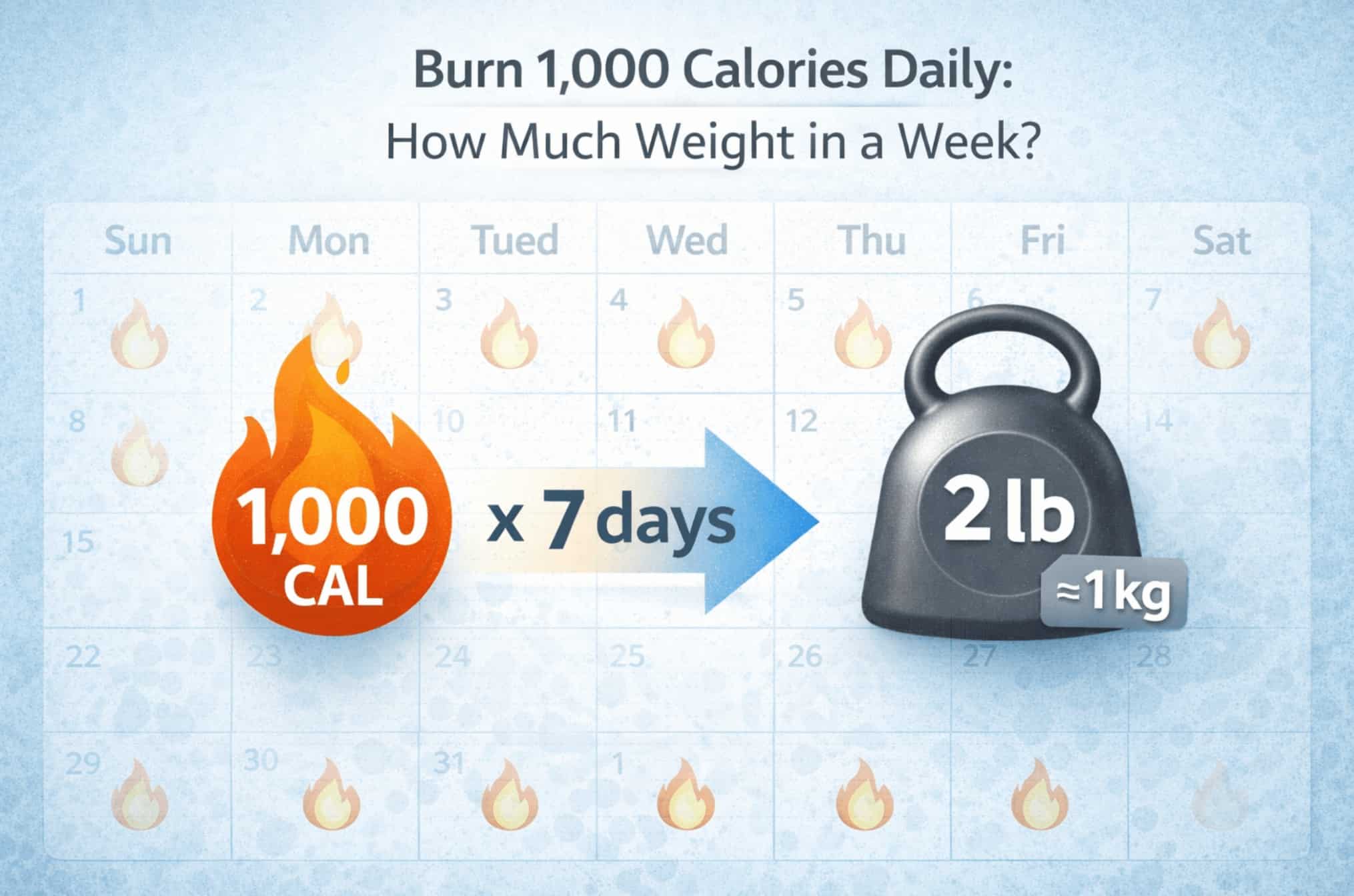
The question sounds straightforward, but the answer reveals why weight loss science is more complex than simple math. If you burn 1,000 calories daily, the theoretical answer is: 2 pounds per week. But in reality, actual weight loss depends on numerous factors that go far beyond just calorie burning. This comprehensive guide explains the real relationship between burning 1,000 calories and weight loss, addresses common misconceptions, and helps you set realistic expectations for your fitness journey.
Contents
- 1 The Basic Math: Theory vs. Reality
- 2 Why Burning 1,000 Calories Doesn’t Always Equal 2 Pounds Lost
- 3 How Much Weight ACTUALLY Burns When You Burn 1,000 Calories Daily
- 4 The Critical Ingredient You Can’t Ignore: Your Diet
- 5 Is Burning 1,000 Calories a Day Even Realistic?
- 6 The Important Reality: Weight Loss Plateaus
- 7 Gender and Body Composition Matter
- 8 The Safety Considerations
- 9 The Realistic Expectation: A Better Framework
- 10 How to Track Your Real Progress
- 11 The Bottom Line
- 12 References
The Basic Math: Theory vs. Reality
The Simple Calculation
Most experts agree that you need to have a 3,500-calorie deficit per week to lose one pound. So if you burn 1,000 calories per day — or 7,000 calories per week — you could lose 2 pounds per week.
Sounds perfect, right? Here’s the breakdown:
- 1,000 calories burned per day
- × 7 days per week
- = 7,000 calories burned per week
- ÷ 3,500 calories per pound
- = 2 pounds of weight loss per week
But Here’s the Critical Caveat
However, it’s not that straightforward.
Weight loss in reality is far more complex than this simple equation suggests. Multiple factors intervene between the number of calories you burn and the actual pounds you lose.
Why Burning 1,000 Calories Doesn’t Always Equal 2 Pounds Lost
1. Your Diet Still Matters More
For burning 1000 calories to lead to significant weight loss, your calorie intake must match the number of calories needed to maintain your current weight. Otherwise, even burning an additional 1000 calories per day may not help you lose weight.
Example: If you burn 1,000 calories but eat back all those calories (or more), you won’t lose weight. Many people unconsciously overeat after intense exercise, negating their calorie burn.
2. Metabolic Adaptation Slows Results
Significantly decreasing caloric intake causes the body to decrease the energy it burns. Typically, when individuals increase their calorie intake, they regain the lost weight. They may even gain more weight because they are in a caloric surplus.
When you maintain extreme calorie burns or deficits, your body adapts by lowering its metabolic rate. This is an evolutionary survival mechanism.
3. Your Training Age Matters
Your rate of weight loss depends on your training age and your training age refers to how many years you’ve been doing strength training.
Someone who has trained for 10 years will experience different weight loss than someone who just started. Experienced athletes have adapted metabolically and may lose weight more slowly.
4. You’re Building Muscle While Losing Fat
By burning 1000 calories a day for 3-4 days a week, you will lose about a pound of fat. Keep in mind that you will also build lean muscle, which weighs more than fat mass. Hence, check your weight loss in terms of body composition.
Your scale weight might not change much, but your body composition is transforming. Muscle weighs more than fat, so you could be losing 3 pounds of fat while gaining 1 pound of muscle—the scale shows only a 2-pound loss.
5. Water Retention Masks Fat Loss
Intense exercise causes muscle inflammation and water retention. Your body holds water to repair muscle tissue, which can completely mask fat loss on the scale for days or weeks.
How Much Weight ACTUALLY Burns When You Burn 1,000 Calories Daily
For One Week: The Realistic Number
In reality, if you burn 1,000 calories daily through exercise while maintaining your normal diet, you’ll likely lose:
- 0.5 to 1.5 pounds per week (not the theoretical 2 pounds)
- The variation depends on your current weight, age, gender, diet, sleep, and stress levels
Why not 2 pounds? Because that math assumes your deficit comes purely from exercise with no dietary compensation or metabolic adaptation.
For One Month: A More Accurate Picture
If you burn 1,000 calories daily, you could lose about 3.9 kg in a month, assuming your caloric intake remains the same and no other factors affect weight loss.
That’s approximately 8.6 pounds per month if everything goes perfectly and your diet stays constant.
The Critical Ingredient You Can’t Ignore: Your Diet
Exercise Alone Rarely Creates Weight Loss
Mayo Clinic Endocrinologist Dr. Michael Jensen also advises focusing on nutrition before exercise when trying to lose weight: “Having an immediate change in eating habits, and then gradually increasing your physical activity until you have a comfortable, active lifestyle is probably the best combination.”
Here’s the harsh truth: Burning 1,000 calories is easier than controlling diet for most people.
Quick math: A typical Starbucks Venti Caramel Macchiato with whipped cream is 390 calories. A fast-food burger is 600 calories. A protein bar is 250 calories. You can easily eat back 1,000 calories in 2-3 snacks without feeling full.
The Real Formula for Weight Loss
True weight loss requires:
- Burning more calories than you eat (exercise is just one component)
- Maintaining that deficit consistently (not just one week)
- Supporting your body with proper nutrition (to prevent muscle loss)
- Getting adequate sleep and managing stress (to prevent metabolic adaptation)
Is Burning 1,000 Calories a Day Even Realistic?
Who Can Actually Do This?
Endurance athletes, such as those training for long-course triathlons or ultra marathons, do put in 1,000 calories worth of training–or more–on most days.
For the average person, burning 1,000 calories in a single session is challenging and potentially unsafe.
How Long It Takes
Different activities require different time commitments to burn 1,000 calories:
- Running at 8 mph: 60-90 minutes
- Cycling: 90-120 minutes
- Elliptical: 90-120 minutes
- Swimming: 120+ minutes
- Walking at 6 mph: 120+ minutes
- HIIT/High-intensity training: 60-90 minutes
Most experts agree you need to have a 3,500-calorie deficit per week to lose one pound. The average workout on Fitbod lasts an hour and burns nearly 400 calories. So, if you do two to three 1-hour Fitbod strength training workouts per week, you’ll burn 1000 calories.
Better Approach: Spread It Throughout the Day
Instead of slogging through grueling workouts to try to burn 1,000 calories in one shot, you’re better off burning more calories throughout your entire day. Some of the ways you can do this include increasing your non-exercise activity thermogenesis (NEAT) — or ways that you move your body without exercising — and getting in at least 8,000 steps per day.
Breaking 1,000 calories into:
- Morning workout: 300 calories
- Lunch-time walk: 200 calories
- Evening workout: 300 calories
- Daily movement (NEAT): 200 calories
- Total: 1,000 calories
This approach is far more sustainable and safer.
The Important Reality: Weight Loss Plateaus
You Can’t Sustain 2 Pounds Per Week Forever
To make things more complicated, your progress will eventually stall when you’re on a weight loss plan. You can only sustain a 2lb/week rate of weight loss for so long. Think about it — if a 200lb person was able to consistently lose 2lbs/week, they’d lose close to half of their body weight in a year, which is an unrealistic expectation.
This explains why people often see fast initial results that slow down dramatically after 6-12 weeks.
What’s a Healthy Rate?
500 to 600 a day under your maintenance level can lead to about a pound of weight loss per week. This is often considered a healthy rate.
This means: Instead of burning 1,000 extra calories daily, a more sustainable approach is creating a 500-750 calorie daily deficit through a combination of slightly reduced food intake AND exercise.
Gender and Body Composition Matter
Who Burns More Calories?
Usually, males and people with bigger bodies burn more calories daily than females and people with smaller bodies. For example, a 100-pound female will have to spend much more time exercising to burn 1,000 calories than a 250-pound male.
The Muscle Mass Factor
People with greater body mass, especially muscle mass, possess a greater Basal Metabolic Rate (BMR). This signifies that their bodies burn more calories when at rest to sustain basic operations.
This is why:
- Athletic men can burn 1,000 calories in an hour of intense exercise
- Smaller women might need 2+ hours to achieve the same burn
The Safety Considerations
Is Burning 1,000 Calories Daily Safe?
Burning 1,000 calories daily is a challenging but possible goal for those who are fit and dedicated to combining high-intensity workouts, regular physical activity, and a healthy diet. However, trying to burn 1,000 calories in just 30 minutes is not recommended for most people because it puts extreme physical stress on the body, increasing the risk of injury or burnout.
Key Safety Rules
- Build gradually: Don’t jump from sedentary to 1,000 calorie burns
- Include rest days: Your body needs recovery time
- Fuel your body: Ensure you’re eating enough to support intense exercise
- Monitor your health: Extreme calorie burns can affect hormones, mood, and recovery
- Consult a professional: Working with a trainer or doctor is wise when attempting extreme calorie burns
The Realistic Expectation: A Better Framework
Forget the 1,000-Calorie Goal
Aiming for a consistent 500-700 calorie deficit through a combination of moderate exercise and healthy eating habits is a more sustainable and effective approach for most people. This reduces the risk of injury, burnout, and muscle loss while still promoting weight loss and long-term health.
The Better Math
Instead of obsessing over burning 1,000 calories:
- Eat 250-350 fewer calories (sustainable dietary change)
- Burn 250-350 extra calories through exercise (achievable activity)
- Total deficit: 500-700 calories per day
- Weekly loss: 1-1.5 pounds
- Monthly loss: 4-6 pounds
- Yearly loss: 52-78 pounds
This approach is:
- Sustainable (you can maintain it for years, not weeks)
- Healthy (preserves muscle, doesn’t trigger metabolic adaptation)
- Realistic (doesn’t require extreme exercise dedication)
- Evidence-based (aligns with medical recommendations)
How to Track Your Real Progress
Don’t Rely on Scale Weight Alone
Keep in mind that you will also build lean muscle, which weighs more than fat mass. Hence, check your weight loss in terms of body composition.
Track progress through:
- Scale weight (weekly, not daily)
- Body composition (muscle vs. fat percentage)
- Measurements (waist, chest, thighs)
- How clothes fit
- Energy levels (feeling stronger, faster)
- Performance (running faster, lifting more)
Use Nutrition Tracking to Stay Accountable
Use an app like EATAI (https://geteatai.app) to track your actual calorie and macro intake. EATAI’s AI photo-recognition shows you exactly what you’re eating without database searching. This accountability prevents you from eating back your 1,000 calorie burn.
Simply photograph your meals and EATAI shows you the nutritional breakdown instantly. This makes it easy to see if you’re actually in the calorie deficit needed for weight loss.
The Bottom Line
If you burn 1,000 calories a day, you could lose approximately 1-2 pounds per week, with the most realistic expectation being 1-1.5 pounds per week.
The theoretical answer is 2 pounds, but real-world factors including metabolic adaptation, dietary compensation, training age, water retention, and muscle gain typically reduce actual fat loss to 1-1.5 pounds weekly.
More importantly: The combination of moderate dietary reduction (250-350 calories) plus moderate exercise (250-350 calories) is far more sustainable and likely to produce better long-term results than attempting to burn 1,000 calories through exercise alone.
Weight loss success comes from consistency, not intensity. A moderate approach you can maintain for years beats an extreme approach you can only survive for weeks.
References
- Mayo Clinic – Counting Calories: Get Back to Weight-Loss Basics
- Fitbod – Burning 1000 Calories: 7 Ways To Do It + How Long It Takes
- Cal AI – If I Burn 1000 Calories a Day, How Much Weight Will I Lose in a Week
- Fitness Volt – Burn 1000 Calories a Day Without Feeling Exhausted—Here’s How
- Cal AI – If I Cut 1000 Calories a Day, How Much Weight Will I Lose
- Longevity – How to Burn 1K Active Calories a Day
- Healthline – Burning 1000 Calories a Day: Tips, Cautions, and More
- Medical News Today – 1000 Calorie Diet: Risks, Benefits, and Safe Weight Loss
- Tone Op Fit – Looking To Achieve Calorie Deficit? Here Is Everything You Need To Know About 1000 Calorie Burn Exercise Safely
- Style Craze – 1000 Calorie Workout: 5 Best Exercises For Safe, Effective Burn
- EATAI Official Website – https://geteatai.app