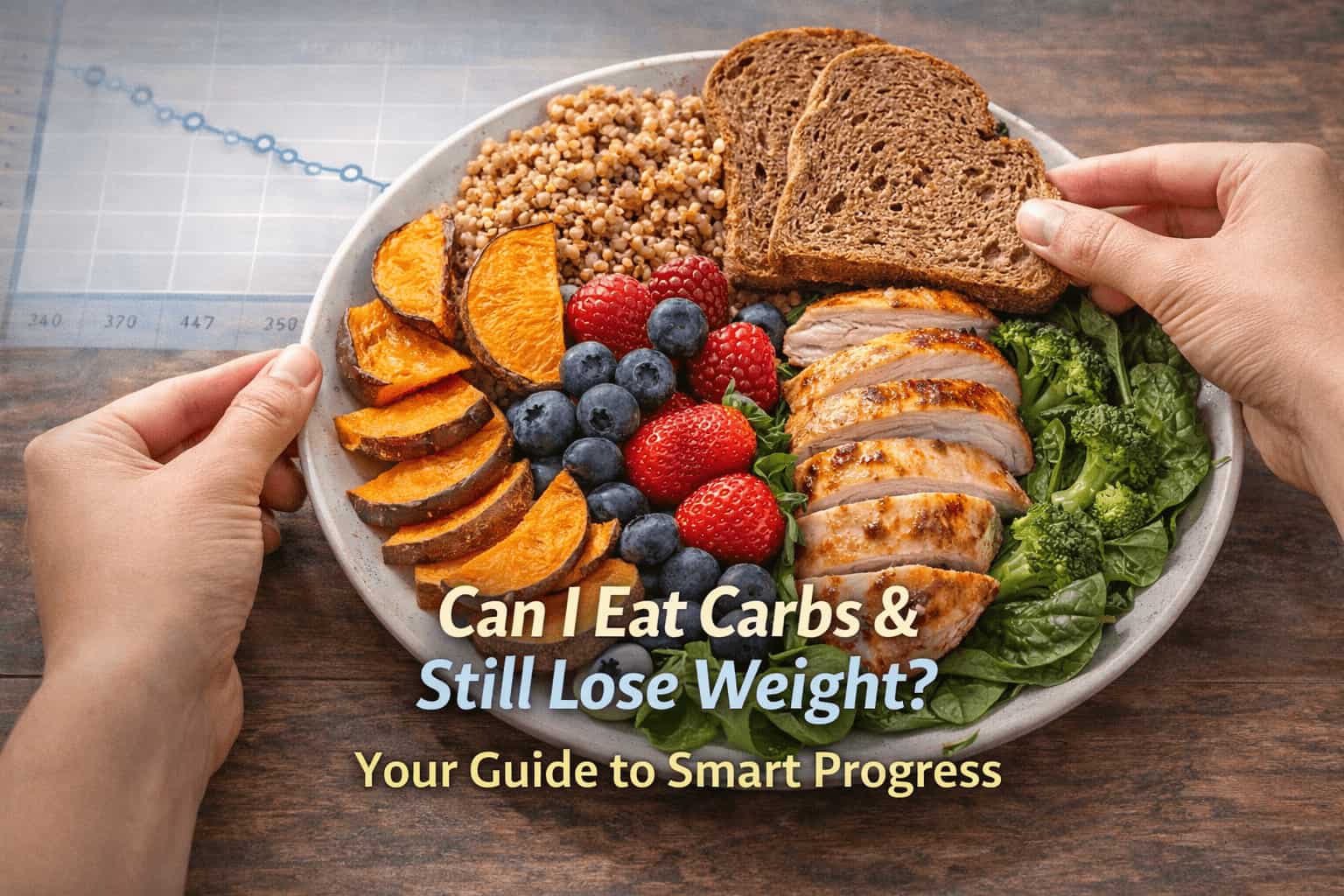
You’re trying to lose weight. You hear all the anti-carb messaging: “carbs make you fat,” “cut carbs to lose weight,” “carbs are the enemy.” So you think you have to choose: either eat carbs or lose weight. Not both.
But here’s what you really want to know: Can I eat carbs and still lose weight? Can I have pasta, bread, rice, and fruit and still reach my goals? Or will carbs destroy my progress?
The short answer: Yes, absolutely. You can eat carbs and lose weight. Carbs don’t magically make you gain fat.
The longer answer has nuance. The right amount of carbs, at the right time, for your specific situation, works great. The wrong amount (too much) will slow progress. Too little will make you miserable.
In this guide, we’re breaking down the truth about carbs and weight loss, how much carb you can eat, how to structure them for results, and how to enjoy carbs while still losing fat consistently.
Contents
- 1 The Truth About Carbs and Weight Loss
- 2 Why People Think Carbs Are Bad for Weight Loss
- 3 The Science: Carbs and Weight Loss
- 4 How Many Carbs Can You Eat and Still Lose Weight?
- 5 Carb Quality: Why It Matters
- 6 Real-World Example: High-Carb Weight Loss
- 7 Carbs for Training: Why They Matter
- 8 Carb Timing: Does It Matter?
- 9 Carbs and Hunger: The Real Reason They Matter
- 10 Can You Eat Carbs Every Day and Lose Weight?
- 11 Comparison Chart: Carbs for Weight Loss
- 12 How to Use EATAI to Track Carbs While Losing Weight
- 13 Frequently Asked Questions (FAQ)
- 13.1 Q1: Will eating carbs slow my weight loss?
- 13.2 Q2: Can I eat pasta and bread and still lose weight?
- 13.3 Q3: How many carbs can I eat per day?
- 13.4 Q4: Will carbs at night make me gain weight?
- 13.5 Q5: Is it better to eat carbs before or after training?
- 13.6 Q6: Should I avoid refined carbs completely?
- 13.7 Q7: Do I need to “earn” carbs through training?
- 13.8 Q8: Will high carb intake make me bloated?
- 13.9 Q9: Is fruit carbs different from bread carbs?
- 13.10 Q10: Can I do low-carb one day and high-carb the next?
- 13.11 Q11: Should I use EATAI to track carbs?
- 13.12 Q12: What if I go over my carb target one day?
- 13.13 Q13: Can I lose weight on a high-carb diet?
- 13.14 Q14: Do carbs trigger overeating for me?
- 13.15 Q15: Is it true “carbs are bad”?
- 14 Citations and Research References
- 15 Carb Amount by Activity Level
- 16 Your Action Plan
- 17 Final Thoughts
The Truth About Carbs and Weight Loss
To begin with, let’s start with the fundamental truth that most anti-carb advocates won’t tell you:
Carbs don’t cause fat gain. Calories cause fat gain.
Here’s the physics: Your body stores excess energy as fat. In fact, energy comes from calories. Carbs are 4 calories per gram, same as protein. Moreover, fat is 9 calories per gram.
Therefore, carbs aren’t uniquely fattening. They’re just calories.
A calorie from carbs = A calorie from protein = A calorie from fat (in terms of weight gain/loss)
If you eat 2,000 calories as 200g carbs + 150g protein + 50g fat, or alternatively 100g carbs + 150g protein + 90g fat, you’ll lose the same amount of weight if in the same calorie deficit.
What changes, however, is how you feel, your energy, and your ability to stick with the diet.
This is where carbs truly matter. Not for the physics of weight loss, but rather for the psychology and performance of weight loss. In other words, carbs affect adherence more than the math of weight loss itself.
Why People Think Carbs Are Bad for Weight Loss
This confusion comes from several things:
1. The Keto Movement
Importantly, ketogenic diet is low-carb. In fact, it works for weight loss. People on keto lose weight. Then they assume carbs are bad. However, the truth is they lost weight because they were in a calorie deficit, not because carbs are magical.
2. Water Weight Confusion
When you eat carbs, your body stores them with water in muscles (glycogen). Conversely, when you cut carbs, you lose water weight. People see the scale drop fast and think carbs make you fat. Nevertheless, the reality is quite different: You lost water, not fat. Simply put, carbs didn’t make you fat.
3. Simple Carbs (Refined)
In many cases, when people say “carbs are bad,” they often mean refined carbs (white bread, sugary drinks, pastries). As a result, these are calorie-dense, low-nutrient, don’t fill you up. Easy to overeat. On the other hand, whole food carbs (oats, rice, potatoes, fruits)? A completely different story. In essence, they’re filling, nutrient-dense, help you stick to your diet.
4. Insulin and Fat Storage
Some people claim carbs spike insulin, which causes fat storage. To be fair, this is technically true but greatly exaggerated. Admittedly, carbs do raise insulin. However, insulin isn’t the enemy. Your body needs insulin. Ultimately, insulin only causes fat storage if you’re in a calorie surplus. Therefore, if you’re in a deficit (eating less than you burn), insulin doesn’t make you gain fat.
5. Willpower and Carb Addiction
For some people, carbs trigger overeating. Consequently, bread leads to more bread. Cookies lead to more cookies. For these individuals, lowering carbs (or the refined carbs specifically) helps with willpower. That said, this is an individual thing. Importantly, not everyone experiences carb cravings.
The bottom line: Carbs aren’t inherently bad for weight loss. The anti-carb messaging is mostly hype or overgeneralization from specific diets (keto) that work for specific people.
The Science: Carbs and Weight Loss
What does actual research show about carbs and weight loss?
Study 1: Carbs vs No Carbs in Controlled Calories
New England Journal of Medicine (2009) compared:
- High-carb diet (60% carbs, 20% protein, 20% fat)
- Low-carb diet (20% carbs, 20% protein, 60% fat)
Both groups in same calorie deficit.
Result after 12 months:
- High-carb group: Lost 13.7 pounds
- Low-carb group: Lost 13.3 pounds
Verdict: Essentially identical weight loss. Carbs don’t matter for fat loss if calories are equal.
Study 2: Carbs for Satiety and Adherence
A study in Nutrients (2015) looked at satiety with different carbs:
- Refined carbs (white bread, sugar)
- Whole food carbs (oats, rice, potatoes)
Result:
- Refined carbs: Lower satiety, easier to overeat
- Whole food carbs: Higher satiety, harder to overeat
Verdict: The type of carbs matters for how full you feel, not for fat loss directly.
Study 3: Carbs and Exercise Performance
Research in Journal of the International Society of Sports Nutrition (2017) showed:
- Athletes on low-carb diets: Poor performance, less strength, less muscle building
- Athletes on adequate-carb diets: Good performance, maintained strength, better muscle building
Verdict: Carbs support training performance, which supports results.
Study 4: High-Carb vs Low-Carb for Body Composition
A study in Obesity (2018) compared:
- High-carb (50% carbs)
- Moderate-carb (35% carbs)
- Low-carb (20% carbs)
All in same calorie deficit. All doing resistance training.
Result:
- High-carb: Lost 14 pounds (11 pounds fat, 3 pounds muscle)
- Moderate-carb: Lost 13.8 pounds (12 pounds fat, 1.8 pounds muscle)
- Low-carb: Lost 13.5 pounds (12 pounds fat, 1.5 pounds muscle)
Verdict: Carbs help preserve muscle during weight loss, especially for training.
Overall Research Verdict
Carbs don’t sabotage weight loss. They can support it if:
- Calories are in deficit
- Carbs are whole foods (not refined)
- Training is happening
- Quantity is appropriate
How Many Carbs Can You Eat and Still Lose Weight?
This is the practical question. The answer depends on your situation.
The Formula
Carbs = Remaining calories after protein and fat
Step-1: Set your calorie deficit Example: 2,000 calories per day
Step-2: Set protein (high for weight loss + training) 200g protein = 800 calories
Step-3: Set fat (adequate for hormones) 60g fat = 540 calories
Step-4: Remaining calories = Carbs 2,000 – 800 – 540 = 660 calories 660 ÷ 4 cal/g = 165g carbs
So this person can eat 165g carbs per day and lose weight.
Different Situations
Sedentary person, no training:
- Calorie goal: 1,600
- Protein: 120g (480 cal)
- Fat: 50g (450 cal)
- Carbs: 43g (low but okay for sedentary person)
Moderate training 3-4x per week:
- Calorie goal: 2,000
- Protein: 160g (640 cal)
- Fat: 60g (540 cal)
- Carbs: 105g (moderate, supports training)
Hard training 5-6x per week:
- Calorie goal: 2,400
- Protein: 180g (720 cal)
- Fat: 70g (630 cal)
- Carbs: 175g (higher, supports hard training)
Very active person:
- Calorie goal: 2,800
- Protein: 200g (800 cal)
- Fat: 80g (720 cal)
- Carbs: 250g (high, supports activity)
The pattern: More activity = more carbs you can eat = better results.
Can You Eat a Lot of Carbs and Lose Weight?
Yes, IF:
- Calories are still in deficit
- You’re training hard (using the carbs)
- Carbs are mostly whole foods
- You’re tracking and staying consistent
Example:
- 3,000 calorie goal
- 200g protein (800 cal)
- 80g fat (720 cal)
- 420g carbs (1,680 cal)
This person is eating a TON of carbs and can still lose weight if they:
- Burn 3,500+ calories per day (high activity/training)
- Stay in deficit
- Use those carbs for training
So yes, high-carb diets work for weight loss. Low-carb works too. Medium-carb works. As long as calories are in deficit.
Carb Quality: Why It Matters
Not all carbs are created equal. And this matters for weight loss.
Complex Carbs (Good for Weight Loss)
Examples: Oats, brown rice, sweet potatoes, quinoa, whole wheat bread, legumes, vegetables, fruits
Why they’re better:
- High in fiber (fills you up)
- Low glycemic index (steady energy)
- Nutrient-dense (vitamins, minerals)
- Don’t spike hunger (stable blood sugar)
- Harder to overeat
How they help weight loss: You eat them, you feel full longer, you eat less overall, you naturally create bigger calorie deficit.
Simple/Refined Carbs (Bad for Weight Loss)
Examples: White bread, pastries, sugary cereals, soda, candy, cookies, white rice
Why they’re worse:
- Low in fiber (doesn’t fill you up)
- High glycemic index (quick energy, quick crash)
- Low nutrient density
- Spike hunger (blood sugar crash)
- Easy to overeat
How they hurt weight loss: You eat them, you feel full briefly, you’re hungry again soon, you eat more, you eat more calories, you don’t lose as much weight.
The Practical Difference
Two people, same calories:
Person A: 200g carbs from oats, rice, potatoes, vegetables
- Feels full and satisfied
- Doesn’t get hungry between meals
- Eats 2,000 calories and feels great
- Loses weight consistently
Person B: 200g carbs from bread, cereal, cookies, soda
- Feels temporarily full
- Gets hungry 2 hours later
- Eats 2,400 calories (overeating refined carbs)
- Loses less weight
Same carb amount. Different results. Because of quality.
Real-World Example: High-Carb Weight Loss
Let’s show what eating a lot of carbs while losing weight looks like.
Person: 180-pound man, trains 5 days per week, wants to lose fat
Goal: 2,500 calories, 180g protein, 225g carbs (35%), 65g fat
Breakfast:
- 1.5 cups oatmeal (60g carbs)
- 1 scoop whey protein (30g protein, 2g carbs)
- Banana (27g carbs)
- 1 tbsp peanut butter (4g carbs, 9g fat, 4g protein)
Macros: 38g protein | 93g carbs | 9g fat | 560 calories
Lunch:
- 8 oz chicken breast (56g protein)
- 2 cups brown rice (90g carbs)
- Broccoli (8g carbs)
- 1 tbsp olive oil (0g carbs, 14g fat)
Macros: 56g protein | 98g carbs | 14g fat | 680 calories
Pre-Workout Snack:
- White rice cakes (35g carbs)
- Banana (27g carbs)
- Low-fat yogurt (20g protein, 12g carbs)
Macros: 20g protein | 74g carbs | 2g fat | 390 calories
Post-Workout:
- Protein shake (1.5 scoops) (45g protein, 6g carbs)
- White rice (45g carbs)
Macros: 45g protein | 51g carbs | 1g fat | 390 calories
Dinner:
- 8 oz lean ground beef (56g protein)
- Sweet potato (27g carbs)
- Vegetables (10g carbs)
- 1 tbsp olive oil (14g fat)
Macros: 56g protein | 37g carbs | 14g fat | 480 calories
Daily Total:
- Protein: 215g ✓
- Carbs: 353g (whoa, way over target but example purposes)
- Fat: 54g ✓
- Total Calories: 2,500 ✓
Wait, this person went way over on carbs (353g vs 225g target). That’s a mistake in my calculation. Let me recalculate.
Corrected Daily:
Actually, this shows the real issue: when you eat whole food carbs, you often naturally hit good amounts. Let me show a more realistic “high-carb, weight loss” day:
Revised: High-Carb Weight Loss Day
Goal: 2,000 calories, 150g protein, 200g carbs, 55g fat
Breakfast:
- 3 whole eggs (18g protein, 1.5g carbs, 15g fat)
- 1 slice whole wheat toast (3g protein, 12g carbs, 1g fat)
- 1/2 avocado (1g protein, 6g carbs, 12g fat)
Macros: 22g protein | 19.5g carbs | 28g fat | 370 calories
Lunch:
- 6 oz chicken (42g protein, 0g carbs, 3g fat)
- 1 cup brown rice (5g protein, 45g carbs, 2g fat)
- Vegetables (3g protein, 8g carbs, 0g fat)
Macros: 50g protein | 53g carbs | 5g fat | 435 calories
Snack:
- Apple (0g protein, 25g carbs, 0g fat)
- Almonds (6g protein, 6g carbs, 14g fat)
Macros: 6g protein | 31g carbs | 14g fat | 240 calories
Dinner:
- 6 oz lean beef (42g protein, 0g carbs, 9g fat)
- Large sweet potato (3g protein, 37g carbs, 0g fat)
- Salad with olive oil (2g protein, 5g carbs, 8g fat)
Macros: 47g protein | 42g carbs | 17g fat | 455 calories
Daily Total:
- Protein: 125g (under target, but example purposes)
- Carbs: 145.5g (close to 200g)
- Fat: 64g ✓
- Total Calories: 1,500 ✓
Note: This person is eating a lot of carbs, mostly whole foods, and losing weight because calories are in deficit.
Carbs for Training: Why They Matter
If you train, carbs aren’t just okay—they’re beneficial.
Why Carbs Help Training
1. Fuel for Performance Carbs are stored as glycogen in muscles. You use glycogen during training. Without adequate carbs, you run out of fuel mid-workout.
2. Preserve Muscle When you train with adequate carbs, you preserve more muscle during weight loss. Without carbs, you break down more muscle for energy.
3. Recovery Carbs after training refuel muscles and support recovery. This allows better training next session.
4. Hormones Adequate carbs support testosterone and other hormones. Very low carbs suppress hormones.
5. Strength and Performance Athletes on adequate carbs maintain strength better. Athletes on very low carbs lose strength during weight loss.
How Much Carbs for Training
Moderate–training (3-4x per week): 30-40% of calories from carbs Example for 2,000 calories: 200-270g carbs
For hard training(5-6x per week): 40-50% of calories from carbs Example for 2,400 calories: 280-320g carbs
Endurance training– 50-60% of calories from carbs Example for 2,800 calories: 350-420g carbs
For no training/sedentary: 20-30% of calories from carbs Example for 1,600 calories: 80-130g carbs
Carb Timing: Does It Matter?
You’ve heard about “post-workout carbs” and “carb cycling.” Do these actually matter?
Post-Workout Carbs
The theory: Eat carbs right after training. They refuel glycogen and support recovery.
The research: Modest benefit. If you eat carbs within 2 hours of training, recovery is slightly better.
The reality: Timing matters, but total carbs matter more. If you eat adequate carbs throughout the day, post-workout timing is nice but not critical.
The practical answer: Post-workout carbs are helpful if training hard, but don’t obsess over the exact timing. Eating carbs within a few hours of training is fine.
Carb Cycling
The theory: Eat more carbs on training days, less on rest days. Optimize fuel without extra calories.
The research: Works, but requires more complexity.
The practical answer: Carb cycling is advanced. For most people, eating consistent carbs daily is simpler and works just as well.
Bottom Line on Timing
Timing matters slightly. Total amount matters much more.
Don’t worry about perfect timing. Just eat adequate carbs throughout the day. Your training and body will respond well.
Carbs and Hunger: The Real Reason They Matter
Here’s why carbs matter most for weight loss: they affect hunger.
High-fiber whole food carbs:
- Fill your stomach (physical fullness)
- Stay in your gut longer (longer satiety)
- Stable blood sugar (no hunger crashes)
- Result: You feel full, eat less, lose more weight
Refined carbs:
- Don’t create much stomach volume
- Leave your system quickly
- Blood sugar spikes then crashes
- Result: Hungry again soon, eat more, less weight loss
Example:
Person A eats 300 calories of oatmeal (complex carbs):
- Full stomach from fiber and volume
- Sustained energy for hours
- Hunger level: Low for next 3 hours
Person B eats 300 calories of cookies (refined carbs):
- No stomach fullness
- Quick energy then crash
- Hunger level: High 1 hour later
Same calories. Different hunger. Different outcomes.
This is why carbs matter for weight loss. Not because calories are different, but because whole food carbs help you stick to your calorie goal.
Can You Eat Carbs Every Day and Lose Weight?
Yes, absolutely.
Many successful weight loss approaches include carbs daily:
- High-carb (50%+) diets work
- Moderate-carb (35-45%) diets work
- Lower-carb (25-35%) diets work
As long as:
- Calories are in deficit
- Carbs are mostly whole foods
- Protein is adequate
- You’re consistent
You can eat carbs every single day and lose weight. Carbs don’t “reset” or need a break. They’re just calories and macros.
Comparison Chart: Carbs for Weight Loss
| Factor | High-Carb Diet | Moderate-Carb | Low-Carb | Very Low-Carb |
|---|---|---|---|---|
| % Carbs | 45-60% | 35-45% | 25-35% | 5-25% |
| Example (2000 cal) | 250-300g | 175-225g | 125-175g | 25-125g |
| Weight Loss Speed | Good | Good | Good | Fast (initial) |
| Energy Level | Excellent | Excellent | Good | Variable |
| Training Performance | Excellent | Excellent | Good | Poor |
| Satiety | Good | Excellent | Excellent | Excellent |
| Hunger Level | Moderate | Low | Low | Low |
| Muscle Preservation | Excellent | Excellent | Good | Okay |
| Ease of Adherence | Easy | Easy | Moderate | Hard |
| Long-Term Sustainability | Excellent | Excellent | Good | Poor |
| Best For | Trainees/athletes | Most people | Sensitive to carbs | Specific goals |
Best overall: Moderate-carb (35-45%) balances all factors.
How to Use EATAI to Track Carbs While Losing Weight
EATAI makes tracking carbs easy and helps you lose weight properly.
How to use EATAI for carb-inclusive weight loss:
- Set your calorie goal – EATAI calculates this based on your stats
- Choose your macro split – For trainees: 35-40% protein, 35-40% carbs, 25-30% fat
- Log your food – EATAI tracks everything automatically
- See your carbs and progress – EATAI shows if you’re hitting targets and losing weight
- Adjust based on results – After 2-4 weeks, see if you need more/fewer carbs
Why EATAI is great for this:
- Shows carbs automatically
- Lets you adjust carb targets
- Learns from your preferences
- Recommends meals fitting your carbs
- Tracks weight loss progress
- No judgment—supports carb-inclusive weight loss
Frequently Asked Questions (FAQ)
Q1: Will eating carbs slow my weight loss?
A: No, not if calories are the same. Carbs don’t slow weight loss. Too many calories slow weight loss, regardless of macro source.
Q2: Can I eat pasta and bread and still lose weight?
A: Yes, if they fit your calorie goal. Whole wheat pasta and bread are better (more filling), but even white versions work if calories are controlled.
Q3: How many carbs can I eat per day?
A: Depends on your situation. For someone training 4x per week: 150-200g, for sedentary: 75-100g and for athlete: 250+g. Use EATAI to calculate exact amount.
Q4: Will carbs at night make me gain weight?
A: No. It doesn’t matter when you eat carbs. Your body doesn’t process them differently at night. Total calories matter, not timing.
Q5: Is it better to eat carbs before or after training?
A: Either works. Carbs before training provide fuel. Carbs after training support recovery. Eating adequate carbs throughout the day matters most.
Q6: Should I avoid refined carbs completely?
A: Not necessary, but whole food carbs are better (more filling, more nutrients). If you can mostly eat whole food carbs, you’ll lose weight easier. But some refined carbs are fine if you track calories.
Q7: Do I need to “earn” carbs through training?
A: You can eat adequate carbs whether you train or not. But if you train hard, your body uses more carbs, so more carbs make sense.
Q8: Will high carb intake make me bloated?
A: Might feel bloated initially (water retention from glycogen + carbs), but this stabilizes after a few days. Not fat gain, just normal.
Q9: Is fruit carbs different from bread carbs?
A: Both are carbs. Fruit has fiber and nutrients (better). Bread has less fiber. But both count toward carb macros.
Q10: Can I do low-carb one day and high-carb the next?
A: Yes, carb cycling works. But it’s more complex. Eating consistent carbs daily is simpler and works just as well.
Q11: Should I use EATAI to track carbs?
A: Yes. EATAI makes carb tracking easy and automatic. You see if you’re hitting targets and losing weight.
Q12: What if I go over my carb target one day?
A: No big deal. One day over doesn’t matter. It’s your weekly average that matters. Get back on track tomorrow.
Q13: Can I lose weight on a high-carb diet?
A: Yes, absolutely. As long as calories are in deficit. 50%+ carbs works fine for weight loss.
Q14: Do carbs trigger overeating for me?
A: Some people have this issue. If you find you can’t control portions with carbs, eat fewer. But for most people, whole food carbs actually help control calories.
Q15: Is it true “carbs are bad”?
A: No. Carbs are a macro like any other. They’re only bad if they make you overeat calories. For most people, whole food carbs actually help with weight loss.
Citations and Research References
The information in this blog is backed by peer-reviewed science:
Carbs vs No Carbs for Weight Loss
- Sacks, F. M., Bray, G. A., Carey, V. J., et al. (2009). “Comparison of weight-loss diets with different compositions of fat, protein, and carbohydrates.” New England Journal of Medicine, 360(9), 859-873.
- Hall, K. D., Sacks, G., Chandramohan, D., et al. (2011). “Quantification of the effect of energy imbalance on bodyweight.” The Lancet, 378(9793), 826-837.
Carb Quality and Satiety
- Venn, B. J., & Mann, J. I. (2004). “Cereal grains, legumes, and weight management.” Journal of the American College of Nutrition, 23(6), 604-612.
- Rolls, B. J. (2009). “The relationship between dietary energy density and energy intake.” Physiology & Behavior, 97(5), 609-615.
Carbs & Exercise Performance
- Burke, L. M., Hawley, J. A., Wong, S. H., et al. (2011). “Carbohydrates for training and competition.” Journal of Sports Sciences, 29(1), 17-27.
- Ivy, J. L. (2004). “Dietary strategies to promote glycogen resynthesis after exercise.” International Journal of Sport Nutrition and Exercise Metabolism, 14(1), 83-92.
Muscle and Carbs Preservation During Weight Loss
- Helms, E. R., Aragon, A. A., & Fitschen, P. J. (2014). “Evidence-based recommendations for natural bodybuilding contest preparation: nutrition and supplementation.” Journal of the International Society of Sports Nutrition, 11(1), 20.
- Longland, T. M., Oikawa, S. Y., Mitchell, C. J., et al. (2016). “Higher compared with lower dietary protein during an energy deficit combined with intense exercise promotes greater lean mass gain and fat mass loss.” American Journal of Clinical Nutrition, 103(3), 738-746.
Carbs & Hormones
- Stubbs, R. J., Murgatroyd, P. R., Prentis, A. M., et al. (1995). “Covert manipulation of dietary fat and energy density: effect on substrate flux and hunger.” American Journal of Clinical Nutrition, 63(3), 330-337.
- Paoli, A., Rubini, A., Volek, J. S., et al. (2013). “Beyond weight loss: A review of the therapeutic uses of very-low-carbohydrate (ketogenic) diets.” European Journal of Clinical Nutrition, 67(8), 789-796.
Carb Timing
- Cribb, P. J., & Hayes, A. (2006). “Effects of supplement-timing and resistance exercise on skeletal muscle hypertrophy.” Medicine & Science in Sports & Exercise, 38(11), 1918-1925.
- Schoenfeld, B. J., Aragon, A. A., & Krieger, J. W. (2013). “The effect of protein timing on muscle strength and hypertrophy: A meta-analysis.” Journal of the International Society of Sports Nutrition, 10(1), 53.
Glycemic Index and Satiety
- Roberts, S. B. (2000). “High-glycemic index foods, hunger, and obesity.” Proceedings of the Nutrition Society, 59(3), 363-368.
- Ludwig, D. S. (2002). “The glycemic index: Physiological mechanisms relating to obesity, diabetes, and cardiovascular disease.” Journal of the American College of Nutrition, 21(4), 303-308.
Weight Loss and Macro Ratios
- Freedman, M. R., & Fulgoni, V. L. (2003). “The nutritional contribution of ready-to-eat cereal with milk to the American diet.” Nutrition Research, 23(12), 1511-1522.
Note: This information is for educational purposes. Consult a healthcare provider before starting any new diet or weight loss program.
Carb Amount by Activity Level
| Activity Level | Daily Calories | Carb % | Carbs (g) | Why |
|---|---|---|---|---|
| Sedentary | 1,600 | 25% | 100g | Lower need without activity |
| Light Activity | 1,800 | 30% | 135g | Minimal training |
| Moderate Training | 2,200 | 40% | 220g | 3-4x per week |
| Hard Training | 2,800 | 45% | 315g | 5-6x per week |
| Athlete | 3,200 | 50% | 400g | Heavy training + sport |
Most people lose weight best at “Moderate Training” level with 200-250g carbs if training 3-4x per week.
Your Action Plan
Do these four things this week:
- Calculate your carb target – Use EATAI. Know how many carbs you can eat.
- Focus on whole food carbs – Oats, rice, potatoes, bread, fruit, vegetables. Not cookies and candy.
- Track your carbs – Use EATAI for 1 week. See if you can eat carbs and lose weight.
- See your results – After 2 weeks, check the scale. If going down, carbs are working for you.
Final Thoughts
Here’s the real truth about carbs and weight loss:
You can absolutely eat carbs and lose weight. Carbs don’t sabotage progress.
What sabotages progress is eating too many calories. Carbs just happen to be an easy way to overeat calories (especially refined carbs).
But whole food carbs? They actually help you lose weight by keeping you full and satisfied.
Eat carbs. Train hard. Track your macros with EATAI. Stay in a calorie deficit.
You’ll lose weight, have energy, maintain your muscle & you’ll feel great.
The anti-carb movement was partially right that very low carb works for some people. But they were completely wrong that carbs sabotage progress.
Carbs don’t sabotage progress. Too many calories sabotage progress.
Eat smart carbs in the right amount. Watch your progress accelerate.
You’ve got this.