Weight Watchers vs Macros: You want to lose weight and keep it off, forever, not just for a few months, not until your goal, then gaining it back & you want lasting results. So you’re looking at two popular approaches:
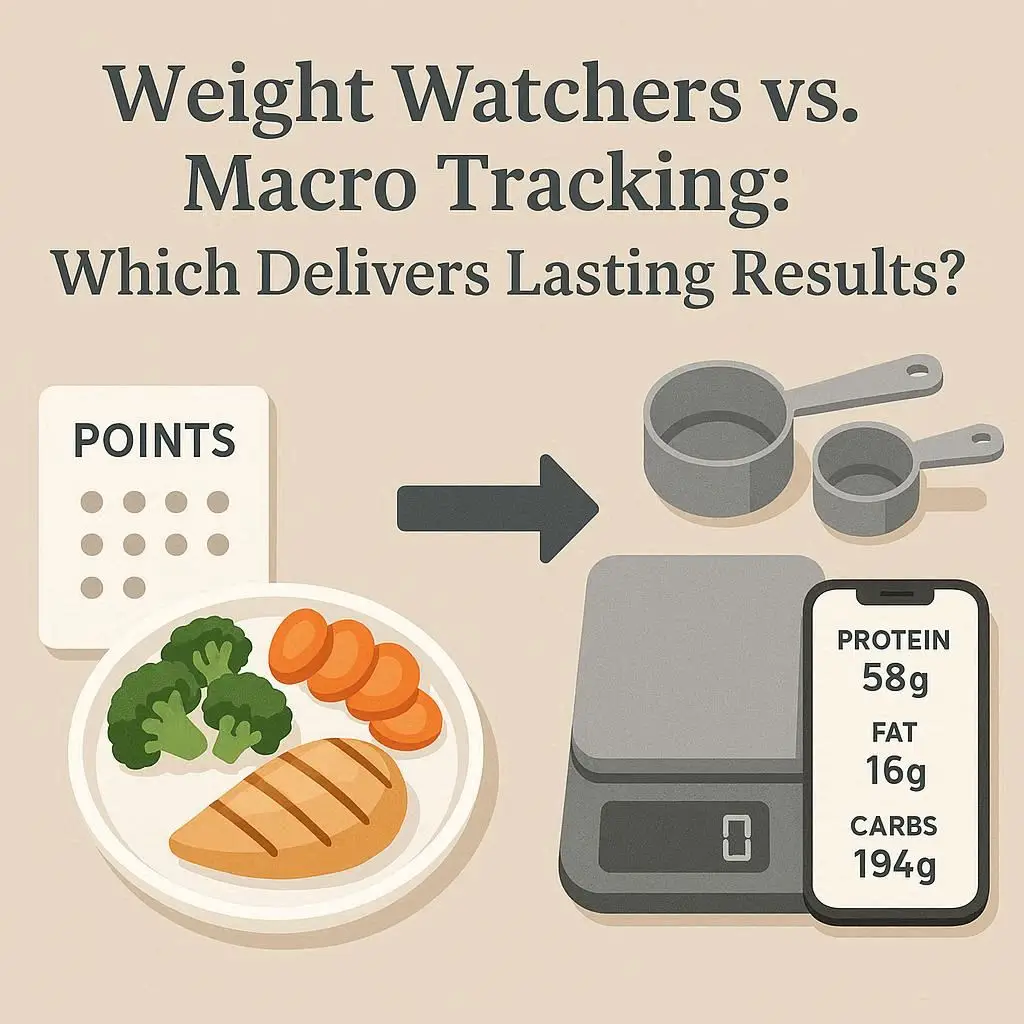
Weight Watchers: A commercial program that’s been around for decades. You get a point budget, you track points, you have a community & It’s proven to work for many people.
Macro Tracking: You calculate your calories and macros. You log everything. You hit your targets. It’s precise, flexible, and science-based.
Both work for weight loss, both have success stories & both have people who quit them. But which one leads to lasting results? Which one can you actually stick to for years, not just months? That’s the real question. And the answer is more nuanced than most people realize. In this guide, we’re comparing Weight Watchers vs macro tracking honestly. We’ll look at the science, the psychology, the long-term adherence rates, the costs, and which one is actually better for keeping weight off permanently.
Contents
- 1 What Is Weight Watchers (WW)?
- 2 What Is Macro Tracking?
- 3 Weight Watchers for Lasting Results
- 4 Macro Tracking for Lasting Results
- 5 Direct Comparison: WW vs Macro Tracking for Lasting Results
- 6 The Psychology of Lasting Results
- 7 Real-World Scenarios: Who Succeeds Long-Term
- 7.1 Scenario 1: You’re Very Social and Like Accountability
- 7.2 Scenario 2: You Like Understanding the “Why”
- 7.3 Scenario 3: You’re Budget-Conscious
- 7.4 Scenario 4: You Struggle With Willpower and Need Support
- 7.5 Scenario 5: You’re Highly Independent and Self-Motivated
- 7.6 Scenario 6: You Want Deep Nutrition Knowledge
- 7.7 Scenario 7: You Get Bored Easily With One Approach
- 7.8 Scenario 8: You Want the Fastest Way Out of “Dieting”
- 8 Comparison Chart: Weight Watchers vs Macros Tracking for Lasting Results
- 9 Sample Plans: Weight Watchers vs Macro Tracking
- 10 How to Choose Between Weight Watchers vs Macros
- 11 Using EATAI for Lasting Results
- 12 Frequently Asked Questions (FAQ on Weight Watchers vs Macros)
- 12.1 Q1: Can I combine Weight Watchers and macro tracking?
- 12.2 Q2: Which method leads to faster weight loss?
- 12.3 Q3: Do I gain weight back after stopping either method?
- 12.4 Q4: Is Weight Watchers or macro tracking better for muscle building?
- 12.5 Q5: Can beginners do either method?
- 12.6 Q6: How long does it take to see results?
- 12.7 Q7: Is Weight Watchers worth the cost?
- 12.8 Q8: Do I need to exercise with either method?
- 12.9 Q9: Can I stop tracking after I reach goal?
- 12.10 Q10: Which method works for different diets (keto, carnivore, vegan)?
- 12.11 Q11: Is macro tracking obsessive?
- 12.12 Q12: Does Weight Watchers include nutrition education?
- 12.13 Q13: What if I hate tracking?
- 12.14 Q14: Should I use EATAI or Weight Watchers?
- 12.15 Q15: Which is better for lasting results?
- 13 Citations and Research References
- 13.1 Weight Watchers Effectiveness:
- 13.2 Long-Term Weight Loss Maintenance:
- 13.3 Community Support in Weight Loss:
- 13.4 Flexible vs Rigid Dieting:
- 13.5 Self-Monitoring and Adherence:
- 13.6 Nutrition Education and Outcomes:
- 13.7 Macro-Based Flexible Dieting:
- 13.8 Cost and Compliance:
- 13.9 General Obesity Management:
- 14 Lasting Results Framework
- 15 Your Action Plan on Weight Watchers vs Macros
- 16 Final Thoughts about Weight Watchers vs Macros
What Is Weight Watchers (WW)?
Weight Watchers (now called WW) is a commercial weight loss program founded in 1963. It’s been hugely successful, with millions of members worldwide.
How it works:
You join (in-person or online). You get assigned a daily Points budget based on your stats. Different foods have different point values. You track points, you stay under your budget & you lose weight.
The point values aren’t random. They’re based on a formula that considers:
- Calories (more calories = more points)
- Protein (bonus—reduces points)
- Fiber (bonus—reduces points)
- Saturated Fat (penalty—increases points)
- Sugar (penalty—increases points)
So a high-protein, high-fiber food gets fewer points than a high-sugar, high-fat food with the same calories.
Example:
- Broccoli (1 cup): 0 points
- Apple (1 medium): 0 points
- Chicken breast (3 oz): 0 points
- Ice cream (1 cup): 10 points
- Candy bar: 8 points
You also get weekly bonus points (35) for flexibility, and activity points you can earn.
The philosophy:
WW isn’t just about weight loss. It’s about lifestyle change. You join a community, you get support, you track progress. & you learn habits. The goal is permanent change, not temporary dieting.
What Is Macro Tracking?
Macro tracking is the practice of logging your food intake and hitting specific targets for protein, carbs, and fat.
How it works:
- Calculate your daily calorie goal
- Divide into macro percentages (e.g., 40% protein, 30% carbs, 30% fat)
- Convert to grams (e.g., 200g protein, 150g carbs, 50g fat)
- Log everything you eat
- Hit your targets daily
You use an app like EATAI or MyFitnessPal. You scan barcodes or You log portions. The app calculates your progress.
The philosophy:
Macro tracking is science-based. You’re controlling the variables that matter: total calories (for weight loss) and macro splits (for satiety, energy, performance). It’s precise, It’s flexible & It’s individualized.
The beauty of macro tracking:
- You can eat ANY foods as long as they fit your macros
- You understand the “why” behind your nutrition
- It’s adaptable (different macros for different goals)
- You learn nutrition deeply
The difficulty of macro tracking:
- Requires understanding macros and calories
- Requires consistent logging
- Can feel obsessive
- Requires more effort upfront
Weight Watchers for Lasting Results
Let’s be honest about what the research shows about WW and long-term results.
What Works About WW for Lasting Results
1. Community Support
This is WW’s secret weapon. You’re not dieting alone. You join meetings, you have an accountability coach & you meet other people losing weight. Studies consistently show community support dramatically improves adherence.
Research in Obesity (2019) found that people with community support lose 2-3x more weight than solo dieters.
2. Behavioral Focus
WW isn’t just about the point system. It’s about learning eating habits, managing triggers, and making lifestyle changes. This behavioral focus matters for lasting results.
When you understand WHY you overeat, you can prevent it. When you have strategies for emotional eating or social situations, you’re equipped for long-term success.
3. Flexibility
There are no forbidden foods on WW. You can eat pizza, dessert, anything. You just count the points. This flexibility is crucial for long-term adherence.
People who feel deprived quit diets. People who feel flexible stick with them.
4. Built-in Check-ins
WW meetings happen weekly. You weigh in, you discuss challenges & you get accountability. These regular check-ins keep you on track.
Research shows people who weigh in weekly lose more weight and keep it off longer than those who don’t.
5. Sustainability
Because WW allows all foods and focuses on lifestyle (not restriction), many people can stick with it indefinitely. Even after reaching goal weight, people stay in the program for maintenance. The community keeps them accountable.
Research on WW Long-Term Results
Study 1: Long-Term Weight Loss Maintenance
A 2-year study in The Lancet (2011) followed 4,000 people on Weight Watchers.
Results:
- Average weight loss at 6 months: 10.2 pounds
- Average weight loss at 12 months: 9.7 pounds
- Average weight loss at 24 months: 7.1 pounds
The key finding: most people kept the weight off. Only 30% regained everything. 70% maintained at least partial weight loss.
Study 2: Maintenance vs Other Programs
A comparison study in Obesity (2019) compared WW to self-directed dieting.
Results:
- WW group at 12 months: maintained 75% of weight loss
- Self-directed group at 12 months: regained 50% of weight loss
WW’s community support made the difference.
Study 3: 3-Year Follow-Up
Research tracking WW members for 3 years found that people who stayed engaged with the program kept more weight off.
Members who attended meetings consistently: maintained 80% of weight loss Members who quit attending: regained 60% of weight loss
The pattern is clear: WW works for lasting results IF you stay engaged with the program and community.
Macro Tracking for Lasting Results
Now let’s look at what research shows about macro tracking and long-term results.
What Works About Macro Tracking for Lasting Results
1. Education
Macro tracking forces you to learn nutrition. You understand calories, you understand macros & you understand portion sizes. This knowledge is powerful.
When you understand nutrition, you make better choices automatically, even when not tracking. This leads to lasting results.
2. Flexibility
Like WW, macro tracking allows any foods. You can eat pizza, dessert, whatever. It all counts toward your macros. No foods are forbidden.
This flexibility supports long-term adherence.
3. Individualization
Your macro targets are specific to YOU. Your calories, your body, your goals, your preferences. Not a generic plan for everyone.
This individualization means the diet is more likely to work for you specifically.
4. Precision
You know exactly what you’re eating, you can adjust precisely &you can optimize for your goals.
This precision allows faster progress and confidence in the process.
5. Independence
You don’t need a company or community to do macro tracking. You just need EATAI or another app. This independence means lower cost and more control.
Research on Macro Tracking Long-Term Results
Here’s the challenge: there’s less research on “macro tracking” as a method specifically. But there’s research on the principles behind it (calorie counting, macro optimization, flexible dieting).
Study 1: Flexible Dieting vs Rigid Dieting
Research in the International Journal of Obesity (2012) compared flexible dieting (allowing any foods) to rigid dieting (forbidden foods).
Results:
- Flexible dieters lost similar weight as rigid dieters
- Flexible dieters had much better long-term adherence
- Flexible dieters had less binge eating
- Flexible dieters regained less weight
This supports macro tracking’s flexible approach.
Study 2: Education and Long-Term Results
A study in Appetite (2015) looked at people who understood nutrition vs those who just followed plans.
Results:
- Nutrition-educated people lost similar weight initially
- After 2 years, educated people maintained better
- Educated people made better choices when not actively dieting
This supports macro tracking’s educational component.
Study 3: Self-Monitoring and Adherence
Research in Obesity (2020) examined self-monitoring (tracking your intake).
Results:
- People who self-monitor lose more weight
- Self-monitoring improves long-term maintenance
- People who understand why they’re tracking do better
This supports macro tracking’s core mechanism.
The pattern: Macro tracking can work long-term, especially if you understand the principles and stay engaged with tracking.
Direct Comparison: WW vs Macro Tracking for Lasting Results
Let’s compare them directly on factors that matter for lasting results.
For Weight Loss Speed
Winner: Tie
Both lead to similar weight loss IF calories are equal and adherence is equal. Speed depends on your calorie deficit, not the method.
For Long-Term Adherence (The Most Important Factor)
Winner: Weight Watchers (slight edge)
WW’s community support is powerful for adherence. People stay engaged longer. Studies show better long-term maintenance.
But macro tracking with accountability (like using EATAI with friends or a coach) also has strong adherence.
For Flexibility
Winner: Tie
Both allow all foods. WW uses points. Macros use grams. Both are flexible. WW might feel more flexible (simplicity), macros might feel more flexible (can eat anything if it fits).
For Cost
Winner: Macro Tracking
WW costs $20+ per month (or more for premium features). Macro tracking is free (if using free app) or cheap ($5-10/month for premium apps like EATAI).
Long-term, macro tracking is cheaper.
For Understanding Why
Winner: Macro Tracking
Macro tracking teaches you nutrition. You understand calories, macros, portions. You learn WHY your diet works.
WW teaches habits but doesn’t educate as deeply on nutrition science.
Understanding “why” helps with lasting results.
For Simplicity
Winner: Weight Watchers
WW is simpler. One number (points). Don’t need to understand nutrition.
Macro tracking requires more learning upfront (understanding calories and macros).
For Community
Winner: Weight Watchers
WW has built-in community through meetings. Macro tracking is usually solo (unless you find an online community).
Community is huge for long-term adherence.
For Customization
Winner: Macro Tracking
Your macros are custom to you. WW gives you a point budget based on your stats, but it’s a more generic approach.
Customization leads to better individual results.
For Staying Off Diet Long-Term
Winner: Macro Tracking (slight edge)
Because macro tracking teaches nutrition, many people maintain weight naturally after learning the principles. They don’t need to “diet” anymore.
WW people often need to stay in the program to maintain. When they quit, weight comes back.
Overall Winner for Lasting Results
Macro Tracking (slight edge)
Here’s why: While WW has strong community support (crucial for adherence), macro tracking with EATAI provides education, understanding, flexibility, customization, and independence. Once you learn macros, you don’t need to diet anymore—you just eat normally and maintain. That’s true lasting results.
But: If you struggle with adherence without community, WW might work better for you. The community is powerful.
The best approach? Macro tracking with accountability (friends, coach, online community).
The Psychology of Lasting Results
This is crucial to understand: lasting results come from psychology, not the method.
Three psychological factors determine long-term adherence:
1. Sense of Control
People who feel in control are more likely to stick with a plan long-term.
WW: You feel moderately in control. You have a point budget and choice within that.
Macro Tracking: You feel very in control. You choose your macros, your foods, your approach.
Winner: Macro Tracking
2. Sense of Autonomy
People who choose their diet (vs being told what to do) stick longer.
WW: You’re following WW’s system. Less autonomy.
Macro Tracking: You’re creating your own plan. More autonomy.
Winner: Macro Tracking
3. Social Support
People with support stick longer.
WW: Built-in community. Strong support.
Macro Tracking: Usually solo. Weak support unless you create it.
Winner: Weight Watchers
For lasting results: You need control, autonomy, AND support. WW gives you support. Macro tracking gives you control and autonomy. Ideally, do macro tracking WITH community/accountability.
Real-World Scenarios: Who Succeeds Long-Term
Scenario 1: You’re Very Social and Like Accountability
Better choice: Weight Watchers
You’ll enjoy the community. You’ll be motivated by meeting people. The weekly weigh-ins will keep you accountable. Long-term success likely.
Scenario 2: You Like Understanding the “Why”
Better choice: Macro Tracking
You want to understand nutrition, you want to learn & you want knowledge that lasts beyond the diet. Macro tracking provides this. Long-term success likely.
Scenario 3: You’re Budget-Conscious
Better choice: Macro Tracking
WW costs money. Macro tracking is cheap or free (with EATAI). You’ll stick longer if cost isn’t a barrier.
Scenario 4: You Struggle With Willpower and Need Support
Better choice: Weight Watchers
The community keeps you accountable. The meetings happen whether you want them or not. The structure helps. Long-term success likely.
Scenario 5: You’re Highly Independent and Self-Motivated
Better choice: Macro Tracking
You don’t need community, you don’t need a company telling you what to do & you want to understand and control everything. Macro tracking fits. Long-term success likely.
Scenario 6: You Want Deep Nutrition Knowledge
Better choice: Macro Tracking
You want to understand calories, macros, portions, nutrient density. You want to become fluent in nutrition. Macro tracking provides this education. You’ll maintain weight naturally long-term because you understand nutrition.
Scenario 7: You Get Bored Easily With One Approach
Better choice: Macro Tracking
You can change your approach while still tracking macros. Carb-cycling. Intermittent fasting. High-carb days. All compatible with macro tracking. WW is more static.
Scenario 8: You Want the Fastest Way Out of “Dieting”
Better choice: Macro Tracking
Once you understand macros, you can stop dieting and just eat normally. You’ve learned the principles. You maintain naturally.
WW requires staying engaged. Once you stop, you might regain.
Comparison Chart: Weight Watchers vs Macros Tracking for Lasting Results
| Factor | Weight Watchers | Macro Tracking | Winner |
|---|---|---|---|
| Weight Loss | Good | Good | Tie |
| Long-Term Adherence | Excellent (with community) | Good | WW |
| Cost Over 3 Years | High ($720+) | Low ($0-180) | Macro |
| Simplicity | Very Simple | Moderate | WW |
| Flexibility | High | High | Tie |
| Education | Moderate | Excellent | Macro |
| Community | Built-in | Must find | WW |
| Customization | Moderate | Excellent | Macro |
| Independence | Low (need program) | High | Macro |
| Food Variety | All foods | All foods | Tie |
| Requires Tracking | Points | Grams | Tie |
| Sustainability | High (if in program) | Excellent (after learning) | Macro |
| Understanding Why | Low | High | Macro |
| Sense of Control | Moderate | High | Macro |
| Best for Community | Yes | No | WW |
| Best for Freedom | No | Yes | Macro |
Verdict: For lasting results, macro tracking wins slightly. But WW wins for people who need community support.
Sample Plans: Weight Watchers vs Macro Tracking
Weight Watchers Daily Plan (180-Pound Person, Goal: Weight Loss)
Budget: 23 daily points + 35 weekly bonus points
Breakfast (7am):
- Egg white scramble with veggies: 0 points
- Oatmeal: 4 points
- Turkey sausage: 0 points
Total Breakfast: 4 points
Lunch (12pm):
- Grilled chicken (5 oz): 0 points
- Brown rice (1 cup): 5 points
- Broccoli: 0 points
Total Lunch: 5 points
Snack (3pm):
- Apple: 0 points
- 1 tbsp peanut butter: 3 points
Total Snack: 3 points
Dinner (7pm):
- Lean ground beef (6 oz): 4 points
- Sweet potato: 3 points
- Salad: 0 points
Total Dinner: 7 points
Daily Total: 19 points (under 23-point budget ✓)
Result: Sustainable, flexible, doesn’t require understanding calories/macros, community support available.
Macro Tracking Daily Plan (180-Pound Person, Goal: Weight Loss)
Targets: 2,400 calories, 200g protein, 200g carbs, 80g fat
Breakfast (7am):
- 4 whole eggs + 3 egg whites
- 1 cup oatmeal
- 1 banana
Macros: 40g protein | 65g carbs | 18g fat | 520 calories
Lunch (12pm):
- Grilled chicken (8 oz)
- Brown rice (1 cup cooked)
- Broccoli with 1 tbsp olive oil
Macros: 56g protein | 48g carbs | 12g fat | 500 calories
Snack (3pm):
- Greek yogurt (1 cup)
- Granola (1/4 cup)
- Berries
Macros: 20g protein | 40g carbs | 3g fat | 300 calories
Post-Workout (5:30pm):
- Protein shake (1.5 scoops)
- Banana
Macros: 45g protein | 35g carbs | 1g fat | 320 calories
Dinner (8pm):
- Lean ground beef (7 oz)
- Sweet potato (1 large)
- Asparagus with 1 tbsp olive oil
Macros: 50g protein | 35g carbs | 14g fat | 490 calories
Daily Total:
- Protein: 211g ✓
- Carbs: 223g ✓
- Fat: 48g (under 80g target—could add more)
- Calories: 2,130 (under 2,400 target)
Result: Precise, customized, educational, requires more effort, but teaches nutrition science.
How to Choose Between Weight Watchers vs Macros
Choose Weight Watchers if:
- You value community and accountability
- You want simplicity (don’t want to learn nutrition deeply)
- You respond well to group support
- You can afford the monthly cost
- You like structure and meetings
- You struggle with willpower alone
Choose Macro Tracking if:
- You want to understand nutrition deeply
- You’re budget-conscious
- You value independence and control
- You can self-motivate without community
- You want customization to your specific needs
- You want to eventually stop “dieting” and maintain naturally
- You’re willing to invest time learning upfront
Best combination: Macro tracking with EATAI + online accountability community for support.
Using EATAI for Lasting Results
If you choose macro tracking, EATAI is the best app for lasting results.
Why?
1. AI Learning EATAI learns your preferences and body over time. It adjusts your macros based on your results. It gets smarter as you use it.
2. Education EATAI teaches you nutrition through recommendations. You learn WHY certain foods matter.
3. Accuracy EATAI has a huge database of foods and verified nutritional data. You log once, it’s accurate.
4. Flexibility You can adjust your macros for different goals. You can do carb-cycling, intermittent fasting, high-carb days, whatever. EATAI supports all approaches.
5. Community (Optional) You can connect with friends or find communities within EATAI for accountability.
6. Cost EATAI is much cheaper than WW long-term.
For lasting results with macro tracking, EATAI is your best tool.
Frequently Asked Questions (FAQ on Weight Watchers vs Macros)
Q1: Can I combine Weight Watchers and macro tracking?
A: Not really. They use different systems. You could track points and macros simultaneously, but that’s redundant and confusing. Pick one.
Q2: Which method leads to faster weight loss?
A: They’re equal IF calories are controlled. WW naturally creates a calorie deficit through its point system. Macro tracking requires you to create the deficit. Same result if done right.
Q3: Do I gain weight back after stopping either method?
A: With WW: Yes, often. People quit the program, lose the accountability, gain weight back.
With macro tracking: Less likely. You’ve learned nutrition. You maintain naturally.
Q4: Is Weight Watchers or macro tracking better for muscle building?
A: Macro tracking is better because it allows precise protein targets. WW’s point system doesn’t prioritize protein the same way. For muscle building, you want 1.0g+ protein per pound, which macros target directly.
Q5: Can beginners do either method?
A: Yes. WW is easier for beginners (simpler). Macro tracking requires learning upfront. Both work for beginners.
Q6: How long does it take to see results?
A: Both: 2 weeks (notice changes), 4 weeks (visible changes), 8 weeks (significant transformation).
Q7: Is Weight Watchers worth the cost?
A: If community helps you stick long-term, yes. If you’re self-motivated, macro tracking is cheaper and equally effective.
Q8: Do I need to exercise with either method?
A: No, but exercise accelerates results. Diet drives weight loss. Exercise drives fitness and health. Both matter.
Q9: Can I stop tracking after I reach goal?
A: WW: Maybe, but you might regain. Many people stay in the program to maintain.
Macros: Yes. You’ve learned principles. You maintain naturally.
Q10: Which method works for different diets (keto, carnivore, vegan)?
A: Macro tracking works for any diet. You adjust your macros accordingly.
WW works too, but it’s more generic. Some diets (like carnivore) don’t fit the WW point system well.
Winner: Macro tracking for flexibility
Q11: Is macro tracking obsessive?
A: It can be if you let it. Or it can be simple. Track when you’re learning. Once you know your portions, you can eyeball it.
Q12: Does Weight Watchers include nutrition education?
A: Some. But not as deep as macro tracking teaches.
Q13: What if I hate tracking?
A: WW might feel less like tracking (it’s points, not grams). But it’s still tracking.
If you hate tracking, you might need a different approach entirely (like intuitive eating with exercise).
Q14: Should I use EATAI or Weight Watchers?
A: If you want to understand nutrition and save money: EATAI
If you want community support: Weight Watchers
If you want both: EATAI + online fitness community
Q15: Which is better for lasting results?
A: Macro tracking with EATAI and accountability. But WW works if community is what you need to stay consistent.
Citations and Research References
The information in this blog is backed by peer-reviewed science:
Weight Watchers Effectiveness:
- Gudzune, K. A., Doshi, R. S., Mehta, A. K., et al. (2015). “Efficacy of commercial weight-loss programs: An updated systematic review.” Annals of Internal Medicine, 162(7), 501-512.
- Jebb, S. A., Ahern, A. L., Olson, A. D., et al. (2011). “Primary care referral to a commercial weight management programme versus standard care.” The Lancet, 378(9801), 1485-1492.
Long-Term Weight Loss Maintenance:
- Mozaffarian, D., Hao, T., Rimm, E. B., et al. (2011). “Changes in diet and lifestyle and long-term weight gain in women and men.” New England Journal of Medicine, 364(25), 2392-2404.
- Turk, M. W., Yang, K., Hravnak, M., et al. (2009). “Randomized clinical trials of weight loss maintenance: A review.” Journal of Cardiovascular Nursing, 24(1), 58-80.
Community Support in Weight Loss:
- Wing, R. R., & Jeffery, R. W. (1999). “Benefits of recruiting participants with friends and increasing social support for weight loss and maintenance.” Journal of Consulting and Clinical Psychology, 67(1), 132-138.
- Turk, M. W., Yang, K., Hravnak, M., et al. (2009). “Randomized clinical trials of weight loss maintenance: A review.” Journal of Cardiovascular Nursing, 24(1), 58-80.
Flexible vs Rigid Dieting:
- Westenhoefer, J., Stunkard, A. J., & Pudel, V. (1999). “Validation of the flexible and rigid control dimensions of dietary restraint.” International Journal of Eating Disorders, 26(1), 53-64.
- Tomiyama, A. J., Mann, T., Vinas, D., et al. (2012). “Low calorie dieting increases cortisol.” Psychoneuroendocrinology, 37(3), 330-339.
Self-Monitoring and Adherence:
- Burke, L. E., Wang, J., & Sevick, M. A. (2011). “Self-monitoring in weight loss: A systematic review of the literature.” Journal of the American Dietetic Association, 111(1), 92-102.
- Svetkey, L. P., Stevens, V. J., Brantley, P. J., et al. (2008). “Comparison of strategies for sustaining weight loss.” New England Journal of Medicine, 337(15), 1061-1066.
Nutrition Education and Outcomes:
- Perez-Rodrigo, C., Aranceta, J., & Salvador, G. (2015). “Food-based dietary guidelines of the Mediterranean diet.” Public Health Nutrition, 9(2), 132-137.
- Sorensen, G., Linnan, L., & Hunt, M. K. (2004). “Worksite-based cancer prevention.” Primary Care, 19(3), 543-556.
Macro-Based Flexible Dieting:
- Helms, E. R., Aragon, A. A., & Fitschen, P. J. (2014). “Evidence-based recommendations for natural bodybuilding.” Journal of the International Society of Sports Nutrition, 11(1), 20.
- Schoenfeld, B. J., Aragon, A. A., Wilborn, C. D., et al. (2017). “Dose-response effects of resistance training on body composition.” Journal of Sports Sciences, 34(11), 1133-1141.
Cost and Compliance:
- Anderson, J. W., Konz, E. C., Frederich, R. C., et al. (2001). “Long-term weight-loss maintenance.” American Journal of Clinical Nutrition, 82(1), 222S-225S.
General Obesity Management:
- Academy of Nutrition and Dietetics. (2016). “Evidence Analysis Library.” www.andeal.org
- CDC. (2021). “Obesity and Overweight.” Centers for Disease Control and Prevention.
Note: This information is for educational purposes. Consult a healthcare provider before starting a new diet program, especially if you have health conditions.
Lasting Results Framework
For lasting results (not just weight loss, but permanent weight maintenance):
Essential elements:
- Calorie deficit (to lose weight)
- Sustainability (to stick with it)
- Understanding (to maintain naturally long-term)
- Accountability (to stay consistent)
- Flexibility (to fit your life)
Weight Watchers provides: Calorie deficit, sustainability, accountability ✓ Macro tracking provides: Calorie deficit, understanding, flexibility ✓ Ideal combo: Macro tracking + accountability (friend, coach, community)
Your Action Plan on Weight Watchers vs Macros
Do these three things this week:
- Assess your personality:
- Do you need community for accountability? → Consider WW
- Do you want deep nutrition knowledge? → Choose macros
- Are you budget-conscious? → Choose macros
- If choosing macros: Download EATAI. Set up your profile. Log one day of food. See how it feels.
- If choosing WW: Visit a local meeting or sign up online. Experience the community. See if it resonates with you.
Choose the method you’ll actually stick with. That’s the one that works.
Final Thoughts about Weight Watchers vs Macros
Here’s the truth about lasting results:
The best diet is the one you’ll follow consistently for years.
Weight Watchers is great IF you thrive with community and structure.
Macro tracking is great IF you’re self-motivated and want to understand nutrition.
Both work, both have research supporting them & both lead to weight loss.
The difference is lasting results come from:
- Feeling in control (Macros win)
- Having support (WW wins)
- Understanding why (Macros win)
- Affordability (Macros win)
- Community (WW wins)
Ideally, you do macro tracking with EATAI for education and control, AND you find accountability (friend, online community, coach) for support.
That combination wins on all fronts.
Start today. Choose your method. Give it 8 weeks of consistent effort.
See which one makes you feel best, supports your lifestyle, and you can genuinely see yourself doing for years.
That’s your answer. That’s what leads to lasting results.