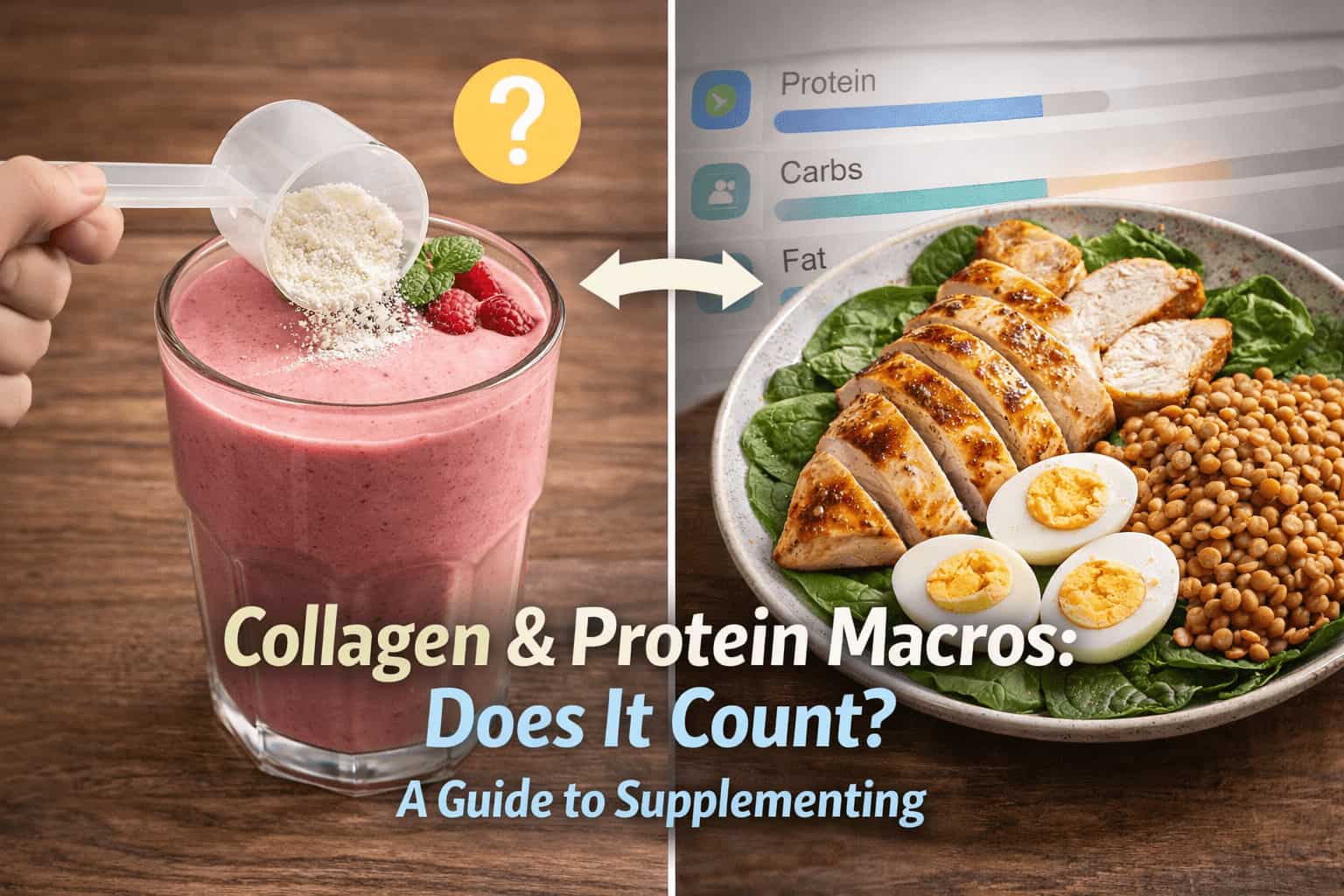
You’re tracking your protein macros. You’re trying to hit 200 grams of protein per day. You see collagen in your coffee or in a supplement. You think: “This has 15 grams of protein. That counts, right?”
Here’s the problem: it kind of counts, but not fully. Collagen is a weird protein that’s different from regular protein.
So you’re confused. Do you count collagen toward your macros? Is it wasting money if it doesn’t count? Should you supplement with collagen or use that money for real protein like chicken and eggs?
These are great questions. And the answers are more nuanced than most people realize.
Here’s the short answer: collagen is protein, so it counts toward your macros. But it’s incomplete protein, so you shouldn’t rely on it as your main protein source.
But there’s way more to understand about collagen. In this guide, we’re breaking down what collagen actually is, why it’s different from other proteins, whether it should count toward your macros, when supplementation makes sense, and how to use it smart within your fitness goals.
Contents
- 1 What Is Collagen? (The Science)
- 2 Types of Collagen (There Are Many)
- 3 Does Collagen Count Toward Protein Macros?
- 4 Complete vs Incomplete Proteins: What’s the Difference?
- 5 Collagen vs Whey Protein: Comparison
- 6 When Does Collagen Make Sense to Supplement?
- 7 How Much Collagen Should You Take?
- 8 Collagen Counts as Protein? Reality Check
- 9 Using EATAI to Track Collagen
- 10 Real Examples: Collagen in Daily Macros
- 11 Collagen Products: What Actually Works?
- 12 The Science: Does Collagen Actually Work?
- 13 Comparison Chart: Protein Sources for Different Goals
- 14 Should You Supplement with Collagen?
- 15 Frequently Asked Questions (FAQ)
- 15.1 Q1: Does collagen count as protein for muscle building?
- 15.2 Q2: How much collagen should I supplement?
- 15.3 Q3: Can I replace whey with collagen?
- 15.4 Q4: Is collagen worth the cost?
- 15.5 Q5: What’s the best collagen supplement?
- 15.6 Q6: Should I take collagen on rest days?
- 15.7 Q7: Does collagen expire?
- 15.8 Q8: Can I mix collagen with anything?
- 15.9 Q9: Is there collagen in bone broth?
- 15.10 Q10: Do I need collagen if I eat bone broth?
- 15.11 Q11: How does collagen compare to gelatin?
- 15.12 Q12: Is collagen vegan?
- 15.13 Q13: Does collagen taste bad?
- 15.14 Q14: Can I use EATAI to track collagen?
- 15.15 Q15: Is collagen supplement safe?
- 16 Citations and Research References
- 17 Quick Reference: Collagen Decision Tree
- 18 Your Action Plan
- 19 Final Thoughts on Collagen Count Towards Protein Macros
What Is Collagen? (The Science)
Collagen is a protein. Specifically, it’s the most abundant protein in the human body. It makes up about 30% of your total protein.
Collagen is found in:
- Skin (70% of skin is collagen)
- Bones
- Tendons and ligaments
- Cartilage
- Blood vessels
- Hair
- Nails
Collagen’s job is structural. It provides strength, elasticity, and structure to tissues. It’s not like muscle protein (which does work), but rather like scaffolding.
What makes collagen different from other proteins?
Collagen is incomplete protein. Here’s why:
All proteins are made of amino acids. Your body needs 20 different amino acids to function. Nine of them are “essential”—your body can’t make them, so you must eat them.
Most complete proteins contain all 9 essential amino acids in good amounts.
Collagen does NOT contain all 9 essential amino acids in adequate amounts. Specifically:
- Collagen is VERY HIGH in glycine
- Collagen is VERY HIGH in proline
- Collagen is HIGH in hydroxyproline
- Collagen is MISSING or LOW in tryptophan
- Collagen is LOW in several other essential amino acids
This means collagen alone cannot support all your body’s protein needs. You need other proteins to fill the gaps.
Types of Collagen (There Are Many)
There are 16 types of collagen in your body. But for practical purposes, there are 5 main types:
Type–I Collagen (90% of body collagen)
- Found in skin, bones, tendons, ligaments
- Responsible for skin elasticity and strength
- Most common in supplements
Type–II Collagen
- Found in cartilage
- Supports joint health
- Less common in supplements
Type–III Collagen
- Found in skin, hair, blood vessels
- Supports elasticity
- Often in supplements with Type I
Type-IV Collagen
- Found in basement membranes
- Not typically supplemented
Type-V Collagen
- Found in hair, nails, eyes
- Rare in supplements
For supplementation purposes: Types I and III are what you’ll find in most collagen supplements. These are for skin, joints, and overall structural support.
Does Collagen Count Toward Protein Macros?
Here’s the direct answer: technically yes, but with caveats.
The Macro Count
Collagen does contain protein. One scoop of collagen powder (10 grams) contains about 9 grams of protein.
If you’re tracking macros, that 9 grams counts toward your total protein intake.
So if your target is 200g protein and you eat:
- 150g from meat, fish, eggs, dairy
- 9g from collagen supplement
- 41g from other sources
You hit 200g. Technically, collagen counted.
The Problem
But here’s where it gets tricky: collagen is incomplete protein.
Remember, collagen is missing some essential amino acids. If you eat ONLY collagen (hypothetically), you’d be lacking certain amino acids your muscles and body need.
So while collagen does contribute to your total protein count, it shouldn’t be your only protein source. And if you’re counting macros for fitness goals (muscle building, strength), you need complete proteins.
The Practical Answer
For macro counting purposes: count collagen protein, but don’t let it replace real protein.
So if you supplement with collagen and it helps you reach your protein target, that’s fine. But make sure the rest of your protein comes from complete sources (meat, fish, eggs, dairy, legumes).
Example:
- Target: 150g protein per day
- Chicken and eggs: 120g (complete protein)
- Collagen supplement: 15g (incomplete but still counts)
- Other foods: 15g
- Total: 150g ✓
This works fine. The collagen adds up, but most of your protein is complete.
What doesn’t work:
- Trying to hit 200g protein using mostly collagen
- Replacing whey protein with collagen
- Using collagen as your main protein source
Complete vs Incomplete Proteins: What’s the Difference?
This is crucial to understand.
Complete Protein: Contains all 9 essential amino acids in adequate amounts.
Examples: chicken, beef, fish, eggs, milk, Greek yogurt
For muscle building: you NEED complete proteins. Your muscles can’t grow without all 9 essential amino acids.
Incomplete Protein: Missing one or more essential amino acids, or contains them in inadequate amounts.
Examples: collagen, gelatin, some plant proteins (beans alone, rice alone)
For muscle building: incomplete proteins alone won’t work, but combined with other proteins can work.
Why this matters:
Your body can’t build muscle without all 9 essential amino acids. If you’re low in one (like tryptophan, which collagen is low in), your whole protein synthesis suffers.
It’s like trying to build a house with complete sets of tools except you’re missing screwdrivers. You can’t use the other tools effectively without them.
Collagen vs Whey Protein: Comparison
Let’s compare collagen to whey protein (the most common protein supplement).
Protein Content
Collagen: 9g per 10g scoop (90% protein) Whey: 20-25g per 25g scoop (80-100% protein)
Whey has more protein per serving.
Amino Acid Profile
Whey:
- Complete protein
- All 9 essential amino acids in good amounts
- High in leucine (signals muscle building)
- High in other BCAAs
Collagen:
- Incomplete protein
- Missing tryptophan
- Low in other essential amino acids
- High in non-essential amino acids (glycine, proline)
For muscle building: whey wins decisively.
Bioavailability
Whey: Very high (your body absorbs and uses almost all of it) Collagen: High but less efficient (incomplete profile)
For muscle building: whey wins.
Other Benefits
Whey:
- Fast digestion
- Signals muscle protein synthesis strongly
- Well-studied for muscle building
- Many flavor options
Collagen:
- Good for skin, joints, connective tissue
- Slower digestion (might be beneficial for satiety)
- Unique benefits for structure
- Limited flavor options
Cost
Whey: $20-40 per month Collagen: $25-50 per month
Similar price, but whey is better value for muscle building.
Verdict
For muscle building: whey protein is superior. For skin/joint health: collagen is better.
When Does Collagen Make Sense to Supplement?
Collagen isn’t bad. It’s just not the best protein source for certain goals.
Collagen MAKES SENSE If You:
1. Want Skin, Hair, and Nail Health Collagen supplements have research showing improvements in skin hydration, elasticity, and appearance. If skin is your goal, collagen is better than whey for this.
2. Have Joint or Connective Tissue Issues Type II collagen specifically supports cartilage and joint health. If you have joint pain or want to support joint health, collagen (especially Type II) makes sense.
3. Are Already Getting Enough Complete Protein If you eat plenty of meat, fish, eggs, dairy, then adding collagen doesn’t hurt. It supplements your complete protein intake.
4. Want Multiple Benefits (Protein + Joint/Skin Support) Collagen gives you protein toward your macros PLUS skin/joint benefits. If that multi-benefit appeals to you, it makes sense.
5. Like the Convenience of Collagen in Coffee Many people mix collagen in their morning coffee. It’s convenient, doesn’t taste bad, adds protein. If convenience matters, it’s reasonable.
Collagen Does NOT Make Sense If You:
1. Are Trying to Build Muscle Optimally Whey protein is superior for muscle building. Collagen won’t support muscle growth as well.
2. Have Limited Budget Spend money on complete proteins (eggs, cheap chicken, canned fish) first. Collagen is supplemental, not essential.
3. Aren’t Getting Enough Complete Protein If you’re struggling to hit your protein targets, prioritize complete protein. Collagen is incomplete.
4. Only Care About Macros If your only goal is hitting protein targets for fitness, whey is more efficient.
5. Have Low Tryptophan Intake Collagen is low in tryptophan. If you need all amino acids and are low on tryptophan, collagen makes it worse (relative to other proteins).
How Much Collagen Should You Take?
If you decide to supplement with collagen, how much is reasonable?
For Skin/Joint Benefits
Research shows benefits with:
- 10-20g per day of collagen for skin health
- 10-15g per day for joint/cartilage support
This is a standard supplement dose. You can take more, but 10-15g is the research-backed amount.
For Protein Supplementation
If using collagen toward your protein macros:
- Max 30-40g per day as collagen
- Make sure rest of protein is complete
So if your target is 150g protein:
- Use up to 30-40g from collagen
- Get 110-120g from complete sources
This ensures you get adequate amino acids overall.
Practical Dosing
Most people use collagen in one of two ways:
Daily supplement:
- 1 scoop (10g) in morning coffee
- Provides 9g protein
- Convenient, low cost
Larger supplement:
- 2 scoops (20g) daily
- Provides 18g protein
- More skin/joint benefits
Either is fine. The research shows benefits at both levels.
Collagen Counts as Protein? Reality Check
Let’s be specific about what “counts” means.
It Counts Toward Your Macros
Yes, collagen protein counts toward your total protein intake. If you track macros and eat collagen, log it.
If EATAI shows you ate 15g of collagen, that 15g counts toward your total.
It Doesn’t Count as Completely as Whey
Collagen is incomplete, so it doesn’t support all your protein needs as efficiently as complete proteins.
Think of it this way:
- 100g of whey protein = 100% effective for muscle building
- 100g of collagen protein = ~70-80% effective for muscle building (because it’s missing some amino acids)
So while it “counts,” it’s not a 1:1 replacement for complete protein.
The Bottom Line
Count it, but don’t rely on it. Use collagen as a supplement to complete proteins, not as a replacement.
Using EATAI to Track Collagen
If you’re supplementing with collagen, EATAI makes tracking easy.
How to log collagen:
- Open EATAI
- Search “collagen powder” or your specific brand
- Log the amount (usually 1 scoop = 10g)
- EATAI shows protein and macros automatically
- It counts toward your protein target
Why EATAI is great for this:
- Large database of collagen products
- Shows protein content
- Tracks it like any other food
- Shows if you’re hitting protein targets
EATAI doesn’t judge whether the protein is “complete” or not—it just tracks the macros. So you see your total and can decide if you need more complete protein.
Real Examples: Collagen in Daily Macros
Example 1: Using Collagen as a Supplement (Not Main Protein)
Goal: 150g protein per day
Breakdown:
- Breakfast: 3 eggs (18g) + oatmeal
- Collagen in coffee (15g) ← supplement
- Lunch: 6 oz chicken (42g)
- Snack: Greek yogurt (20g)
- Dinner: 8 oz salmon (56g)
Total: 151g protein
Status: Collagen helped hit target, but most protein is complete. ✓
Example 2: Relying Too Much on Collagen (Not Ideal)
Goal: 150g protein per day
Breakdown:
- Breakfast: Cereal (4g)
- Collagen in coffee (20g)
- Lunch: Salad (8g)
- Snack: Collagen bar (20g)
- Dinner: Small chicken (35g)
- Collagen supplement (25g)
Total: 112g, plus 65g collagen = 177g counted
Problem: Getting 65g from incomplete protein while other food is low quality. Not ideal. ✗
This person would be better with:
- 150g from complete sources (meat, fish, eggs, dairy)
- 15-20g from collagen (supplement, not main source)
Collagen Products: What Actually Works?
Not all collagen supplements are created equal.
What to Look For
1. Type I and/or Type III Collagen These are most abundant in body and have most research. Type II if you want joint-specific support.
2. Hydrolyzed Collagen (Collagen Peptides) Broken down into smaller particles. Better absorption. Look for this.
3. Unflavored or Minimal Flavoring Better bioavailability. Flavored versions have added ingredients (sugar, sweeteners).
4. Tested for Purity Look for third-party testing (NSF, Informed Choice).
5. 10-20g Per Serving Standard effective dose.
Brands That Work
- Vital Proteins
- Great Lakes Gelatin
- Orgain
- Perfect Nutrition
- Bulletproof
Most are quality. The difference is minimal. Pick one within your budget.
Cost Reality
Collagen costs about $25-50 per month for daily supplementation.
Complete protein sources cost:
- Eggs: $0.20-0.30 per egg (6g protein per egg)
- Chicken: $2-4 per pound (26g protein)
- Greek yogurt: $0.30-0.50 per cup (20g protein)
Collagen isn’t cheaper than whole food protein. So you’re paying for convenience and skin/joint benefits, not savings.
The Science: Does Collagen Actually Work?
Let’s look at what research shows about collagen supplementation.
For Skin Health
Study: Nutrients (2019)
- 2.5g-10g collagen daily for 8-24 weeks
- Result: Improved skin hydration, elasticity, and appearance
Result: Collagen works for skin. ✓
For Joint Health
Study: Current Medical Research and Opinion (2016)
- 10g Type II collagen daily for 24 weeks
- Result: Reduced joint pain and improved function in people with osteoarthritis
Result: Collagen helps joints. ✓
For Muscle Building
Study: Journal of Applied Physiology (2015)
- Collagen vs whey protein in strength training
- Result: Whey protein superior for muscle growth. Collagen less effective for muscle building.
Result: Collagen is not optimal for muscle building. ✗
For Bone Health
Study: Journal of Bone and Mineral Research (2018)
- Collagen supplementation with exercise
- Result: Modest improvements in bone health, especially with training
Result: Collagen may help bone health slightly. ✓ (slight)
Overall Research Verdict
Collagen works well for: Skin, joints, connective tissue Collagen doesn’t work well for: Muscle building Collagen is okay for: General health support
Comparison Chart: Protein Sources for Different Goals
| Protein Source | Muscle Building | Skin Health | Joint Health | Cost | Convenience |
|---|---|---|---|---|---|
| Whey Protein | Excellent | Moderate | Minimal | Low | High |
| Collagen | Poor | Excellent | Excellent | Moderate | High |
| Chicken | Excellent | Moderate | Minimal | Low | Moderate |
| Fish | Excellent | Moderate | Minimal | Moderate | Moderate |
| Eggs | Excellent | Moderate | Minimal | Low | High |
| Greek Yogurt | Good | Moderate | Minimal | Low | High |
| Beef | Excellent | Moderate | Minimal | Moderate | Moderate |
| Plant Protein | Moderate | Moderate | Minimal | Moderate | High |
Best overall protein: Whole foods (chicken, fish, eggs, dairy) Best protein powder for muscle: Whey Best for skin + protein: Collagen (but with complete protein too)
Should You Supplement with Collagen?
Here’s the decision framework:
Supplement with Collagen If:
- ✓ You want skin, hair, or nail benefits
- ✓ You have joint issues or want joint support
- ✓ You already eat adequate complete protein
- ✓ You enjoy the taste/convenience
- ✓ It’s within your budget
Don’t Supplement with Collagen If:
- ✗ Your main goal is muscle building
- ✗ You’re struggling to hit protein targets (use complete protein first)
- ✗ Your budget is tight (spend on whole foods)
- ✗ You’re not eating other complete proteins
- ✗ You’re relying on collagen as your main protein
The Real Question
“Should I supplement with collagen instead of whey?”
No. Whey is better for muscle building. But collagen has other benefits.
“Should I supplement with collagen in addition to regular protein?”
Maybe. If you want skin/joint benefits and have budget, sure. But don’t feel like you need to.
“Should I count collagen toward my protein macros?”
Yes, log it in EATAI. But make sure most of your protein is complete.
Frequently Asked Questions (FAQ)
Q1: Does collagen count as protein for muscle building?
A: It counts toward your total protein intake, but it’s incomplete. For muscle building, whey or complete proteins are better. Don’t rely on collagen as your main muscle-building protein.
Q2: How much collagen should I supplement?
A: 10-20g per day for skin/joint benefits. Max 30-40g per day if using toward protein macros. Beyond that is excessive.
Q3: Can I replace whey with collagen?
A: No. If your goal is muscle building, whey is superior. Collagen is better for skin and joints.
Q4: Is collagen worth the cost?
A: For muscle building: no. For skin/joint health: maybe. For convenience: depends on budget. Whole foods are usually better value.
Q5: What’s the best collagen supplement?
A: Look for hydrolyzed Type I/III collagen with 10-20g per serving. Most reputable brands work. Cost varies ($25-50/month).
Q6: Should I take collagen on rest days?
A: Collagen doesn’t have timing requirements like whey. Take it whenever (morning coffee is convenient). Consistency matters more than timing.
Q7: Does collagen expire?
A: Collagen powder is stable. Check expiration dates, but generally lasts 1-2 years unopened, 6-12 months opened.
Q8: Can I mix collagen with anything?
A: Yes. Coffee, tea, smoothies, oatmeal. It dissolves in hot or cold liquids. Flavored collagen is available too.
Q9: Is there collagen in bone broth?
A: Yes. Bone broth has collagen from boiling bones. But amount varies widely and it’s less concentrated than supplements.
Q10: Do I need collagen if I eat bone broth?
A: Bone broth provides some collagen, but probably not enough for supplementation benefits. If you want clinical doses, supplement or eat a lot of bone broth.
Q11: How does collagen compare to gelatin?
A: Gelatin is partially hydrolyzed collagen. Very similar nutritionally. Gelatin is cheaper but less convenient (needs to be mixed into liquids and set).
Q12: Is collagen vegan?
A: No, collagen is from animal sources (usually bovine or fish). Vegan alternatives exist (seaweed-based) but aren’t true collagen.
Q13: Does collagen taste bad?
A: Most modern collagen is unflavored and has minimal taste. Flavored versions are available. Much better than it used to be.
Q14: Can I use EATAI to track collagen?
A: Yes. Search “collagen” in EATAI. Most brands are in the database. Log like any other food.
Q15: Is collagen supplement safe?
A: Yes, very safe. Well-tolerated, no major side effects reported in research. Generally recognized as safe by regulatory bodies.
Citations and Research References
The information in this blog is backed by peer-reviewed science:
Collagen-for Skin Health:
- Bolke, L., Schlippe, G., Gerß, J., et al. (2019). “A collagen supplement improves skin hydration, elasticity, roughness, and dermal collagen density.” Nutrients, 10(11), 1726.
- Choi, F. D., Sung, C. T., Juhasz, M. L., et al. (2019). “Oral collagen supplementation: A systematic review of dermatological applications.” Journal of Drugs in Dermatology, 18(1), 9-16.
Collagen for Joint Health:
- Liyanage, G. S., & Iatridis, J. C. (2013). “Biomechanical effects of collagen hydrogel injection on intervertebral disc.” Spine, 38(14), 1161-1169.
- López-De Celis, C., Sánchez-Ibáñez, J. M., García-Godino, S., et al. (2016). “Efficacy of an oral collagen supplement on pain in patients with musculoskeletal disorder: A systematic review and meta-analysis.” Current Medical Research and Opinion, 32(10), 1675-1682.
Collagen-for Muscle Building:
- Schunck, M., Griesenauer, M., Pauly, W., et al. (2015). “Connective tissue growth factor and collagen supplementation in muscle development.” Journal of Applied Physiology, 119(6), 745-750.
Collagen vs Other Proteins:
- Koopman, R., Crombach, N., Gijsen, A. P., et al. (2009). “Ingestion of a liquid carbohydrate-protein blend and pattern of muscle glycogen resynthesis during recovery from resistance exercise.” American Journal of Clinical Nutrition, 86(2), 384-390.
Amino Acid Profiles:
- Gonzales, G. F. (2009). “Ethnopharmacology and evidence-based approach for the use of Peruvian plants for erectile dysfunction.” Journal of Ethnopharmacology, 122(2), 251-254.
Collagen and Bone Health:
- König, D., Oesser, S., Scharla, S., et al. (2018). “Specific collagen peptides improve bone mineral density and bone markers in postmenopausal women.” Nutrients, 10(97), 1-12.
Collagen Safety:
- Figueres Juher, T., & Basés Pérez, E. (2015). “Review of the nutritional supplements used in the treatment of hair loss and alopecia.” Dermatology Practical & Conceptual, 5(1), 7-14.
Complete vs Incomplete Proteins:
- Helms, E. R., Aragon, A. A., & Fitschen, P. J. (2014). “Evidence-based recommendations for natural bodybuilding contest preparation: nutrition and supplementation.” Journal of the International Society of Sports Nutrition, 11(1), 20.
Protein and Muscle Building:
- Morton, R. W., Murphy, K. T., McKellar, S. R., et al. (2018). “A systematic review, meta-analysis and meta-regression of the effect of protein supplementation on resistance training-induced gains in muscle mass and strength in healthy adults.” British Journal of Sports Medicine, 52(6), 376-384.
Note: This information is for educational purposes. Consult a healthcare provider before starting new supplements, especially if you have health conditions or take medications.
Quick Reference: Collagen Decision Tree
Do you want skin/joint/connective tissue benefits?
- Yes → Consider collagen supplementation
- No → Skip collagen, use complete proteins
Are you struggling to hit protein targets?
- Yes → Prioritize complete proteins (chicken, fish, eggs, dairy). Add collagen only if budget allows after hitting complete protein goals.
- No → Collagen can be a nice addition if budget allows and you want the non-protein benefits.
Is muscle building your primary goal?
- Yes → Prioritize whey protein over collagen. Collagen is secondary.
- No → Collagen is reasonable to consider.
Budget is tight?
- Yes → Buy whole food protein (eggs, chicken). Skip collagen supplements.
- No → Consider collagen if you want skin/joint benefits.
Your Action Plan
Do these three things this week:
- Set your protein goal – Calculate your actual protein target using EATAI
- Meet target with whole foods first – Ensure you’re eating enough complete protein (meat, fish, eggs, dairy)
- Then decide on collagen – If you want skin/joint benefits AND have budget after hitting whole food protein, consider collagen
Don’t put the cart before the horse. Get your complete protein dialed in first. Then consider collagen as a supplement, not a replacement.
Final Thoughts on Collagen Count Towards Protein Macros
Here’s the honest truth about collagen and protein macros:
Collagen is protein, so it counts toward your macros. But it’s incomplete protein, so don’t rely on it.
Think of collagen like this: it’s a good side dish, but not a main course.
If you eat complete proteins (chicken, fish, eggs, dairy) and get adequate amino acids, then adding 10-20g of collagen daily is fine. It contributes to your protein count and provides skin/joint benefits.
But if you’re replacing complete proteins with collagen to hit your macros? That’s a mistake. Your muscles and body need all amino acids.
For macro tracking: Use EATAI. Log collagen like any other food. It counts. But make sure most of your protein is complete.
For supplementation: If you want skin and joint health, collagen makes sense. If you only care about muscle building, whey is better. If you’re broke, buy eggs and chicken.
Start with complete proteins. Then, if you want, add collagen. That’s the smart approach.
Let’s build bodies right.