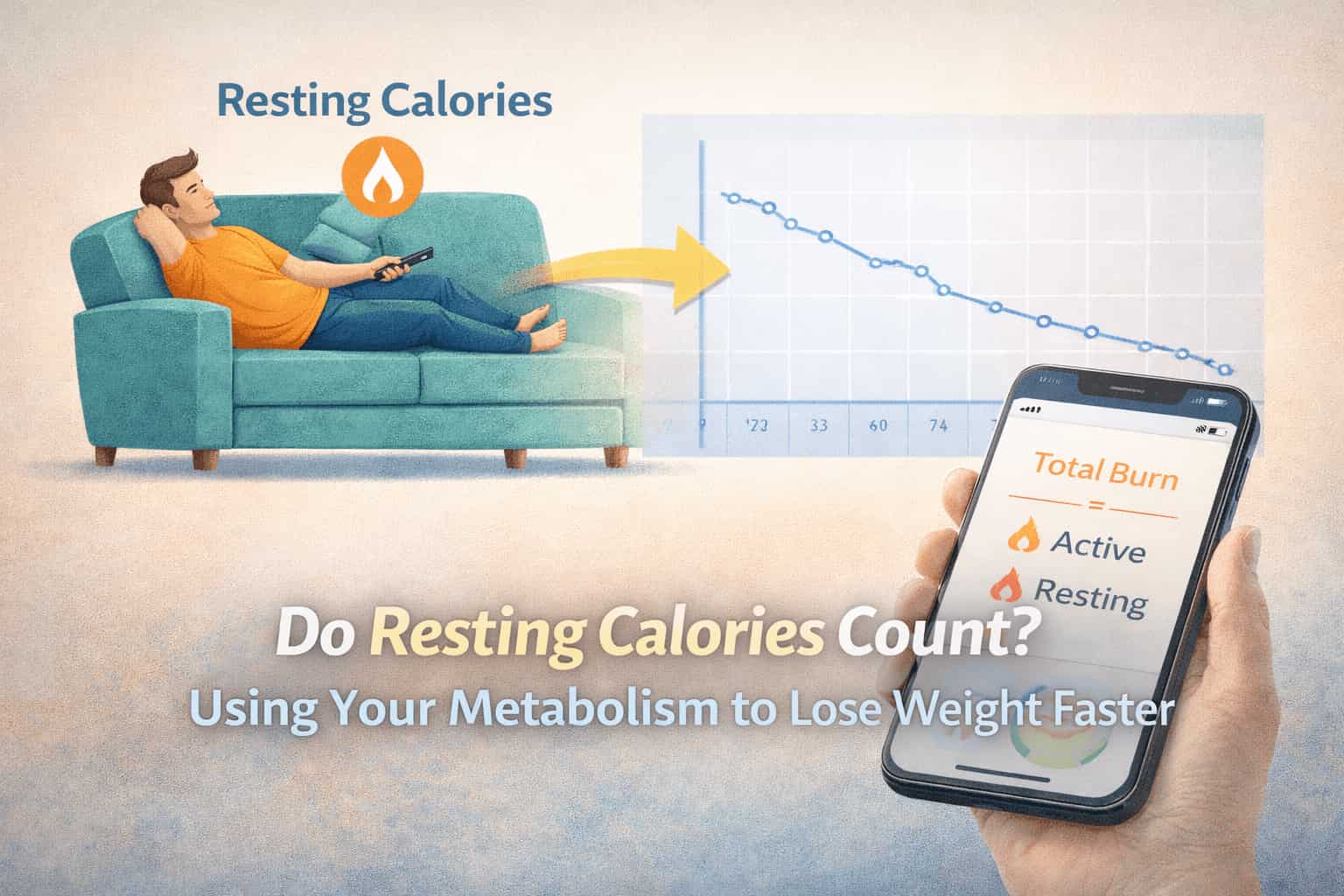
You’re trying to lose weight. You create a calorie deficit. You eat less. You work out. But then you wonder: what about all the calories I burn while I’m just existing? What about sleeping, working at your desk, or simply breathing? In fact, these “resting calories” might be more important than you realize. To put it another way, they could be the missing piece in your weight loss strategy.
Here’s the short answer: Yes, resting calories absolutely count towards your deficit. Moreover, they’re actually the largest contributor to your total calorie burn—often making up 60-75% of everything you burn daily.
This discovery changes everything. Consequently, you don’t need to live at the gym to lose weight. Furthermore, you don’t need extreme exercise to achieve results.
In this guide, we’re breaking down exactly what resting calories are, how they contribute to weight loss, whether you can increase them, and how to leverage them for faster fat loss results.
Contents
- 1 What Are Resting Calories?
- 2 Do Resting Calories Count Towards Your Deficit?
- 3 Can You Increase Your Resting Calories?
- 4 The Myth of “Boosting” Metabolism Dramatically
- 5 Why Understanding Resting Calories Matters
- 6 How Resting Calories Support Sustainable Weight Loss
- 7 Common Mistakes That Undermine Resting Calories
- 8 Real-World Example: How Resting Calories Enable Sustainable Fat Loss
- 9 Using EATAI to Track Your Resting Calories
- 10 Comparison Chart: Resting Calories vs Total Calorie Burn
- 11 Frequently Asked Questions (FAQ about Resting Calories Count Towards Deficit )
- 11.1 Q1: Does my resting metabolic rate change throughout the day?
- 11.2 Q2: Can I increase my resting calories significantly through supplements?
- 11.3 Q3: Does cold exposure really boost metabolism?
- 11.4 Q4: How much does muscle actually increase resting burn?
- 11.5 Q5: Can metabolism slow down from dieting?
- 11.6 Q6: Does age significantly affect resting calories?
- 11.7 Q7: Is my resting metabolic rate fixed?
- 11.8 Q8: Should I focus on increasing resting calories or creating a deficit?
- 11.9 Q9: Do I need to eat more on rest days?
- 11.10 Q10: Can EATAI accurately calculate my resting calories?
- 11.11 Q11: What if I eat below my resting metabolic rate?
- 11.12 Q12: Does hydration affect resting calories?
- 11.13 Q13: Can building muscle increase resting calories enough to lose fat without dieting?
- 11.14 Q14: Is it possible to have a “slow” metabolism?
- 11.15 Q15: How does EATAI adjust recommendations as I lose weight?
- 12 Citations and Research References
- 12.1 Resting Metabolic Rate and TDEE
- 12.2 Calorie Deficit and Weight Loss
- 12.3 Metabolic Adaptation and Calorie Restriction
- 12.4 Muscle and Resting Metabolic Rate
- 12.5 Protein and Thermic Effect
- 12.6 Sleep and Metabolism
- 12.7 Exercise and Weight Loss
- 12.8 Strength Training and Muscle Preservation
- 12.9 Sustainable Weight Loss
- 13 Your Resting Calorie Strategy
- 14 Final Thoughts on Resting Calories Count Towards Deficit
What Are Resting Calories?
To understand weight loss, first you need to understand resting calories. Essentially, resting calories—also known as your Basal Metabolic Rate (BMR) or Resting Metabolic Rate (RMR)—represent the energy your body burns simply to keep you alive.
In other words, these are the calories your body uses for essential functions like:
- Breathing and circulation – Your heart pumps continuously
- Cell production and repair – Constantly replacing old cells
- Hormone regulation – Managing testosterone, cortisol, and more
- Brain and nervous system function – Thinking, moving, processing
- Maintaining body temperature – Thermogenesis keeps you warm
- Digesting food – Though this is sometimes calculated separately
Importantly, your resting metabolic rate typically accounts for 60-75% of your total daily energy expenditure (TDEE). To emphasize this point, it’s the largest component of your calorie burn—even if you never step foot in a gym.
Think of it this way: your body is a furnace that burns fuel continuously. The flames keep burning whether you’re active or sleeping. Specifically, that constant burn at rest is resting calories.
Do Resting Calories Count Towards Your Deficit?
Here’s where many people get confused. The answer is unequivocally yes.
Your calorie deficit isn’t just about exercise. Rather, it’s about the total difference between all the calories you consume and all the calories you burn throughout the entire day.
The Complete Calorie Equation
Understanding this requires breaking down your Total Daily Energy Expenditure (TDEE):
TDEE = Resting Metabolic Rate + Activity Thermogenesis + Thermic Effect of Food
Let’s examine each component:
Resting Metabolic Rate (60-75% of TDEE): This is what your body burns at complete rest. Essentially, it’s the calories burned if you stayed in bed all day.
Activity Thermogenesis (15-30% of TDEE): This includes structured exercise plus non-exercise activity (walking, fidgeting, cleaning, work).
Thermic Effect of Food (10% of TDEE): This is the energy required to digest food. Notably, protein has the highest thermic effect.
When you eat fewer calories than your TDEE, you create a deficit. Consequently, your body taps into stored fat for energy. To clarify, your resting calories are the foundation of this entire equation.
A Real-World Example
Let’s illustrate this with a concrete example. Consider a 35-year-old woman weighing 160 pounds:
Her Daily Calorie Breakdown:
- Resting Metabolic Rate: 1,400 calories (70%)
- Daily activities (walking, cleaning, work): 300 calories (15%)
- Structured exercise (3x per week average): 150 calories (7.5%)
- Thermic effect of food: 150 calories (7.5%)
- Total Daily Energy Expenditure: 2,000 calories
Now, suppose she eats 1,500 calories daily. Accordingly, she creates a 500-calorie deficit.
Here’s the critical insight: 1,400 of those 2,000 calories burned come from simply existing—that’s 70% happening at rest.
Over one week, this 500-calorie daily deficit totals 3,500 calories. Theoretically, this translates to approximately one pound of fat loss. In reality, results vary based on many individual factors.
The Key Takeaway: Even on days when she doesn’t exercise, she’s still burning 1,400 calories just from existing. That massive calorie burn absolutely counts towards her deficit.
Can You Increase Your Resting Calories?
While your RMR is largely determined by factors like age, sex, height, and genetics, you can influence it to some degree. Importantly, even modest improvements matter significantly.
Strategy 1: Build Muscle Mass
Notably, muscle tissue burns more calories at rest than fat tissue. Specifically, muscle burns approximately 6 calories per pound per day, while fat burns about 2 calories per pound per day.
Strength training helps preserve and build muscle. Over time, this can modestly increase your RMR. Moreover, muscle provides numerous other health benefits beyond metabolism.
The Reality: The metabolic boost from muscle is often overstated in fitness marketing. That said, every calorie counts, and muscle tissue is metabolically active.
Strategy 2: Eat Adequate Protein
Significantly, protein has the highest thermic effect of all macronutrients. In essence, your body burns more calories digesting protein than digesting carbs or fat.
Furthermore, adequate protein helps preserve muscle during weight loss. Consequently, maintaining muscle protects your resting metabolic rate. Generally, aim for 0.7-1.0 grams of protein per pound of body weight.
Strategy 3: Avoid Extreme Calorie Restriction
Importantly, eating too few calories for extended periods can cause metabolic adaptation. Simply put, your body lowers its RMR to conserve energy when threatened by starvation. Therefore, crash diets often backfire spectacularly.
Research shows that severe calorie restriction can reduce your RMR by 10-20% or more. Conversely, moderate deficits preserve metabolic health better.
Strategy 4: Stay Hydrated
Interestingly, some research suggests that drinking water can temporarily boost metabolism. Additionally, chronic dehydration may reduce metabolic efficiency. Therefore, proper hydration supports optimal resting calorie burn.
Strategy 5: Prioritize Sleep Quality
Furthermore, poor sleep disrupts hormones that regulate metabolism and hunger. Consequently, inadequate sleep can lower your RMR and make weight loss harder. Notably, aiming for 7-9 hours nightly supports metabolic health.
Strategy 6: Manage Stress
Additionally, chronic stress elevates cortisol, which can negatively impact metabolism. Therefore, stress management techniques like meditation, yoga, or outdoor time can support your resting burn.
The Myth of “Boosting” Metabolism Dramatically
You’ll find countless products and programs claiming to “boost your metabolism” or “speed up fat burning significantly.” The reality, however, is far more modest.
Essentially, while small improvements are possible through the strategies above, you cannot dramatically increase your RMR through supplements, special foods, or “metabolism-boosting” workouts. This fundamental truth contradicts much fitness marketing.
What Studies Actually Show
Research consistently demonstrates that:
- Metabolism-boosting supplements typically don’t work
- Special “fat-burning” foods don’t provide significant boosts
- Detoxes and cleanses don’t speed up fat loss
- Most metabolic increases from interventions are 5-10% at best
The Evidence-Based Approach
The most effective strategy, therefore, is to focus on what you can control:
- Create a sustainable calorie deficit through mindful eating and reasonable activity
- Support your metabolic health through strength training
- Maintain adequate protein intake to preserve muscle
- Prioritize quality sleep for hormonal balance
- Manage stress effectively for optimal hormone function
This approach might seem less exciting than a “metabolism-boosting supplement.” However, it actually works, and it’s sustainable long-term.
Why Understanding Resting Calories Matters
Recognizing that the majority of your calorie burn happens at rest has several profound implications for your weight loss journey:
Implication 1: Exercise Isn’t Required for Weight Loss
Accordingly, you can create a deficit through diet alone because your body burns calories around the clock. To clarify, while physical activity has tremendous health benefits and makes creating a deficit easier, it’s not technically necessary for weight loss.
The Reality: A person eating 1,500 calories daily will lose weight even without exercise because their resting burn alone (perhaps 1,400 calories) nearly covers that amount.
Implication 2: Rest Days Aren’t “Wasted” Days
Furthermore, even when you’re not working out, your body continues burning significant calories. Importantly, rest and recovery are essential parts of any fat loss journey. In fact, overtraining without adequate recovery can sabotage results.
Implication 3: Extreme Exercise Isn’t Necessary
Consequently, you don’t need hours of cardio daily to lose weight. Moreover, moderate activity combined with a reasonable calorie deficit is often more sustainable and effective.
Implication 4: Preservation of RMR Is Crucial
Significantly, losing muscle through crash dieting or inadequate protein directly lowers your resting metabolic rate. Therefore, this makes long-term weight maintenance harder. Essentially, protecting your metabolism is as important as losing weight initially.
How Resting Calories Support Sustainable Weight Loss
Here’s where this knowledge becomes powerful for your fat loss strategy:
The Sustainability Advantage
Understanding resting calories removes the pressure to exercise excessively. Instead, you can focus on sustainable practices. Specifically:
- Eat a moderate calorie deficit (500-750 calories below maintenance)
- Include regular strength training (3-4 times per week)
- Maintain adequate protein intake (supports muscle preservation)
- Get quality sleep (supports hormones and recovery)
- Engage in moderate activity (walking, daily movement)
This combination works because your resting burn is doing most of the heavy lifting. Consequently, you don’t need extreme measures.
The Metabolic Protection Factor
Furthermore, this approach protects your metabolism. Unlike crash dieting, which can reduce RMR by 10-20%, sustainable approaches maintain your resting burn. Therefore, weight loss is easier to sustain long-term.
Common Mistakes That Undermine Resting Calories
Understanding what NOT to do is equally important. Importantly, these mistakes can reduce your resting metabolic rate:
Mistake 1: Eating Too Little for Too Long
Significantly, when you drastically cut calories, your body adapts by reducing non-essential functions. Consequently, you burn fewer calories for the same tasks. This metabolic adaptation is real and well-documented.
Research shows that severe calorie restriction for extended periods can reduce RMR by 10-25%. Therefore, sustainable deficits are superior to crash diets.
Mistake 2: Losing Weight Too Quickly
Moreover, rapid weight loss often means losing significant muscle alongside fat. This directly reduces your resting metabolic rate. Consequently, the initial rapid results often reverse when you return to normal eating.
The Better Approach: Aim for 1-2 pounds of weight loss per week. This pace preserves muscle while still achieving results.
Mistake 3: Neglecting Strength Training
Certainly, cardio burns calories during the activity. However, strength training helps preserve and build the muscle tissue supporting your RMR. Therefore, including resistance training is crucial for long-term results.
Mistake 4: Ignoring Protein Intake
Furthermore, without adequate protein (generally 0.7-1.0 grams per pound), you’ll lose more muscle during weight loss. Consequently, this decreases your resting burn. Additionally, low protein intake increases hunger and reduces satiety.
Mistake 5: Chronic Sleep Deprivation
Notably, poor sleep disrupts leptin and ghrelin (hunger hormones). Additionally, it increases cortisol, which promotes fat storage. Therefore, sleep is not a luxury—it’s a necessity for weight loss.
Real-World Example: How Resting Calories Enable Sustainable Fat Loss
Let’s show how this works practically with a detailed example:
Person: 200-pound man, age 35, sedentary job, trains 3x per week
His Calorie Breakdown:
- Resting Metabolic Rate: 1,700 calories (75%)
- Daily activities (work, movement): 300 calories (13%)
- Structured exercise (3x per week average): 200 calories (9%)
- Thermic effect of food: 100 calories (3%)
- Total Daily Energy Expenditure: 2,300 calories
Weight Loss Scenario:
- Eats: 1,800 calories daily
- Creates: 500-calorie deficit
- Expected loss: ~1 pound per week
Key Insight: Even if he stopped exercising, his resting burn (1,700 calories) alone would still create a significant deficit if he maintained 1,800 calorie intake. Consequently, his exercise is bonus, not essential.
One Year Results:
- If maintaining this deficit: ~50 pounds lost
- If preserving muscle with strength training + protein: ~45 pounds fat lost, minimal muscle loss
- If not preserving muscle (low protein, no training): ~45 pounds lost, but includes 10+ pounds muscle loss
The Difference: The muscle-preserving approach maintains his resting burn (crucial for maintenance), while the non-preserving approach makes regaining weight easier.
Using EATAI to Track Your Resting Calories
EATAI makes understanding and tracking your resting calories simple:
How EATAI helps:
- Calculate your RMR – EATAI determines your resting metabolic rate based on your stats
- Show your TDEE – Displays total daily energy expenditure with breakdown
- Create your deficit – Automatically calculates calorie targets for weight loss
- Track progress – Shows if you’re hitting your targets and losing weight
- Adjust intelligently – If weight loss slows, EATAI can recommend adjustments
Why EATAI is valuable for this:
- Removes guesswork from calorie calculations
- Shows you exactly how much your resting burn contributes
- Helps you understand your deficit
- Tracks progress accurately
- Recommends sustainable adjustments
Comparison Chart: Resting Calories vs Total Calorie Burn
| Component | Percentage | Calories (Average) | Controllable? | Impact |
|---|---|---|---|---|
| Resting Metabolic Rate | 60-75% | 1,400-1,800 | Slightly (muscle, protein) | Huge |
| Daily Activity | 15-30% | 300-500 | Moderately (movement) | Moderate |
| Exercise | 5-15% | 100-300 | Highly (structured activity) | Moderate |
| Thermic Effect of Food | 10% | 200-250 | Moderately (protein choice) | Small |
Key Insight: Your resting burn is the largest component AND the most stable. Therefore, protecting it through sustainable practices is crucial.
Frequently Asked Questions (FAQ about Resting Calories Count Towards Deficit )
Q1: Does my resting metabolic rate change throughout the day?
A: Slightly, yes. Metabolism varies based on circadian rhythms, food intake timing, and activity patterns. However, the 24-hour average (RMR) is what matters for weight loss calculations.
Q2: Can I increase my resting calories significantly through supplements?
A: Unfortunately, no. While caffeine and green tea provide modest, temporary boosts (5% at most), no supplement creates dramatic increases. Strength training and muscle building are more effective.
Q3: Does cold exposure really boost metabolism?
A: Slightly, yes. Shivering generates heat and burns calories. However, the effect is modest and impractical for sustained weight loss. Cold water exposure for weight loss is mostly hype.
Q4: How much does muscle actually increase resting burn?
A: One pound of muscle burns approximately 6 calories per day at rest. Therefore, building 5 pounds of muscle increases daily burn by roughly 30 calories. It helps but isn’t dramatic.
Q5: Can metabolism slow down from dieting?
A: Yes, significantly. Severe calorie restriction triggers metabolic adaptation, reducing RMR by 10-25%. Consequently, this is why crash diets often fail long-term.
Q6: Does age significantly affect resting calories?
A: Yes. RMR typically decreases 3-8% per decade after age 30. Moreover, this is partly due to muscle loss. Notably, strength training can offset much of this decline.
Q7: Is my resting metabolic rate fixed?
A: Mostly, yes. However, you can influence it through muscle building, adequate protein, sleep, and avoiding extreme calorie restriction. The changes are modest but meaningful over time.
Q8: Should I focus on increasing resting calories or creating a deficit?
A: Focus on both. Create a moderate deficit while protecting your resting burn through strength training and adequate protein. This combination produces optimal results.
Q9: Do I need to eat more on rest days?
A: No. Your resting burn is constant. However, if you’re doing structured training, eating more carbs on training days (for energy) is reasonable.
Q10: Can EATAI accurately calculate my resting calories?
A: Yes. EATAI uses scientifically-validated equations (like Mifflin-St Jeor) to estimate your RMR based on your stats. It’s accurate for most people.
Q11: What if I eat below my resting metabolic rate?
A: Your body will still lose weight initially, drawing from both fat and muscle. However, this is unsustainable and will eventually slow metabolism further. Aim for deficits around 500 calories below TDEE, not below RMR.
Q12: Does hydration affect resting calories?
A: Somewhat. Proper hydration supports metabolic efficiency. Additionally, drinking water has a small thermic effect (burning calories to process it). However, the effect is modest.
Q13: Can building muscle increase resting calories enough to lose fat without dieting?
A: Partially. Building muscle increases resting burn, but the effect is modest (roughly 6 calories per pound of muscle per day). Therefore, you still need a calorie deficit for fat loss.
Q14: Is it possible to have a “slow” metabolism?
A: Some variation exists between individuals (due to genetics, muscle mass, hormones). However, true metabolic disorders are rare. Most “slow metabolism” is actually just high calorie intake or low activity.
Q15: How does EATAI adjust recommendations as I lose weight?
A: As you lose weight, your resting metabolic rate naturally decreases (smaller body burns fewer calories). EATAIautomatically recalculates your targets based on updated stats, keeping your deficit appropriate.
Citations and Research References
The information in this blog is backed by peer-reviewed science:
Resting Metabolic Rate and TDEE
- Mifflin, M. D., St Jeor, S. T., Hill, L. A., et al. (1990). “A new predictive equation for resting energy expenditure in healthy individuals.” American Journal of Clinical Nutrition, 51(2), 241-247.
- Roza, A. M., & Shizgal, H. M. (1984). “The Harris Benedict equation reevaluated: resting energy requirements and the body cell mass.” American Journal of Clinical Nutrition, 40(1), 168-182.
Calorie Deficit and Weight Loss
- Hall, K. D., Sacks, G., Chandramohan, D., et al. (2011). “Quantification of the effect of energy imbalance on bodyweight.” The Lancet, 378(9793), 826-837.
- Thomas, D. M., Schoeller, D. A., Redman, L. M., et al. (2014). “A computational model to determine how much food intake change is needed to achieve a target change in bodyweight.” International Journal of Obesity, 39(3), 369-377.
Metabolic Adaptation and Calorie Restriction
- Rosenbaum, M., Hirsch, J., Gallagher, D. A., et al. (2008). “Long-term persistence of adaptive thermogenesis in subjects who have maintained a reduced body weight.” American Journal of Clinical Nutrition, 88(4), 906-912.
- Fothergill, E., Guyonnet, S., Hermsdorff, H., et al. (2016). “Persistent metabolic adaptation 6 years after “The Biggest Loser” competition.” Obesity, 24(8), 1612-1619.
Muscle and Resting Metabolic Rate
- Wolfe, R. R. (2006). “The underappreciated role of muscle in health and disease.” American Journal of Clinical Nutrition, 84(3), 475-482.
- Kim, J., Wang, Z., Heymsfield, S. B., et al. (2002). “Total-body skeletal muscle mass: estimation by a new dual-energy X-ray absorptiometry method.” American Journal of Clinical Nutrition, 76(2), 378-383.
Protein and Thermic Effect
- Westerterp, K. R. (2004). “Diet induced thermogenesis.” Nutrition & Metabolism, 1(1), 5.
- Helms, E. R., Aragon, A. A., & Fitschen, P. J. (2014). “Evidence-based recommendations for natural bodybuilding contest preparation: nutrition and supplementation.” Journal of the International Society of Sports Nutrition, 11(1), 20.
Sleep and Metabolism
- Knutson, K. L., Spiegel, K., Penev, P., et al. (2007). “The metabolic consequences of sleep deprivation.” Sleep Medicine Reviews, 11(3), 163-178.
- Taheri, S., Lin, L., Austin, D., et al. (2004). “Short sleep duration is associated with reduced leptin, elevated ghrelin, and increased body mass index.” PLoS Medicine, 1(3), e62.
Exercise and Weight Loss
- Donnelly, J. E., Blair, S. N., Brown, J. D., et al. (2009). “Appropriate physical activity intervention strategies for weight loss and prevention of weight regain for adults.” Medicine & Science in Sports & Exercise, 41(2), 459-471.
- Wewege, M., van den Berg, R., Ward, R. E., et al. (2017). “The effectiveness of high-intensity interval training for body composition and cardiometabolic health: A systematic review and meta-analysis.” Obesity Reviews, 18(11), 1257-1273.
Strength Training and Muscle Preservation
- Longland, T. M., Oikawa, S. Y., Mitchell, C. J., et al. (2016). “Higher compared with lower dietary protein during an energy deficit combined with intense exercise promotes greater lean mass gain and fat mass loss.” American Journal of Clinical Nutrition, 103(3), 738-746.
- Morton, R. W., Murphy, K. T., McKellar, S. R., et al. (2018). “A systematic review, meta-analysis and meta-regression of the effect of protein supplementation on resistance training-induced gains in muscle mass and strength in healthy adults.” British Journal of Sports Medicine, 52(6), 376-384.
Sustainable Weight Loss
- Wing, R. R., & Hill, J. O. (2001). “Successful weight loss maintenance.” Annual Review of Nutrition, 21, 323-341.
- Turk, M. W., Yang, K., Hravnak, M., et al. (2009). “Randomized clinical trials of weight loss maintenance: A review.” Journal of Cardiovascular Nursing, 24(1), 58-80.
Note: This information is for educational purposes. Consult a healthcare provider before starting a new diet or weight loss program, especially if you have health conditions.
Your Resting Calorie Strategy
To leverage resting calories for weight loss:
Step 1: Calculate Your RMR Use EATAI to determine your resting metabolic rate. Understand that this is your foundation.
Step 2: Determine Your TDEE EATAI shows total daily expenditure. This includes resting burn plus all activity.
Step 3: Create a Moderate Deficit Aim for 500 calories below TDEE (roughly 1 pound loss per week). This is sustainable.
Step 4: Protect Your Metabolism
- Include 3-4 days of strength training weekly
- Eat adequate protein (0.7-1.0g per pound)
- Prioritize 7-9 hours of quality sleep
- Stay hydrated
Step 5: Track Progress with EATAI Monitor weight loss and energy levels. If stalled after 3-4 weeks, EATAI can recommend adjustments.
Final Thoughts on Resting Calories Count Towards Deficit
Here’s the fundamental truth about resting calories:
Your body works for you 24 hours a day, burning calories while you sleep, work, and relax. This continuous burn is the foundation of weight loss. Understanding this removes the pressure to exercise excessively and highlights the importance of sustainable practices.
The most effective approach isn’t trying to dramatically increase your resting burn or engaging in extreme exercise. Rather, it’s creating a moderate calorie deficit while protecting your metabolic rate through strength training, adequate protein, quality sleep, and sustainable habits.
Your resting burn is your secret weapon. Respect it. Protect it. Support it.
Do that, and the weight loss will follow naturally and sustainably. Furthermore, you’ll maintain your results long-term because you’ve preserved your metabolism in the process.
Start today with EATAI. Understand your resting burn. Create your sustainable deficit. Watch your body transform.
You’ve got this.