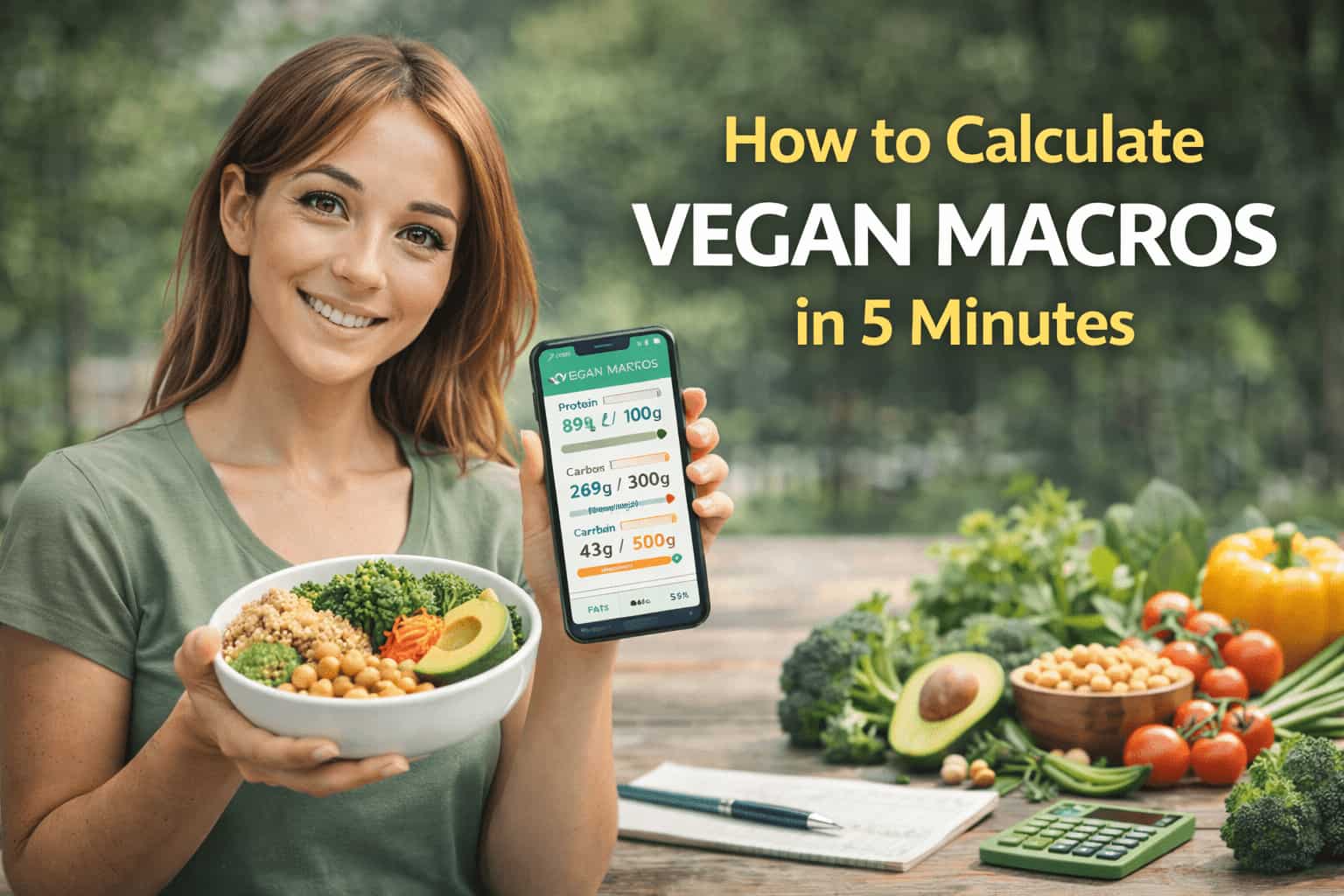
How to Calculate Vegan Macros? Are you struggling to hit your protein goals on a vegan diet? Do you wonder how many carbs and fats you should eat? Calculating macros as a vegan doesn’t have to be complicated. This simple 5-step guide shows you exactly how to determine your perfect macro ratios, and introduces EATAI as the easiest way to track vegan nutrition with AI-powered photo recognition.
Contents
- 1 The 5 Easy Steps to Calculate Vegan Macros
- 2 Your Complete Vegan Macro Summary
- 3 Best Vegan Protein Sources
- 4 Frequently Asked Questions About How to Calculate Vegan Macros
- 5 How much protein do vegans really need?
- 6 What’s the best macro ratio for vegan weight loss?
- 7 Can I build muscle on a vegan diet?
- 8 How do I track vegan macros easily?
- 9 Do vegans need to eat more carbs?
- 10 What if I can’t hit my protein goals?
- 11 Conclusion
- 12 References on How to Calculate Vegan Macros
The 5 Easy Steps to Calculate Vegan Macros
Step 1: Calculate Your Daily Calorie Needs
First and foremost, you need to determine your Total Daily Energy Expenditure (TDEE). This represents the total calories you burn each day.
Quick TDEE Formula:
- Multiply your weight in pounds by 14-16 for maintenance
- Example: 150 lbs × 15 = 2,250 calories daily
Adjust for Your Goals:
- Weight loss: Subtract 300-500 calories (1,750-1,950 calories)
- Weight gain: Add 300-500 calories (2,550-2,750 calories)
- Maintenance: Keep at TDEE (2,250 calories)
Step 2: Calculate Your Protein Needs
Next, protein is crucial for vegans to preserve muscle and stay satisfied. Research shows vegans need slightly more protein than omnivores due to lower digestibility of plant proteins.
Protein Recommendations:
- Sedentary: 0.8-1.0g per lb body weight
- Active/Athletic: 1.0-1.2g per lb body weight
- Muscle building: 1.2-1.4g per lb body weight
Example (150 lb person, moderately active):
- 150 lbs × 1.0g = 150g protein daily
- 150g protein × 4 calories = 600 calories from protein
Step 3: Calculate Your Fat Needs
Subsequently, healthy fats are essential for hormone production and nutrient absorption. Vegans should prioritize omega-3 rich sources.
Fat Recommendations:
- 20-30% of total calories from fat
- Minimum: 0.3-0.4g per lb body weight
Example (2,250 calorie diet at 25% fat):
- 2,250 × 0.25 = 562 calories from fat
- 562 ÷ 9 calories per gram = 62g fat daily
Step 4: Calculate Your Carbohydrate Needs
After calculating protein and fat, the remaining calories come from carbohydrates. Carbs fuel your workouts and daily activities.
Carb Calculation:
- Total calories – (protein calories + fat calories) = carb calories
- Carb calories ÷ 4 = grams of carbs
Example:
- 2,250 – (600 + 562) = 1,088 calories from carbs
- 1,088 ÷ 4 = 272g carbs daily
Step 5: Track Your Macros Daily
Finally, consistent tracking ensures you hit your targets. Traditional tracking requires searching databases and measuring portions for 15-30 minutes daily.
How EATAI Simplifies Vegan Macro Tracking:
Instead of manual calculations, simply photograph your vegan meals. EATAI’s AI instantly recognizes:
- Tofu, tempeh, seitan, and plant proteins
- Beans, lentils, and legumes
- Nuts, seeds, and nut butters
- Whole grains and vegetables
- Complete macro breakdown in 2-3 seconds
Visit https://geteatai.app for free AI-powered vegan macro tracking.
Your Complete Vegan Macro Summary
For 150 lb person (2,250 calories, moderately active):
- Protein: 150g (600 calories, 27%)
- Fat: 62g (562 calories, 25%)
- Carbs: 272g (1,088 calories, 48%)
Best Vegan Protein Sources
- Tofu: 20g protein per cup
- Tempeh: 31g protein per cup
- Seitan: 75g protein per cup
- Lentils: 18g protein per cup
- Chickpeas: 15g protein per cup
- Edamame: 18g protein per cup
- Quinoa: 8g protein per cup
- Hemp seeds: 10g protein per 3 tbsp
Frequently Asked Questions About How to Calculate Vegan Macros
How much protein do vegans really need?
Generally, vegans need 1.0-1.4g protein per pound of body weight depending on activity level. Specifically, this is slightly higher than omnivore recommendations because plant proteins have lower digestibility. For example, a 150 lb active vegan should consume 150-180g protein daily. Consequently, prioritize complete proteins like quinoa, soy, and protein combinations.
What’s the best macro ratio for vegan weight loss?
Typically, an effective vegan weight loss ratio is 30-35% protein, 20-25% fat, and 40-50% carbs. Importantly, higher protein preserves muscle during calorie deficits. Moreover, adequate fat supports hormones while carbs fuel workouts. Therefore, adjust ratios based on how you feel – some vegans thrive on higher carbs while others prefer more fat.
Can I build muscle on a vegan diet?
Yes, absolutely. Research confirms vegans build muscle equally well as omnivores when consuming adequate protein (1.2-1.4g per lb) and calories. Furthermore, plant proteins support hypertrophy effectively when combined properly. Therefore, focus on leucine-rich sources like soy and supplement with complete protein combinations.
How do I track vegan macros easily?
Undoubtedly, EATAI is the easiest method – simply photograph meals for instant macro calculations. In contrast, traditional apps require manual database searching and measuring. Additionally, EATAI recognizes all plant-based foods including homemade meals. Visit https://geteatai.app for free unlimited vegan macro tracking.
Do vegans need to eat more carbs?
Not necessarily. While many vegans naturally eat more carbs, you can follow low-carb vegan diets successfully. However, ensure adequate protein and fat first, then fill remaining calories with carbs. Consequently, active vegans often thrive on 40-60% carbs while sedentary vegans may prefer 30-40%.
What if I can’t hit my protein goals?
Initially, focus on protein-dense foods like tofu, tempeh, seitan, and legumes at every meal. Additionally, protein powder (pea, soy, hemp) helps bridge gaps conveniently. Moreover, track consistently to identify where you’re falling short. Ultimately, EATAI’s photo tracking shows exactly which meals need more protein.
Conclusion
Calculating vegan macros is straightforward with these 5 steps: determine calories, set protein needs, calculate fat requirements, fill remaining with carbs, and track consistently. Moreover, understanding your macro targets ensures adequate nutrition for your goals.
However, the biggest challenge is consistent tracking. While traditional apps require 15-30 minutes daily, EATAI provides instant 2-3 second macro tracking through AI photo recognition. Consequently, you spend less time logging and more time enjoying your vegan lifestyle.
Visit https://geteatai.app to stop manual calculations and start effortless vegan macro tracking completely free.
References on How to Calculate Vegan Macros
- Vegan Liftz. (n.d.). Vegan Macro Calculator. Retrieved from https://veganliftz.com/vegan-macro-calculator/
- The Conscious Plant Kitchen. (2023). How to Calculate Macros (Vegan). Retrieved from https://www.theconsciousplantkitchen.com/how-to-calculate-macros-vegan/
- Vegan Gym. (n.d.). How to Calculate Macros for Vegans. Retrieved from https://vegangym.com/how-to-calculate-macros-for-vegans/
- Healthline. (2023). The Vegan Diet: A Complete Guide. Retrieved from https://www.healthline.com/nutrition/vegan-diet-guide
- Nutrients Journal. (2021). Protein Requirements and Recommendations for Vegans. Retrieved from research on plant protein digestibility