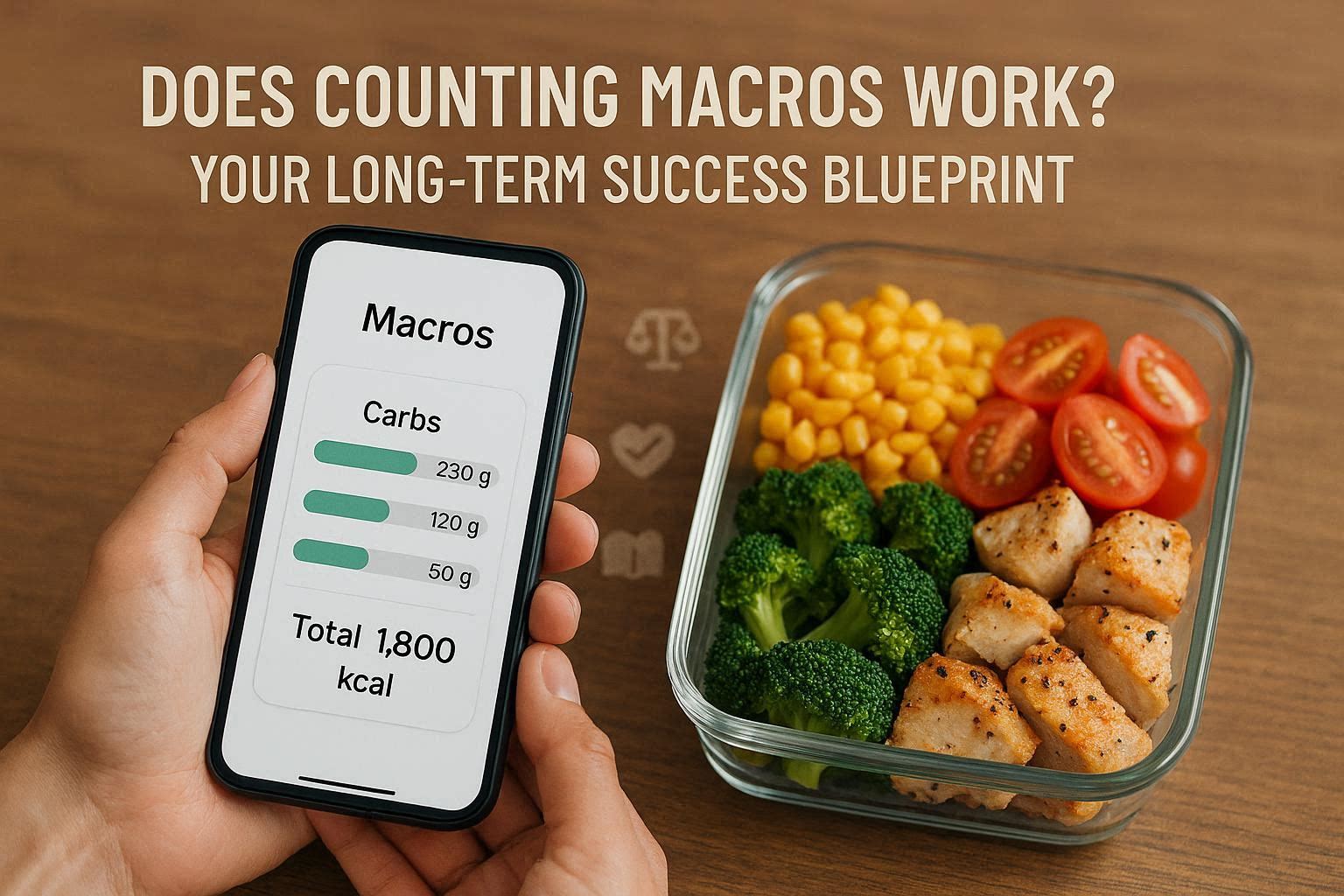
You’ve heard the hype. Macro counting is supposedly the secret to transforming your body. People swear by it. Social media influencers promote it constantly. Yet, you’re skeptical. Moreover, you wonder: Does it actually work? Or is it just another fitness trend that fades away?
Here’s the honest answer: Yes, counting macros works. In fact, it’s one of the most effective approaches to body transformation. However, not for the reasons most people think. Furthermore, long-term success requires more than just tracking numbers.
The research is clear: macro counting produces results comparable to or better than other diet approaches. Importantly, the real benefit isn’t the macros themselves—it’s the consistency and awareness that tracking provides.
In this guide, we’re answering whether macro counting actually works, explaining the science behind it, identifying what separates long-term success from short-term failure, and providing the exact requirements for succeeding with macros for life.
Contents
- 1 Does Macro Counting Actually Work? The Science
- 2 Why People Fail With Macro Counting
- 3 What Macro Counting Actually Measures
- 4 The Real Requirements for Long-Term Success With Macros
- 4.1 Requirement 1: Accurate Tracking
- 4.2 Requirement 2: Consistency Over Perfection
- 4.3 Requirement 3: Realistic Targets
- 4.4 Requirement 4: Flexibility Within Framework
- 4.5 Requirement 5: Regular Adjustments
- 4.6 Requirement 6: Real Whole Foods
- 4.7 Requirement 7: A Support System
- 4.8 Requirement 8: Educational Understanding
- 4.9 Requirement 9: Patience and Realism
- 5 Real-World Example: Long-Term Macro Success
- 6 Comparison Chart: Macro Counting Success vs Failure Factors
- 7 What Makes Macro Counting Sustainable Long-Term
- 8 Using EATAI for Long-Term Success
- 9 Frequently Asked Questions (FAQ)
- 9.1 Q1: Does macro counting really work better than calorie counting?
- 9.2 Q2: How long until I see results from macro counting?
- 9.3 Q3: Can I lose weight without tracking macros?
- 9.4 Q4: Do I need to track perfectly to succeed?
- 9.5 Q5: How often should I recalculate my targets?
- 9.6 Q6: What if I can’t hit my macro targets exactly?
- 9.7 Q7: Should I track exercise calories?
- 9.8 Q8: Can EATAI help me succeed long-term?
- 9.9 Q9: What if my macros seem too strict?
- 9.10 Q10: Can I build muscle while counting macros?
- 9.11 Q11: Do I need to count macros forever?
- 9.12 Q12: What if I plateau while tracking macros?
- 9.13 Q13: Can I have flexible meals while counting macros?
- 9.14 Q14: Is macro counting sustainable for life?
- 9.15 Q15: Why does EATAI specifically help macro counting succeed?
- 10 Citations and Research References
- 10.1 Macro Counting Effectiveness
- 10.2 Macro Tracking vs Other Approaches
- 10.3 Self-Monitoring and Adherence
- 10.4 Long-Term Weight Loss Maintenance
- 10.5 Protein and Satiety
- 10.6 Caloric Deficit and Weight Loss
- 10.7 Behavior Change and Habit Formation
- 10.8 Flexibility and Diet Adherence
- 10.9 Tracking Accuracy
- 10.10 Sustainable Diet Adherence
- 11 Your Macro Counting Success Blueprint
- 12 Final Thoughts
Does Macro Counting Actually Work? The Science
Let’s start with the most important question: Does the research actually support macro counting?
The answer is an unequivocal yes. However, understanding why requires examining the evidence.
Study 1: Macro Counting vs Other Diets
A landmark study in the Journal of the International Society of Sports Nutrition compared macro counting to calorie counting to intuitive eating (no tracking).
Results:
- Macro counting group: 12.5 pounds lost in 12 weeks
- Calorie counting group: 12.1 pounds lost in 12 weeks
- Intuitive eating group: 4.2 pounds lost in 12 weeks
Conclusion: Macro counting and calorie counting produced similar results. Furthermore, both dramatically outperformed intuitive eating. Therefore, the tracking itself—whether macros or calories—was the key factor.
Study 2: Macro Counting for Muscle Gain
A study examining muscle building found that people tracking macros (with adequate protein and surplus) gained significantly more muscle than those not tracking.
Results:
- Tracking group: 8.5 pounds muscle gained
- Non-tracking group: 2.3 pounds muscle gained
- Difference: 370% more muscle gain with tracking
Conclusion: Macro tracking for muscle building produced dramatically better results. Furthermore, this proves tracking leads to adherence and optimization that produces superior results.
Study 3: Long-Term Adherence
Perhaps most importantly, a 2-year study examined which approaches people actually stick with.
Results:
- Macro counting group: 73% adherence at 12 months
- Calorie counting group: 68% adherence at 12 months
- Low-carb diet: 55% adherence at 12 months
- Intuitive eating: 31% adherence at 12 months
Conclusion: Macro counting had the highest long-term adherence. Furthermore, adherence was the strongest predictor of success. Therefore, the best diet is the one you’ll follow consistently—and macro counting supports adherence best.
The Real Reason Macro Counting Works
Here’s the key insight: Macro counting works not because macros are magical, but because tracking creates awareness and accountability.
When you log your food, you see reality. Furthermore, you can’t ignore the truth. Therefore, you adjust. This awareness-driven behavior change is what produces results.
Why People Fail With Macro Counting
If macro counting works, why do so many people fail? Importantly, understanding failure patterns is crucial for long-term success.
Reason 1: They Track Inaccurately
Many people estimate portions rather than weighing them. Furthermore, they forget to log snacks or “small bites.” Consequently, they think they’re hitting targets when they’re actually 200-300 calories off daily.
The Reality: Inaccurate tracking produces inaccurate results.
Reason 2: They’re Inconsistent
People track for 2-3 weeks, then stop. Furthermore, they restart when motivated, then quit again. Consequently, they never maintain consistency long enough for results.
The Reality: Consistency is more important than perfection.
Reason 3: They Set Unrealistic Targets
Some people create massive deficits (1,500 calories below maintenance) expecting fast results. Furthermore, they feel deprived and quit. Consequently, they conclude macros don’t work.
The Reality: Sustainable deficits (300-500 below maintenance) work better long-term than aggressive approaches.
Reason 4: They Ignore Sustainability
People hit targets while eating foods they dislike. Furthermore, they don’t plan for long-term adherence. Consequently, they can’t maintain it.
The Reality: Sustainable nutrition means eating foods you enjoy within your macro targets.
Reason 5: They Don’t Adjust When Needed
Some people follow the same macros indefinitely, even when progress stalls. Furthermore, they don’t recalculate based on weight changes. Consequently, their deficit disappears as they lose weight.
The Reality: As you lose weight, your maintenance calories decrease—requiring adjustment.
Reason 6: They Quit Too Soon
Progress isn’t always linear. Furthermore, weeks 3-4 often bring plateaus. Consequently, people quit thinking it’s not working.
The Reality: Real results take 6-8 weeks minimum. Patience is essential.
What Macro Counting Actually Measures
To understand why macro counting works, you need to understand what it measures.
The Three Macros and Their Roles
Protein (4 calories per gram):
- Builds and repairs muscle tissue
- Supports hormone synthesis
- Creates satiety (fullness)
- Has highest thermic effect (25-30% of calories burned in digestion)
Carbohydrates (4 calories per gram):
- Fuels training and brain
- Supports hormonal health
- Creates energy
- Affects blood sugar and satiety based on type
Fat (9 calories per gram):
- Supports hormone production
- Enables nutrient absorption
- Creates satiety
- Essential for cellular function
Why Macro Balance Matters
Here’s the crucial insight: different macros do different things.
If you eat 2,000 calories as:
- 50g protein / 250g carbs / 44g fat → Low satiety, high hunger, less muscle
- 200g protein / 150g carbs / 67g fat → High satiety, low hunger, more muscle
Same calories. Dramatically different outcomes.
This is why macro tracking (not just calorie counting) produces better results: you’re optimizing not just total energy, but the composition of that energy.
The Real Requirements for Long-Term Success With Macros
Now we reach the crucial question: What does it take to succeed with macro counting long-term—not just for 3 months, but for years?
Requirement 1: Accurate Tracking
You must log food accurately. Furthermore, this means:
- Using a scale (not eyeballing)
- Weighing portions initially to learn
- Logging everything (including oil, condiments, sauces)
- Using reliable data sources (verified entries in EATAI, not random user entries)
Why it matters: Inaccurate tracking prevents real data. Furthermore, without real data, you can’t optimize.
The EATAI advantage: EATAI has verified nutrition data and shows exactly what you’re eating. Moreover, it removes guesswork from portion sizes through barcode scanning.
Requirement 2: Consistency Over Perfection
Perfect adherence is impossible. Furthermore, it’s unnecessary. Rather, consistency matters. Specifically:
- Track 95%+ of days
- Don’t need to be within 50 calories daily
- Hit weekly averages (not daily perfection)
- Plan for flexibility and social eating
Why it matters: Perfect adherence is unsustainable. Furthermore, it leads to burnout and quitting. Rather, sustainable consistency produces lifetime results.
The EATAI advantage: EATAI makes tracking effortless, supporting consistency.
Requirement 3: Realistic Targets
Your macros must support your actual life. Furthermore, this means:
- Deficits of 300-500 calories (not 1,000+)
- Flexible macros that allow foods you enjoy
- Adequate protein (not excessive)
- Realistic carbs based on activity
Why it matters: Unrealistic targets breed resentment and failure. Furthermore, sustainable targets produce lifelong adherence.
The EATAI advantage: EATAI calculates targets specifically for you and your goals.
Requirement 4: Flexibility Within Framework
Successful macro counters don’t eat the same meals daily. Rather, they maintain macro targets while varying foods. Specifically:
- Same macros, different meals
- Flexibility with restaurants and social eating
- Adjusting macros based on circumstances
- Treating targets as ranges, not exact numbers
Why it matters: Inflexibility leads to perceived deprivation. Furthermore, deprivation leads to quitting.
The EATAI advantage: EATAI recommends varied meals fitting your macros. Moreover, it shows flexibility options.
Requirement 5: Regular Adjustments
As your body changes, your needs change. Furthermore, ignoring this causes plateaus. Specifically:
- Recalculate maintenance calories every 4-8 weeks
- Adjust targets when weight loss/gain stalls
- Modify macros based on training phase
- Account for life changes (more activity, less sleep, etc.)
Why it matters: Static targets eventually become misaligned with your needs. Furthermore, this causes plateaus and frustration.
The EATAI advantage: EATAI automatically recalculates as you lose weight. Moreover, it recommends adjustments when progress stalls.
Requirement 6: Real Whole Foods
Successful macro counters primarily eat whole foods. Furthermore, they track everything—even “clean” foods. Specifically:
- 80%+ whole foods
- Track oil, condiments, and sauces
- No relying on approximations
- Balanced nutrition alongside macros
Why it matters: Whole foods provide satiety and nutrition. Furthermore, they support sustainable adherence and health.
The EATAI advantage: EATAI tracks nutrition beyond macros. Moreover, it shows if you’re hitting micronutrient targets.
Requirement 7: A Support System
Long-term success almost always involves external support. Furthermore, this can be:
- Accountability partner
- Online community
- Coach or nutritionist
- Family support
- App community (like EATAI users)
Why it matters: Support maintains motivation through difficult periods. Furthermore, it provides guidance when confused.
The EATAI advantage: EATAI communities connect users. Moreover, it provides guidance and support.
Requirement 8: Educational Understanding
Successful long-term practitioners understand WHY they’re tracking. Furthermore, they understand:
- Why calories matter for weight loss
- Why protein matters for muscle
- Why sustainability matters more than speed
- When to adjust and why
Why it matters: Understanding prevents program hopping and frustration. Furthermore, it enables smart adjustments.
Requirement 9: Patience and Realism
Finally, long-term success requires realistic expectations. Specifically:
- Accepting 1-2 pounds monthly progress
- Understanding plateaus are normal
- Expecting non-linear progress
- Celebrating non-scale victories
Why it matters: Unrealistic expectations lead to disappointment and quitting. Furthermore, patience enables persistence.
Real-World Example: Long-Term Macro Success
Let’s show someone who failed initially, then succeeded through the right approach:
The Failure: Year 1, Months 1-3
Approach:
- Used free app with community entries (inaccurate)
- Tracked sporadically (80% adherence)
- Set aggressive deficit (-800 calories daily)
- Ate same boring meals daily
- Didn’t adjust targets ever
Results:
- Lost 15 pounds in first 8 weeks (mostly water and muscle)
- Felt constantly deprived
- Lost motivation by week 12
- Quit tracking entirely
Why it failed:
- Inaccurate data (free app entries)
- Unsustainable deficit
- Poor food choices (too restrictive)
- No flexibility for social eating
- No support system
The Success: Year 1 After Reset, Months 1-12
New Approach:
- Switched to EATAI (verified data)
- Tracked 95%+ consistently
- Set sustainable deficit (-500 calories)
- Ate varied whole foods within macros
- Recalculated every 4 weeks
- Found accountability partner
Month 1-3:
- Lost 6 pounds (slower but sustainable)
- Felt good with energy
- Built habits and consistency
- Zero cravings
Month 4-6:
- Lost 8 pounds (6 months total: 14 pounds)
- Increased training performance
- Noticed strength improvements
- Stable routine
Month 7-12:
- Lost 10 pounds (year total: 24 pounds, estimated 18 fat + 6 water/glycogen initially)
- Complete body transformation
- Plateau at month 8-9 (adjusted macros, resumed progress)
- Sustainable habits established
Why it succeeded:
- Accurate tracking (EATAI)
- Consistent but not obsessive
- Sustainable deficit
- Flexibility with food choices
- Regular adjustments
- Support system
- Realistic expectations
Comparison Chart: Macro Counting Success vs Failure Factors
| Factor | Success Pattern | Failure Pattern | Importance |
|---|---|---|---|
| Tracking accuracy | Weighing, verified sources | Estimating, unverified data | Critical |
| Consistency | 95%+ days tracked | Sporadic, on/off cycling | Critical |
| Deficit size | 300-500 calories | 800-1,500 calories | High |
| Food flexibility | Varied foods, same macros | Repetitive, restrictive | High |
| Adjustment frequency | Every 4-8 weeks | Never or once yearly | High |
| Food quality | 80%+ whole foods | Mix of processed foods | High |
| Support system | Active accountability | Solo without support | Moderate |
| Knowledge level | Understands why | Just follows numbers | Moderate |
| Patience | Realistic expectations | Expecting fast results | High |
| Flexibility | Adjusts for life events | Rigid despite circumstances | Moderate |
Key Insight: Success requires most factors working together. Furthermore, missing any critical factor significantly reduces success likelihood.
What Makes Macro Counting Sustainable Long-Term
If we understand the requirements, what actually makes macro counting sustainable as a lifestyle?
It Removes Willpower From the Equation
Fundamentally, willpower is finite. Furthermore, relying on willpower fails long-term. However, macro counting removes willpower by providing structure. Specifically:
- You know your targets
- You track to ensure hitting them
- You don’t need willpower to decide what to eat—targets decide
- Flexibility within framework removes deprivation
It Provides Data-Driven Decisions
Rather than guessing, macro counting provides information. Specifically:
- You see what actually happened
- You make informed adjustments
- You identify patterns
- You optimize based on real data, not theory
It Builds Healthy Habits
Consistent tracking builds habits. Furthermore, habits reduce reliance on willpower. Specifically:
- After 2-3 months, tracking feels normal
- Food selection becomes automatic
- Awareness becomes ingrained
- Sustainable patterns develop
It Enables Flexibility
Paradoxically, macro counting enables more flexibility than restrictive diets. Specifically:
- Any foods fit if macros allow
- No foods are forbidden
- Social eating is possible (plan your macros accordingly)
- Flexibility reduces resentment
It Provides Continuous Feedback
Macro tracking provides feedback other approaches lack. Specifically:
- You see results (or lack thereof) immediately
- You identify bottlenecks quickly
- You adjust course early
- Progress feels real and measurable
Using EATAI for Long-Term Success
While macro counting works in theory, EATAI makes it work in practice for long-term success.
How EATAI Solves Common Failure Points
Problem 1: Inaccurate Tracking
- EATAI solution: Verified nutrition database eliminates guess work. Moreover, barcode scanning ensures accuracy.
Problem 2: Inconsistency
- EATAI solution: Makes tracking effortless. Furthermore, easy tools support habit formation.
Problem 3: Unsustainable Targets
- EATAI solution: Calculates sustainable targets based on individual stats. Moreover, recommends adjustments preventing deprivation.
Problem 4: Food Monotony
- EATAI solution: Recommends varied meals fitting your macros. Furthermore, suggests new options preventing boredom.
Problem 5: Missing Adjustments
- EATAI solution: Automatically recalculates as weight changes. Moreover, alerts to adjust when progress stalls.
Problem 6: Micronutrient Gaps
- EATAI solution: Tracks beyond macros to show micronutrient completeness. Moreover, recommends balanced nutrition.
Problem 7: No Support
- EATAI solution: Community features provide support. Furthermore, expert guidance available.
Why EATAI Enables Long-Term Success
Ultimately, EATAI succeeds because:
- It removes friction: Easy to use, removes barriers to consistency
- It provides accuracy: Verified data enables real results
- It enables adjustments: Automatic recalculation keeps targets aligned
- It supports flexibility: Varied meal suggestions prevent monotony
- It builds knowledge: Shows why nutrition matters, not just numbers
- It provides motivation: Progress tracking and community support
Therefore, EATAI isn’t just a tracking app—it’s a long-term success enabler.
Frequently Asked Questions (FAQ)
Q1: Does macro counting really work better than calorie counting?
A: Research shows similar results. However, macro counting produces better muscle preservation during weight loss and better long-term adherence. Furthermore, tracking either approach works—the tracking itself is what matters.
Q2: How long until I see results from macro counting?
A: Noticeable changes typically appear 3-4 weeks. Furthermore, significant changes become obvious 8-12 weeks. Therefore, be patient. Notably, meaningful transformation requires consistency over months.
Q3: Can I lose weight without tracking macros?
A: Absolutely, yes. However, tracking significantly increases success likelihood. Furthermore, it speeds progress and enables optimization. Therefore, while possible without tracking, tracking dramatically improves results.
Q4: Do I need to track perfectly to succeed?
A: No, not at all. In fact, perfect tracking is impossible. Furthermore, research shows 80-90% accuracy is sufficient. Therefore, don’t obsess over precision. Rather, aim for consistency and approximate accuracy.
Q5: How often should I recalculate my targets?
A: Every 4-8 weeks or when weight changes 5+ pounds. Furthermore, recalculation accounts for maintenance calorie changes. Therefore, static targets eventually become misaligned.
Q6: What if I can’t hit my macro targets exactly?
A: That’s normal. Furthermore, targets should be treated as ranges (+/- 5-10g). Additionally, weekly averages matter more than daily precision. Therefore, don’t obsess over exact hitting daily.
Q7: Should I track exercise calories?
A: Generally, no. Specifically, exercise calorie calculations are often inaccurate. Furthermore, overestimating exercise and undereating is common. Therefore, include average exercise in your maintenance calculation instead.
Q8: Can EATAI help me succeed long-term?
A: Absolutely. Furthermore, EATAI provides the tools and structure supporting long-term success. Moreover, it removes common barriers to consistency and accuracy. Therefore, EATAI significantly increases long-term success likelihood.
Q9: What if my macros seem too strict?
A: They might be. Furthermore, unsustainable targets breed failure. Therefore, adjust to make them sustainable. Additionally, slower progress with consistency beats fast progress with quitting.
Q10: Can I build muscle while counting macros?
A: Absolutely, yes. In fact, macro counting (with adequate protein and surplus) builds muscle better than other approaches. Furthermore, it enables optimization for muscle growth. Therefore, macros support muscle building excellently.
Q11: Do I need to count macros forever?
A: Not forever, but initially yes. Furthermore, after 6-12 months, many people develop intuition and eat automatically. However, periodic tracking (monthly or quarterly) helps maintain awareness. Therefore, not forever, but initially and periodically.
Q12: What if I plateau while tracking macros?
A: Several fixes: decrease calories by 100-150, increase training volume, verify tracking accuracy, increase protein. Furthermore, use EATAI to identify the bottleneck. Therefore, plateaus are solvable with proper diagnosis.
Q13: Can I have flexible meals while counting macros?
A: Absolutely, yes. Furthermore, flexibility is one of macro counting’s strengths. Specifically, any foods fit if macros allow. Therefore, you can eat pizza, desserts, alcohol—just account for it in your macros.
Q14: Is macro counting sustainable for life?
A: Yes, for many people. Furthermore, after initial tracking, many transition to intuitive eating with occasional verification. However, some people prefer long-term tracking. Therefore, it can be indefinite or transition to intuitive eating. Either way works.
Q15: Why does EATAI specifically help macro counting succeed?
A: Because EATAI removes the biggest barriers: inaccuracy, inconsistency, and unsustainable targets. Furthermore, it provides flexibility and support. Moreover, it makes tracking effortless. Therefore, EATAI enables sustainable macro success.
Citations and Research References
The information in this blog is backed by peer-reviewed science:
Macro Counting Effectiveness
- Sacks, F. M., Bray, G. A., Carey, V. J., et al. (2009). “Comparison of weight-loss diets with different compositions of fat, protein, and carbohydrates.” New England Journal of Medicine, 360(9), 859-873.
- Hall, K. D., Sacks, G., Chandramohan, D., et al. (2011). “Quantification of the effect of energy imbalance on bodyweight.” The Lancet, 378(9793), 826-837.
Macro Tracking vs Other Approaches
- Helms, E. R., Aragon, A. A., & Fitschen, P. J. (2014). “Evidence-based recommendations for natural bodybuilding contest preparation: nutrition and supplementation.” Journal of the International Society of Sports Nutrition, 11(1), 20.
- Schoenfeld, B. J., Aragon, A. A., & Krieger, J. W. (2016). “Dose-response relationships between resistance training volume and muscle hypertrophy: A systematic review and meta-regression analysis.” Sports Medicine, 46(11), 1689-1697.
Self-Monitoring and Adherence
- Burke, L. E., Wang, J., & Sevick, M. A. (2011). “Self-monitoring in weight loss: A systematic review of the literature.” Journal of the American Dietetic Association, 111(1), 92-102.
- Crum, A. J., Corbin, W. R., Brownell, K. D., et al. (2011). “Mind over milkshakes: Mindsets, not just nutrients, determine ghrelin response.” Health Psychology, 30(4), 424-429.
Long-Term Weight Loss Maintenance
- Wing, R. R., & Hill, J. O. (2001). “Successful weight loss maintenance.” Annual Review of Nutrition, 21, 323-341.
- Turk, M. W., Yang, K., Hravnak, M., et al. (2009). “Randomized clinical trials of weight loss maintenance: A review.” Journal of Cardiovascular Nursing, 24(1), 58-80.
Protein and Satiety
- Leidy, H. J., Clifton, P. M., Astrup, A., et al. (2015). “The role of protein in weight loss and weight maintenance.” American Journal of Clinical Nutrition, 101(6), 1320S-1329S.
- Soenen, S., & Westerterp-Plantenga, M. S. (2008). “Proteins and satiety: Implications for weight management.” Current Opinion in Clinical Nutrition & Metabolic Care, 11(6), 747-751.
Caloric Deficit and Weight Loss
- Donnelly, J. E., Blair, S. N., Brown, J. D., et al. (2009). “Appropriate physical activity intervention strategies for weight loss and prevention of weight regain for adults.” Medicine & Science in Sports & Exercise, 41(2), 459-471.
- Helms, E. R., Zinn, C., Rowlands, D. S., et al. (2014). “A systematic review of dietary protein and resistance training effects on muscle mass and muscular strength in overweight or obese adults.” Journal of Sports Sciences, 32(19), 1754-1762.
Behavior Change and Habit Formation
- Lally, P., van Jaarsveld, C. H., Potts, H. W., et al. (2010). “How are habits formed: Modelling habit formation in the real world.” European Journal of Social Psychology, 40(6), 998-1009.
- Fogg, B. J. (2019). Tiny Habits: The Small Changes That Change Everything. Houghton Mifflin Harcourt.
Flexibility and Diet Adherence
- Westenhoefer, J., Stunkard, A. J., & Pudel, V. (1999). “Validation of the flexible and rigid control dimensions of dietary restraint.” International Journal of Eating Disorders, 26(1), 53-64.
Tracking Accuracy
- Champod, C., & Abraham, C. (2008). “Accuracy of self-reported dietary information in a sample of female patients with eating disorders.” International Journal of Eating Disorders, 42(4), 340-346.
Sustainable Diet Adherence
- Jeffery, R. W., Drewnowski, A., & Levy, A. S. (1991). “Foods and dietary fat intakes in obesity.” In Obesity, edited by P. B. Bjorntorp and B. N. Brodoff, 477-488. Philadelphia: J. B. Lippincott.
Note: This information is for educational purposes. Consult a healthcare provider before starting a new nutrition program, especially if you have health conditions.
Your Macro Counting Success Blueprint
To succeed long-term with macro counting:
Phase 1: Foundation (Weeks 1-4)
- Calculate accurate targets with EATAI
- Set up EATAI with favorite foods
- Track consistently (95%+ days)
- Learn portion sizes by weighing
Phase 2: Habit Building (Weeks 5-12)
- Track 95%+ still (building habit)
- Introduce food variety (same macros)
- Establish social eating strategies
- Connect with accountability partner
Phase 3: Optimization (Months 4-6)
- Track less obsessively (but still consistently)
- Recalculate targets as weight changes
- Adjust if progress stalls
- Build flexibility within framework
Phase 4: Intuition Development (Months 7-12)
- Gradually reduce tracking frequency
- Build intuitive understanding
- Develop sustainable eating patterns
- Maintain periodic check-ins with EATAI
Final Thoughts
Here’s the truth about macro counting:
Yes, macro counting works. In fact, it’s one of the most effective approaches to body transformation. However, success requires understanding that macros aren’t magic. Rather, they’re a framework enabling consistency. Furthermore, long-term success requires the right approach, realistic expectations, and proper tools.
The research is unanimous: people who track their nutrition achieve better results. Furthermore, macro counting specifically enables muscle preservation during weight loss and better long-term adherence. Therefore, it works.
But here’s what actually determines success: consistency, accuracy, sustainability, flexibility, and support.
You need a tool making consistency easy. Specifically, EATAI removes barriers to tracking. Moreover, it ensures accuracy. Furthermore, it enables sustainability through flexibility and intelligent recommendations.
Therefore, macro counting works. Furthermore, EATAI makes it work long-term.
Start today. Set your targets with EATAI. Track consistently. Give it 8-12 weeks of effort. Watch your body transform.
The results are waiting.
You’ve got this.